
Waiving the right of veto in the EU: What would the concept backed by Edi Rama bring—and what would it take away—from future members?
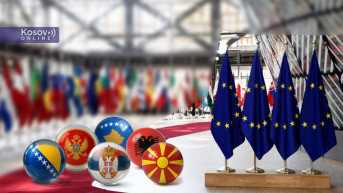
Edi Rama’s readiness to bring Albania into the European Union without the right of veto in decision-making enjoyed by current members can be interpreted as pragmatism on the part of the Albanian prime minister. However, some of Kosovo Online’s interlocutors believe that such a form of belonging to the European club is not a democratic solution and, if the EU were to establish it, it should not be permanent. Others consider it not entirely problematic, arguing that it could be a winning formula to avoid rivalries among new members from the region once they cross the EU threshold.
Written by: Dusica Radeka Djordjevic
“Bring us into Europe, and I am ready to sign an agreement clearly stating that we do not want to have the power of veto,” Rama said in December in an interview with the British Observer.
As he explained, this would serve as protection against any fears that “some crazy guy from the Balkans might want to enter the club with veto power and start imposing things.”
Albania, Rama went a step further, does not even want its own commissioner in the European Commission and could reach an agreement with Italy for the Italian commissioner to represent it as well.
Although advocates of this approach to EU enlargement insist it would not amount to second-class membership, not everyone agrees—nor is everyone in the Balkans ready to follow a concept with which Rama has no issue.
One of his closest neighbors, Montenegrin Prime Minister Milojko Spajic, has clearly stated what he thinks about the new winds blowing from Brussels.
“If you do not have balance as a member, then it really does not work,” Spajic said.
No Veto—No Political Weight
Slobodan Zecevic, Director of the Institute for European Studies in Belgrade, told Kosovo Online that EU member states, through their vote, their members of the European Parliament, and their representative in the European Commission, usually lobby for certain decisions, enter coalitions during decision-making, and derive specific benefits from that.
“When you have a vote, you do not just state your position—you take part in political bargaining within the European Union. You say: I will support this and that, provided I get this and that in return. When you do not have voting rights in the Council of Ministers, you do not participate in this process and you have no political weight whatsoever,” Zecevic emphasized.
He sees Rama’s messages as a signal that Albania will not create problems as long as it is admitted to the EU.
“This shows that Rama has calculated that it pays off for him to be an EU member even without political decision-making rights within the Union, because he would receive funds as a full member—and that is what matters most to him. He believes it is more profitable for Albania to receive funds as if it were a full member, while decision-making is less important,” Zecevic said.
He also recalls that the idea of time-limiting the absence of decision-making rights—five to ten years until the EU’s institutional system is reformed—has existed within the EU itself, and that Rama proposed it because he knows the EU’s biggest problem is that further enlargement would further complicate an already complex constitutional order.
To illustrate the difference between being inside and outside the EU, Zecevic cites figures: Serbia, as a non-member, can in the best case draw about €500 million annually for various projects, whereas as a member it would have access to €2.2 billion from the EU.
“The difference is enormous. Edi Rama says: give me that, I do not even need to decide. That is his philosophy and calculation: it is better for me to take two billion a year and not be a full member than to remain outside the EU and receive far less money, while everything happening in the EU affects me anyway given my geographical and political position in Europe,” he explained.
Nevertheless, he stresses that admitting new EU members without veto rights in the Council of Ministers is not a democratic solution. Given the EU’s democratic nature and federal elements, such a scenario, he notes, should not be permanent.
A Change of Standards Would Apply to All
Analyst Artan Muhaxhiri from Pristina finds the Albanian prime minister’s position interesting and believes it will have an impact within the EU, but not that it will accelerate Tirana’s European path.
For anyone, he says, the only way to gain member status faster is to meet all the criteria and requirements the EU sets for all member states—and the same will apply to Albania.
“This is an extreme option and I do not think it will be accepted, because it would change the standard. The EU has been working on standards and criteria from A to Z. If they change this standard, it would have to be changed for all other candidate countries as well,” Muhaxhiri told Kosovo Online.
He adds that Edi Rama is an unconventional politician with a specific style.
“He is very creative and always tries to find original ways to approach problems—in this case, European integration. He is doing a good job because Albania is moving very quickly along the EU track. He also has excellent relations with all the main decision-makers in the EU. I think he is in the best position compared to other Balkan states because he works very smartly and does what is expected of him. He is on the right frequencies with the EU,” Muhaxhiri said.
“The EU Caught in a Trap”
According to analyst Petar Arsovski from Skopje, entering the EU without veto rights as a temporary option would be good for Western Balkan countries because it would avoid their mutual competition in the initial period.
“The veto right is essentially intended for smaller countries to protect them from being outvoted. I think it is good for Balkan countries not to have a veto for some time, because if we are given veto power, there will be an explosion of dissatisfaction and competition among us in the first ten years. It is good for each country to gain veto rights only after it has already had about ten years of experience in the EU,” Arsovski told Kosovo Online.
He believes the stance publicly expressed by the Albanian prime minister will speed up Albania’s EU path.
“The EU is in a state where it does not know what full membership should look like—whether it should be in one or two tiers—and it keeps hesitating about what the final package for Western Balkan countries will be. With his response, Rama has de facto caught the EU in a trap. Now they have to commit to integrating Albania and must accelerate and deliver what they actually promised. This relationship will certainly speed up or make more secure Albania’s entry into the EU,” Arsovski assessed.
Gerta Zaimi, a researcher at the Center for International Strategic Studies in Tirana, believes Rama’s proposal was not coincidental, as it emerged at a time when Europeans are facing a major dilemma over what to do with the small Western Balkan countries.
“With what status should they admit countries with 800,000 inhabitants like Montenegro, or several million like Serbia—the largest in the region, yet comparable to some large European cities? They face a dilemma: should these countries enter the EU with veto rights, or should the veto principle be bypassed in some way upon their accession? Rama’s proposal is not personal, so I do not believe it was made without consultations with the EU. I think it is an appropriate way to avoid a major European problem, while Western Balkan countries have an interest in integration. I do not think it is such a negative idea,” Zaimi told Kosovo Online.
At the same time, she notes that the veto right within the EU was introduced to prevent large countries from making decisions on behalf of smaller ones, and that what is now called the veto issue—today one of the pillars of the European community—was created to prevent the dominance of major powers, particularly France and Germany, as well as Italy.
“The problem is that over time Europeans themselves realized that the veto has become a major problem. They do not know how to change this principle, because doing so would require amending the EU’s foundational treaties. For that reason, EU leaders do not know how to proceed. Perhaps a solution can be found through agreements, as was done in the case of Brexit, when it was decided how the United Kingdom would leave the Union without changing the main treaties,” Zaimi said.
Commenting on Rama’s statement that Albania would even be willing for another member state, such as Italy, to represent its interests in the European Commission, Zaimi said she was unsure how serious that proposal was.
“I would say Albania does not need anyone else to represent it, because it will be capable of representing itself when it needs to be represented in the EU’s highest bodies,” Zaimi concluded.




0 comments