
The renovation of Xhafer Deva's house "in neo-Nazi style
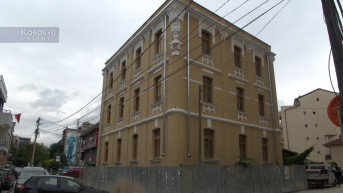
For Xhafer Deva's house in South Mitrovica, whose renovation was recently completed, the Kosovo Ministry of Culture stated that it considers it a site of cultural heritage deserving preservation due to its architectural significance, "as the first building constructed in modern Western European style in Mitrovica." It seems that people of style were, and remain, collaborators with the occupiers during World War II, after whom streets across Kosovo are named. By that logic, Hitler's watercolors could have ended up in school textbooks. Fortunately, they have almost no artistic value.
Written by: Dragana Savic
Even the German ambassador to Kosovo, Jorn Rohde, had previously expressed that he was "deeply concerned about the plans to restore the house of Xhafer Deva, a well-known Nazi collaborator and a prominent figure of the infamous SS Skanderbeg division."
"Don't cover up history! Don't hide the truth about the Holocaust or the war crimes committed by the Nazis and their local collaborators. Protect the facts," warned Rohde, which Kosovo clearly disagreed with, completing the house's renovation without EU support.
All the worse for the facts, as Hegel would say.
However, if any trace of anti-fascism existed two years ago, when Rohde made this statement, it has since melted away.
To express it artistically, other styles have prevailed, in which those aforementioned watercolors might even gain in value.
Since the house was renovated despite the opposition of the EU Office in Kosovo, Dr. Petar Ristanovic, a research associate at the Institute for Serbian Culture in Leposavic, believes that these messages from the European Union were purely formal.
However, Ristanovic adds that since the opposition to the renovation came from the Serbian community, it sent a message to the Albanian side that they should further persist, which led them to decide to renovate the house with their own funds and create a memorial for Xhafer Deva.
"This is scandalous in itself, given that Xhafer Deva's involvement in the Holocaust, as well as in the persecution of Serbs, Roma, and Jews, is indisputable. He is not a controversial historical figure. His past and his role in World War II are fully illuminated and clear," Ristanovic emphasizes.
When asked whether it was negligence or the West’s inability to stop Pristina, Ristanovic argues that it is a matter of disinterest.
"They send a message that they oppose it, that it shouldn't be done, and in a way, they wash their hands of the whole thing. Kosovo is indeed a Western protectorate, but no one cares about these, so-called, small issues. They are small for someone from the West who came here just to do their job in Pristina. On the other hand, for Serbs, this is very important. It's important for the entire climate that exists and is being created in Kosovo. For Albanians, Xhafer Deva is a hero, his past is unquestionable and pure. They refuse to acknowledge any other version of the truth, which sends a message to the Serbian community that what Deva did in the past is simply acceptable. And what Deva worked on was ensuring that there would be no more Serbs in Kosovo and Metohija," Ristanovic emphasized.
He added that Xhafer Deva was a proponent and executor of the creation of Greater Albania and was directly responsible for the Holocaust, the execution of Serbs, and the formation of the SS Skanderbeg division.
"However, due to his nationalistic efforts, he is perceived today as a national hero among Albanians. They are completely disinterested in the other part of his biography, his involvement in crimes. The focus is on him being a national activist, and today he is celebrated in Kosovo. Schools and streets bear his name, and now he even has his own memorial," our interlocutor said.
Kosovo still fosters a neo-Nazi policy, says Luka Jovanovic, a historian from North Mitrovica, for Kosovo Online, reminding that the EU previously halted the renovation of Xhafer Deva's house, explaining that he was a controversial figure, or "a figure with an ambiguous historical role."
"First of all, it must be said that he is a figure with a clearly defined historical role, a person who from 1941 to 1943 was the occupation administrator, meaning the Nazi regime’s administrator of Kosovska Mitrovica, and from 1943 until the end of the war, the Minister of Internal Affairs of the quisling Albania. This means he was a person who, initially in the region of Kosovska Mitrovica, and later in the wider area of the then-quisling entity, was responsible for the arrests and liquidation of all anti-Nazi and anti-fascist elements on the ground. In other words, a person responsible for implementing Adolf Hitler's policies," Jovanovic explains, adding that such a figure can never be said to have an ambiguous role.
For such a person, he assesses, there is no place in the public narrative, much less in the actions and policies of the European Union, which strives for multiculturalism and the fight against Nazism and neo-Nazism.
The message, he says, is clear — neo-fascism is in force today in all the countries that were major supporters of Adolf Hitler.
"This certainly does not bode well for the communities and countries to which Serbs belong, or for the state of Serbia and other countries and peoples of the anti-fascist bloc, which never nurtured Nazi policies. It certainly means that this has been done in the context of a broader and larger movement in Kosovo and Metohija, particularly among the Albanians, which has been ongoing for decades—a stronger momentum in the revision of history and historical figures," Jovanovic notes.
He reminds that, in addition to Xhafer Deva's house in South Mitrovica, the most significant streets and cultural monuments are dedicated to individuals who were proven collaborators with the occupiers.
"For instance, you'll find that the Cultural Center in South Mitrovica is dedicated to Rexhep Mitrovica, the prime minister of the quisling Albania under the Nazi-fascist regime. The main streets are named after Bislim Bajgora, Jusuf and Bajazit Boletinac, and many other individuals who were proven servants, Nazis, and fascists," Jovanovic emphasizes.
Historian Igor Vukadinovic also points out for Kosovo Online that Pristina nurtures the legacy and cult of Xhafer Deva and other quisling leaders from World War II, adding that the West does not have a major issue with the restoration of Deva's house because it is "pragmatic and likes to use various extreme totalitarian ideas and ideologies to achieve its interests."
Vukadinovic reminds that Kosovo has streets named after Xhafer Deva in Pristina and other cities, as well as streets named after Mustafa Kruja, who was the Prime Minister of Greater Albania.
"All of these figures participated on the side of the occupiers during World War II, and they hold a positive image and role in today’s Kosovan society," Vukadinovic observes.
Deva, the historian recalls, lived for some time in Turkey, Italy, and various countries after the war, before moving to America in 1956, where he collaborated with U.S. intelligence services.
"There is a report from the Albanian Ministry of Foreign Affairs from 1968 which states that the Americans encouraged Xhafer Deva to form the Third League of Prizren, as an organization of extreme Albanian emigrants. The same reports indicate that German intelligence services supported the Prizren League and worked on the secession of Kosovo from Yugoslavia, aiming to establish a second Albanian state in the Balkans. It is quite clear that he enjoyed the support and protection of the Americans during his lifetime, so this current relationship is not surprising at all," our interlocutor notes.
According to him, symbolic actions like the restoration of Xhafer Deva's house are less significant than other measures being taken in Kosovo, which have been intensified over the past 10–12 years. However, he observes that "the public often reacts more to these symbolic moments, such as the bridge on the Ibar."
"The main problems now are the threatened security of people in northern Kosovo and the feeling of abandonment. In that sense, Xhafer Deva is the least of their problems; they have many Xhafer Devas around them today, both in the West and in the region," the historian concludes.



0 comments