
Return of Delegations to the Belgrade–Pristina Dialogue: Greater Chance of Success or an Unnecessary Performance?
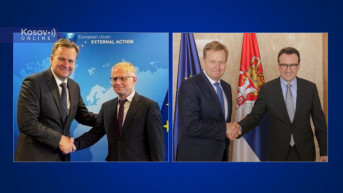
Various formats have been tested in the negotiations between Belgrade and Pristina—both the mediators and the representatives of the two sides have changed over time: from multi-member delegations, through technical-level talks, to chief negotiators and the highest political level. According to some analysts, depersonalizing the dialogue and returning to a format in which each side would have multiple delegates at the table could help move the process out of its current deadlock. Others, however, believe that such a model would be nothing more than “theater” that would change little.
Written by: Dusica Radeka Djordjevic
“Two people from Belgrade and Pristina do not constitute a dialogue,” says Naim Rashiti of the Balkans Policy Research Group, who argues that there was real dialogue in Vienna, when the two delegations had many more members.
Rashiti believes the dialogue has become a bureaucratic process when conducted for two hours by the same individuals who have been sitting across from each other since 2011.
“If both sides included more people, it would be something else. As it is now, everything is merely a protocol lasting a few hours, in Brussels or elsewhere. That fundamental change is what we need,” Rashiti said at the recent conference “Toward an Agreement,” held in Belgrade to discuss key questions related to the dialogue.
During the Vienna negotiations in 2006 and 2007, mediated by UN Special Envoy Martti Ahtisaari and his deputy Albert Rohan, both sides had large negotiating teams, and talks were held in 17 rounds.
University professor Kole Krasniqi shares Rashiti’s view to some extent regarding the contribution of delegations that include experts from relevant areas.
He believes that expanding negotiating teams could bring substantial benefits, such as increased professionalism and higher-quality agreements, but stresses that the success of the dialogue ultimately depends on the political will of the parties.
“Expanded and professional delegations help depersonalize the process. The fact is that the current personalized model—Vucic–Kurti, Petkovic–Bislimi—keeps the dialogue dependent on personal styles and conflicts. Broader delegations institutionalize the process, increase stability, and improve transparency and accountability,” Krasniqi told Kosovo Online.
However, regardless of the composition of the delegations, Krasniqi emphasizes that success depends exclusively on the political will of the negotiating parties, as well as on establishing binding and enforceable mechanisms by the EU and the United States.
“To achieve real progress in the dialogue, we need a complete reconceptualization of the process: a clear final goal, guarantees for the implementation of agreements and warnings about consequences, a symmetrical approach to both sides, wider engagement of international partners, depersonalization and professionalization of the negotiations, and a shift from crisis management to a final settlement. Only a new, balanced, and binding architecture can end the current deadlock and create real conditions for sustainable normalization between Kosovo and Serbia,” the professor said.
Returning to the Vienna-style format—where both sides were represented by delegations rather than only chief negotiators—would be a performance involving more people but with essentially the same result, according to Stefan Surlic, Assistant Professor at the Faculty of Political Sciences in Belgrade: the failure of normalization.
“Any type of delegation is mostly theater for the domestic political audience. What matters far more is that the results of the dialogue, if there are any, be presented to parliament and the public. We should move in the direction where citizens, both Serbs and Albanians, feel that the dialogue represents the national interest and that they are part of it. When you distance it and present it solely as a meeting between two leaders who do not even shake hands, where the mediator sets the agenda, then no citizen sees it as something that concerns them or their quality of life, mutual understanding, and reconciliation. That is why I think it is more important to involve parliament and the public, at least when it comes to reporting on the process,” Surlic told Kosovo Online.
Delegations, he added, usually meet only when there is basic consensus on the framework within which an agreement is possible. According to Surlic, the Vienna talks failed precisely because it was clear that Pristina would discuss nothing other than independence, while Belgrade would agree only to some form of autonomy for Kosovo—and in such conditions, real dialogue was impossible.
“I suppose that if delegations met today, Pristina’s demand would be UN membership, while for Belgrade that would be unacceptable—that discussions could be held about other international organizations, but not about the United Nations. So we would have a performance involving more people but with essentially the same outcome: failure of normalization,” Surlic concluded.
Aleksandar Rapajic, Program Director of the NGO Center for Advocacy of Democratic Culture in North Mitrovica, also does not believe that changing the format is the right solution at this moment.
The problem in the dialogue, he told Kosovo Online, is not the format, but the lack of willingness to resolve anything.
“I think the problem is that there is no will to resolve anything. We have seen that this format of dialogue produced results in previous years, and those results were positive, which means the format is not the problem—the problem is the current lack of will. That lack of will is greatest in Pristina, although Belgrade is also not particularly interested in making concessions at this time. Changing the format or entering a new process is not a good solution right now,” Rapajic said.
During the Vienna negotiations, Pristina’s delegation included Hashim Thaçi, Lutfi Haziri, Enver Hoxhaj, Bljerim Shala, Skender Hyseni, Isa Mustafa, Sadik Idrizi, Ardian Gjini, Ilber Hisa, Veton Surroi, Fatmir Sejdiu, and others.
Belgrade’s delegation was led by Serbian President Boris Tadic, Prime Minister Vojislav Kostunica, and Foreign Minister Vuk Draskovic. Coordinators were Slobodan Samardzic and Leon Kojen, while members included Aleksandar Simic, Dusan Batakovic, Sanda Raskovic-Ivic, Marko Jaksic, Goran Bogdanovic, Thomas Fleiner, as a permanent advisor to the team, and others.


0 comments