
Rights of Serbs in Kosovo only on paper: Who and why is bothered by the Serbian flag?
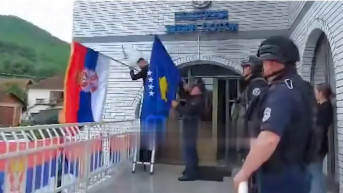
Anyone who has ever been to Kosovo could notice that the flags of Albania, Germany, the USA, Switzerland, and many others fly freely, but not Serbia's. Kosovo even celebrates the Flag Day of neighboring Albania, but there is no place for the symbols of the Serbian community, which has lived in this area for centuries, even on flagpoles. When asked why this is the case, interlocutors of Kosovo Online had a unanimous response - flags have always been the first target when the people were under attack.
The Prime Minister of Kosovo, Albin Kurti, often informs the public in his speeches that Kosovo operates as a multiethnic and multicultural place, regularly boasting that "Kosovo is the most democratic country in the Western Balkans." Even the Constitution of Kosovo states that all communities are free to display their symbols.
However, the reality is different. Kosovo's "multiculturalism" once again proved itself during the celebration of the town feast day of Saint Basil of Ostrog in Leposavic, when Mayor Luljzim Hetemi banned the use of the Serbian tricolor. This is not an isolated incident but official policy, as evidenced by Hetemi's and other Albanian mayors' promise in northern Kosovo in April last year that as soon as they took office, they would remove Serbian flags, which indeed happened.
Reacting to the ban on using the Serbian flag, historian Luka Jovanovic from the Faculty of Philosophy in North Mitrovica says that the two main symbols of Serbs as a people, in comparison with other countries, have been the flag and the script, namely Cyrillic. As he tells Kosovo Online, the flag, as the main symbol of Serbian nationality, has often been the first target when the Serbian people themselves were under attack.
"We could see in our modern history, especially in the last two centuries, that every time the Serbian people found themselves under occupation, or faced potential extermination, expulsion, or destruction in a territory, their script and their flag would be the first things to be banned. Similarly, in this case, we can see that the Serbian script is accepted as equal according to the so-called Kosovo constitution, but it is actually not applied anywhere, it is even banned, meaning that we cannot see Cyrillic in official documents, not even the Serbian language written in Latin script. Thus, we first see discrimination against the Serbian script, and then discrimination against the Serbian flag," says Jovanovic.
He adds that it is important to differentiate between two types of Serbian flags: the Serbian national flag with the coat of arms and the double-headed eagle, and the Serbian folk flag used by Serbs in the diaspora, which is accepted in all foreign countries where Serbs live.
"This is the classic Serbian tricolor. However, even this flag bothers the Kosovo authorities, not just them but also the international community, hence it is a symbol of prohibition and a symbol of discrimination in Kosovo and Metohija," our interlocutor assesses.
The latest example from Leposavic, he says, is a blatant example that shows a people who are in the majority in their municipality do not have the right to display their national feelings, which is guaranteed not only by law but also by general international acts.
"However, we have seen that every violation of the law and every breach of international norms in Kosovo and Metohija is actually synonymous with this so-called state. The Albanian side widely violates its constitution and not only its constitution but every international document and every international act to which it has previously committed. It gives the impression that the Kosovo administration does not recognize the power of law, the strength of rights, thereby not knowing even the basic norms of respecting minority communities in its territory, which it considers independent," says Jovanovic.
On the other hand, he gives the example of the Republic of Serbia where minority communities, as he states, have all their rights realized.
"They are gathered in their national councils, their national flags, national script, education in their language, and a number of other privileges that minorities have in civilized Europe, not just in the European Union, so it is really a big paradox that Kosovo, which calls itself the most democratic country in Europe, does not respect the basic democratic rights of minority communities," he states.
He assesses that the only thing Serbs can do is to seek protection from the international community, but they must be aware of the fact "that they are actually seeking to solve the problem from the one who caused the problem."
"We have seen in the past three decades that the international community is absolutely deaf to all the calls and all the pleas of the Serbian community in Kosovo and Metohija. The international community is the sponsor of Kosovo's statehood, it is the coordinator of all their plans and the sponsor of all their plans," says Jovanovic.
Petar Ristanovic, a research associate at the Institute for Serbian Culture in Leposavic, assesses for Kosovo Online that the ban on using Serbian flags is another in a series of proofs that Albin Kurti and a significant number of Albanians do not want the presence of Serbs and that the best possible solution for them would be if there were no Serbs in Kosovo at all.
Ristanovic explains that in Kosovo, there are more flags of other countries than Kosovo's own, but the problem is only with the Serbian ones. He adds that there are numerous examples of discrimination against the Serbian community which even violate the Kosovo constitution itself.
"Regarding the flags specifically, anyone who has ever been to Kosovo is a witness that Kosovo is flooded with various flags. If we were to speak in absolute numbers, I am sure that the number of flags of America, Germany, England, and Albania is definitely dozens of times greater than the number of Kosovo flags in the territory of Kosovo. However, the only problem exists with the Serbian flag, which is removed not only from public buildings but from all public surfaces and even taken away from individuals at certain celebrations and gatherings," says our interlocutor.
He assesses that the international community does not react because it "typically pursues such a policy that its reactions are reduced to some lukewarm statements."
"These statements are no longer taken seriously in Pristina. Simply, for the international community, it is only important that the situation on the surface is calm, that there is no escalation, no mass violence, and while this is the case, the repression against Serbs, which continues unabated, can continue," warns the historian.
Speaking about the use of flags in Kosovo, he recalls that during the existence of communist Yugoslavia, from 1948 to 1968, the use of the Albanian flag in Kosovo was effectively prohibited. He explains that there was no formal decision, but in practice, it was not allowed to display the Albanian flag, as separatist groups advocating for the secession of territories inhabited by Albanians from Yugoslavia always started their activities by displaying Albanian flags.
"After '68, the use of the Albanian flag was allowed, as the flag of the Albanian nationality, and a flag identical to the flag of Albania, which was at that time hostile towards Yugoslavia, was used. Such a situation lasted a full twenty years. During the 80s, the Constitutional Court challenged such practice and stated that the flag used by Albanians must differ in some way from the flag of Albania. It was suggested that it differ in dimensions, but the then Albanian leadership in Kosovo did not allow this, and all requests to prohibit the use of the Albanian flag were characterized as anti-Albanian, racist, an example of repression, and they strongly opposed this," explains our interlocutor.
He states that with such actions, Kosovo is violating its own constitution and recalls that for eight years they have refused to implement the decision of the Constitutional Court regarding the Visoki Decani monastery.
"In this context, we also view the ban on the entry of the patriarch into the southern province and the ban on the performance. Besides spreading fear and raising tensions, they are violating their own constitution, and this is not the first time. If we remember the land of Visoki Decani, for a full eight years they have refused to implement the decision of their Constitutional Court to register that land to the monastery, so Albin Kurti does not choose means and ways to worsen and endanger the security of Serbs in Kosovo and Metohija," he says.
He adds that the Serbs have endured even worse things when they were arrested, kidnapped, and attacked with firearms, but even then the international community "silently observed the behavior of Albin Kurti."
"They even allow them to use some steps that were signed long ago, which are taken for granted, for negotiations. Thus, Albin Kurti uses as elements of negotiation what he was supposed to have fulfilled 11 full years ago, such as the formation of the Community of Serb Municipalities (CSM), in order to negotiate Kosovo's membership in some international organizations. Unfortunately, we see that the international community will remain silent on this violence being carried out in the north of Kosovo and Metohija, although the ball, that is, the responsibility, is certainly on them," said Blazic.



0 comments