
Rutte arrives in Kosovo at a challenging geopolitical moment – What will he say?
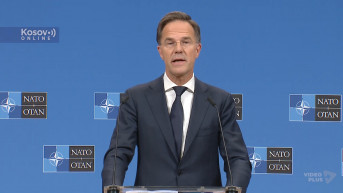
During Mark Rutte’s first visit to Kosovo since taking office as NATO Secretary General in October, statements reaffirming the Alliance’s commitment to regional stability are expected, along with confirmation that a contingency plan exists in case of a U.S. troop withdrawal from KFOR. Additionally, NATO’s Secretary General will, according to sources from Kosovo Online, assess the situation on the ground firsthand through discussions with officials in Pristina and representatives of international missions.
Written by: Dusica Radeka Djordjevic
In the early days of his mandate, Rutte stated that, even after more than two decades, NATO’s commitment to KFOR remains strong and that KFOR will stay in Kosovo.
Meanwhile, concerns have grown that the new U.S. administration might withdraw its troops from the mission. Addressing this issue, Rutte recently stated that policy changes or minor adaptations are always possible but that there is no reason to expect dramatic decisions.
Apart from uncertainties regarding KFOR’s future structure, Rutte’s arrival in Pristina is also accompanied by anticipation over Kosovo’s new government. The electoral stage has not yet been fully set, but the head of the Alliance has already indicated that NATO will cooperate with any government formed in Kosovo.
According to Frauke Seebass, a researcher at the Brussels office of the German Foundation for Science and Politics, Rutte’s visit to Pristina tomorrow, along with his visit to Sarajevo today, is taking place amid a transatlantic divide, which represents “an unprecedented challenge for the European security order, not only in the Western Balkans, whose incomplete transformation and EU integration remain a critical point for the continent.”
“Rutte’s visit is a clear signal that NATO is closely monitoring the region and that its stability remains a high priority for Europe and its partners,” Seebass wrote in an op-ed for Deutsche Welle.
While in Pristina, Rutte will meet with Kosovo President Vjosa Osmani and Prime Minister Albin Kurti. He is also expected to visit the KFOR Mission, NATO’s Advisory and Liaison Team (NALT), and hold discussions with EULEX chief Giovanni Pietro Barbano, EU Office head in Pristina Aivo Orav, UNMIK head Caroline Ziadeh, and OSCE Mission Deputy Head in Kosovo Cornelia Taylor.
Political analyst Artan Muhaxhiri believes that NATO Secretary General Mark Rutte’s visit to Kosovo is highly significant, demonstrating that Kosovo and the region hold great importance for NATO, which, he says, is beneficial for regional stability. According to him, the timing of the visit is also important in light of U.S. President Donald Trump’s announcements regarding the reduction of American troops in international missions, which will inevitably impact KFOR’s mission.
“KFOR currently has about 4,700 troops, of which 600 are from the U.S. If President Trump decides to reduce this number, then I believe there must be a Plan B. I am convinced that the highest NATO structures already have a plan and that it will be presented to Kosovo’s leadership to ensure they are not caught off guard and to find the best solution if this scenario unfolds,” Muhaxhiri told Kosovo Online.
Senior advisor at the ISAC Fund, Marko Savkovic, says that Rutte’s visit comes at a very delicate geopolitical moment, as discussions emerge about the possibility of a gradual U.S. withdrawal from Europe.
“This will certainly have implications for NATO’s mission in Kosovo, which is the longest-running NATO mission when compared to others. His visit follows immediately after his trip to Bosnia and Herzegovina as part of a regional tour, and it is no coincidence that Rutte chose our region to reaffirm NATO’s commitment to its stability. However, I do not expect messages different from those we heard from his predecessor,” Savkovic told Kosovo Online.
He also sees Rutte’s visit to Kosovo as an opportunity to assess the situation on the ground. According to Savkovic, Kosovo is not entirely stable, despite the fact that the February 9 elections passed without major incidents. He believes NATO is undoubtedly concerned about Kosovo’s stability.
“It is quite possible that they planned the visit to take place after the elections, which is natural. They may have expected the situation to be clearer, although that is not so important now, as Kosovo has not yet emerged from its political crisis—there may even be new elections. However, this does not significantly affect KFOR’s primary mission. What matters to them is to reaffirm their presence despite ongoing geopolitical developments and to emphasize their commitment to supporting all communities living in Kosovo,” Savkovic explains.
He adds that research has shown that the Serbian community has generally trusted KFOR and that there has been a relationship of confidence.
“This trust may have been somewhat shaken in recent years when it was expected that KFOR would try to protect the Serbian community from the aggressive actions of Pristina’s institutions. That did not happen because NATO took a neutral stance,” he said.
Marko Milenkovic from the NGO New Social Initiative told Kosovo Online that, although Bosnia and Herzegovina is currently a greater security challenge due to recent events, Kosovo remains a concern not only for NATO but also for the international community.
According to Milenkovic, NATO is concerned about Kosovo’s security due to its unstable political situation, the lack of progress in the dialogue between Belgrade and Pristina, and Pristina’s lack of constructive engagement with the international community in recent times.
“NATO Secretary General Mark Rutte is likely visiting to send a message that NATO wants to remain present in the region as the primary security initiative and that, despite the global changes occurring right now, NATO’s policy towards the region is not changing,” he said.
Milenkovic believes that a key topic during Rutte’s visit to Kosovo could be the potential withdrawal of U.S. troops from KFOR.
“And not just from the military withdrawal perspective, but also politically, because both the Kosovo administration and the international community have been accustomed to strong support from the U.S. administration and the State Department. This will likely change in the coming period, so it is important to consider the political aspect as well. The possible reduction of a key international actor’s presence in Kosovo, at the level it has been so far, is likely a cause for concern among some parties,” Milenkovic concluded.

comments