
Seized archives in Leposavic – Serbia's cultural heritage being processed in Pristina
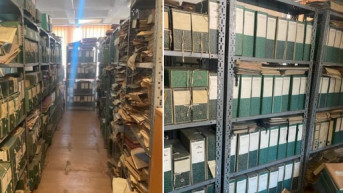
The archival material belonging to the archival fund of Serbia, which was seized by the Kosovo police in Leposavic and transferred to the Kosovo Archives Agency, should, according to the interlocutors of Kosovo Online, be returned. However, they are not optimistic that this will happen easily. At the same time, there is concern that some of the documents, which testify to decades of life in this area, could disappear as if they never existed or that the information they contain might even be misused.
Written by: Dusica Radeka Djordjevic
"Archival material is a cultural asset of general interest to the Republic of Serbia, which enjoys special protection established by law," states the Law on Archival Material and Archival Activities, adopted by the Serbian National Assembly.
It is clear that any Serbian law holds no value for the Kosovo authorities, which is why it came as no surprise when Kosovo Prime Minister Albin Kurti announced that the archival material found in Leposavic had been "illegally kept by parallel municipalities and other illegal Serbian structures" all these years.
Although Kurti stated in the same announcement that this documentation would "after being processed by the Kosovo Archives Agency" be available for research purposes, the entire action from the perspective of Belgrade is nothing short of theft.
"When archival material is handled outside the procedures prescribed by international archival standards and laws in all countries - it is called looting," stated the Serbian Ministry of Culture and the State Archives of Serbia on the day the Kosovo police transferred the documents to Pristina.
What was in the archives?
According to Ratomir Vukasinovic, who worked at the Historical Archives in Leposavic for 35 years, the archival material contained documentation about all enterprises, labor and socio-political organizations, and administrative bodies across the entire territory of the municipality of Leposavic.
Vukasinovic worked at the Historical Archives in Leposavic from 1974 until his retirement in 2010. As he explained to Kosovo Online, the Historical Archives in Kosovska Mitrovica had branches in Leposavic, Srbica, Vucitrn, and Zubin Potok, although Srbica and Vucitrn later separated.
"The archive in Leposavic covered the entire municipality and surrounding settlements. All labor organizations and socio-political organizations were part of the Historical Archives of Kosovska Mitrovica, with its headquarters in Leposavic as a branch. The Historical Archives oversaw the documentation—where it was located, under what conditions it was stored, and how it was organized and processed. I worked on assessing the condition of the material in all enterprises, socio-political organizations, and administrative bodies, in other words, in all the archival funds where archival material is created. Every month, I reviewed the condition of the archival material in the registries," Vukasinovic told the portal.
When he started working in 1974, he says, he took over 22 archival collections from the municipality. These included documents from the People's Committee of the Srpska Bistrica Municipality from 1945-1955, Saljska Bistrica from 1945-1947, the People's Committee of the Belo Brdo Municipality from 1952-1955, the Local People's Committees (MNO) of Borcane from 1945-1947, Vracevo from 1945-1955, Granicane from 1945-1947, Guvniste from 1945-1947, MNO Dren from 1945, MNO Jarinje from 1945-1952, MNO Josanica from 1945-1947, the Municipality of Leposavic from 1945-1964, the People's Committee of Lesak from 1945-1959, MNO Miokovice from 1950-1951, the People's Committee of Slatina from 1945-1959, and seven agricultural cooperatives: "Ibar" Leposavic from 1949-1954, "Kopaonik" Socanica from 1950-1952, "Napredak" Krusevo from 1949-1952, "Novi život" Gornji Krnjin from 1949-1954, "Selo" Popovce from 1949-1954, "Proleter" Tvrdjen from 1950-1952, and "Sloboda" Majdevo from 1949-1951, as well as "Sloga" Josanica from 1949-1954.
"All of this was mostly organized and processed, ready for scientific research and legal purposes. I also took over the collections from the municipal committees of the Communist League of Leposavic, Slatina, and Lesak. This documentation was also organized and ready for scientific research and legal purposes," said Vukasinovic.
He emphasized that someone needs to ensure that this documentation is returned to its rightful place.
"All this archival material is now being taken by those who are not welcome in Leposavic, and God willing, they will soon leave and return the documents where they belong. They broke down the doors and took it. In fact, no one even knows what exactly they took. They will gain nothing from this, but I assume their task is to simply discard this documentation as if it never existed, thereby violating the law. They will likely destroy it to leave no trace," Vukasinovic said bitterly.
Historian Aleksandar Rastovic sees the seizure of the archival material as part of a broader plan to erase the Serbian national, cultural, and spiritual identity.
"We have witnessed a carefully planned effort in recent years to erase everything connected to Serbian cultural heritage in Kosovo and Metohija, from the early Middle Ages to the present, and to present it as part of the so-called Kosovo cultural heritage. This is a comprehensive plan to deny the Serbian presence in Kosovo and Metohija, politically, economically, and—what is especially concerning—culturally and spiritually, because Kosovo and Metohija are the heart and soul of the Serbian people and state. Therefore, this is a dangerous act aimed at this objective, as archives are the heart and history of a people, not only the Serbian people but all peoples. This is part of that plan," Rastovic explained to Kosovo Online.
He added that archives are primary historical sources that give historians the most reliable picture of how the life of a community, a people, who have lived in a place for centuries, has evolved.
"As a researcher of the history of the Serbian people, the history of the Balkans, and Kosovo and Metohija in the 19th and 20th centuries, I can agree with the recent assessment of the Ministry of Culture and the State Archives of Serbia that the removal of the archival material from Leposavic to Pristina is a form of theft," said Rastovic.
Rastovic further explains that the seized archival material encompasses an extensive period from the end of World War II to the present day, covering political, economic, healthcare, educational, and cultural aspects—everything that constitutes the life of the people and citizens living in these areas. He also notes that this material doesn't only concern the Serbian population in northern Kosovo, as Albanians also lived in Leposavic, coexisting peacefully with Serbs for a long time.
Rastovic points out that this is nothing new, as throughout history, conquerors have repeatedly taken valuable cultural treasures from the Serbian people. For example, during World War I, after occupying Serbia in the winter of 1916, Austro-Hungarian authorities formed a special commission for archives, libraries, and museums, including prominent Austrian and German historians like Karl Patsch, who scrutinized the content of the Serbian State Archives, which had been founded in 1898.
"Everything related to our past is kept in the Serbian State Archives. In 1916, they entered the State Archives, and during the three years of Austro-Hungarian occupation, they transported more than 180 valuable crates of the most representative archival material from Belgrade to Vienna and Berlin. It was a kind of plunder of the most valuable documents. These were documents from the Prince's Office, the Ministry of Foreign Affairs, the Ministry of Education and Church Affairs, and the personal collections of the most prominent Serbs of the time. Much of this was taken to Vienna, to their State Archives. After the end of World War I, the Serbian government, and later the Kingdom of Serbs, Croats, and Slovenes, had a long and arduous task that took several years to retrieve this national treasure and return it to the depositories of the Serbian State Archives," explains Rastovic.
Unfortunately, he adds, this happened again during World War II when the German occupiers also seized a large part of the archival material that had been returned after World War I and transferred it to Berlin.
"So, what is happening in Kosovo and Metohija, in Leposavic, is, unfortunately, part of a continuous policy of denying the Serbian national cultural identity and our spiritual heritage in Kosovo and Metohija," Rastovic concludes.
Can the material be returned to Serbia?
When asked if he believes the archival material from Leposavic will be returned, Rastovic, as a historian, says he cannot predict events, but he references the post-World War I example when some of the archival material was returned after long and difficult negotiations.
"However, not all archival material was returned. Many important collections, concerning the relations between Austria-Hungary and Serbia during the Balkan Wars and the annexation crisis, remained in archives in Vienna, in the War Archives, and the State Archives, and after the second plundering during 1941-1945, in archives in Berlin. So, in some way, I am pessimistic, if I may predict as a historian, that any of this very valuable archival material will ever be returned to the Serbian state, material that allows historians to reconstruct the political and social life in the northern part of Kosovo and Metohija, Kosovska Mitrovica, Leposavic, Zubin Potok, Vucitrn, and other places in the region," says Rastovic.
Assistant professor at the Faculty of Law at the University of North Mitrovica, Dusko Celic, told Kosovo Online that it is very important for Serbia to react immediately and demand the urgent return of the archival material seized by the Kosovo police in Leposavic from international missions. He warns that, in addition to the historical value of the material, there is a risk that the information it contains could be misused.
"If this is valuable historical material, the Ministry of Culture must react. There have been verbal reactions in the media, but there also needs to be an effective response, requesting the return of this historical material from international institutions," says Celic.
When it comes to potential misuse, Celic highlights a range of possibilities, especially if the seized material is related to the work of the Temporary Authorities.
“If personal data of citizens has fallen into the hands of unauthorized individuals—what we lawyers call data processors and users—namely, the self-proclaimed authorities in Pristina, there is a real risk that this data could be misused, potentially leading to identity theft. That’s why it’s crucial for Serbia to promptly react to international missions in this regard and urgently request the immediate return of the archival material,” Celic emphasized.
He recalls that when UNMIK (the United Nations Interim Administration Mission in Kosovo) arrived in 1999, a significant portion of the archival material from municipal archives, the largest being the Pristina archive, as well as from the Provincial Archives, which contained a lot of valuable material, fell into the hands of this mission. UNMIK, in turn, handed it over to the self-proclaimed authorities in Pristina in 2008.

comments