
Self-Determination internal document: Kurti's revolutionary method, dirty hands, and the spread of disinformation
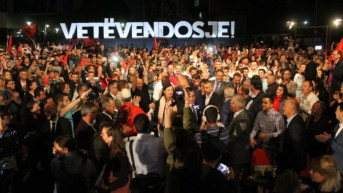
The internal document of Self-Determination, in which the leader of this movement, Albin Kurti, indicates to party colleagues that they should gain and retain power with a revolutionary approach, be ready to "get their hands dirty" and concentrate on spreading disinformation, was presented to party members and sympathizers five years ago and deeply rooted in the policy implemented today by the current Kosovo Prime Minister and the government in Pristina, according to the interlocutors of Kosovo Online.
In the Self-Determination document from 2017, published by the Albanian Post, on 52 pages, it is stated, among other things, that about 40 percent of the citizens of Kosovo were functionally illiterate, and that this party should concentrate on spreading rumors, which "have power, while the facts are not very important".
Kurti further asks his party colleagues that "when they come to power, they must get their hands dirty, otherwise they will lose power."
The document states that the Self-Determination Movement can come to power only within the framework of the state of emergency in Kosovo, and even retain power through the state of emergency. He also suggests that Self-Determination organizes "an illegal type of operational sector and surprises the political opponent through it".
The Albanian Post also writes that this document, which was then proposed as a political organization plan, caused the first divisions in Self-Determination, stating that part of the party's Presidency was against it, including the Speaker of the Parliament, Glauk Konjufca.
Despite the opposition, Kurti, thanks to his power in the party, "pushed through" his plan with the intention that the dissatisfied would leave the party.
The president of the “Matica Albanaca” in Serbia, Demo Berisha, believes that Kurti, both in the opposition and in the government, applies the same "revolutionary, guerilla approach" and that this makes the last actions he carried out in the north of Kosovo clearer.
Demo Berisha says that even today he sticks to what he said five years ago and behaves as if he is still in the opposition and is leading that policy on a destructive wave.
"What the US, the EU, and the West tried to make of Kosovo, a democratic society, Kurti is now canceling all that. He adheres to the Statute of his party, more precisely to one point that foresees the creation of a "Greater Albania" one day. This is the key direction of his political activity, to create an ethnically pure "Greater Albania". He believes that he is at war with Serbia, and when you are at war with someone, disinformation and "getting your hands dirty" are allowed. Using precisely, as he stated in this Self-Determination document, the low level of education of the people in Kosovo, he traces the key direction of action, to convince people of his views and goals," Berisha explains.
He says that he partially succeeded in that.
"Kurti sees himself as Che Guevara, he considers himself a revolutionary, who will lead to the creation of a 'Greater Albania'. I would compare him to the former Albanian dictator Enver Hoxha. Kurti is an 'Enverist', he continues that ideology of a pure Albanian nation," Berisha says.
Our interlocutor points out that Kurti's "revolutionary approach", keeping Kosovo in a constant state of emergency, is especially visible in the crisis he caused in the north with the invasion of Kosovo Special Forces in municipal buildings, the imposition of illegitimate Albanian mayors and the arrest of the Serbs.
"It's just a continuation of what Kurti and Self-Determination did before they came to power when they attacked the parliament and organized violent demonstrations. Now it continues with that methodology in the north, only much more perfidious, because it has the levers of government. And all with the goal of conquering the north and creating a clean territory, because Kurti believes that the Serbs have no place in Kosovo," he notes.
He also points out that Kurti is now "packaging" these dangerous political methods under the guise of the alleged fight for democracy and the rule of law.
"Kurti is just trying to modernize his violent politics and the violent methods he uses to achieve his goals. His ultimate intention is exactly the same as when he formed Self-Determination and he will not give up on it. He has even spoiled relations with America because he thinks he is inviolable, that he is the one who has to be in charge. He does not recognize any politician from the West, he believes that he should talk directly with the American president Joseph Biden, Olaf Scholz, and Emmanuel Macron. For him, there are no "lower" officials of the administration, neither American nor the European ones," Berisha says.
Writer and journalist, Zivojin Rakocevic, states that Kurti has an enormous "will to power" and that he does not choose methods in order to constitute his Greater Albanian concept and ideology.
Rakocevic indicates that the politics and political philosophy of Albin Kurti during his entire career is a combination of the most extreme nationalism and social populism.
"This internal document, which regulates relations within the party and its action in the masses, can also be placed within the framework of such an attitude. Albin Kurti is aware that small radical groups in anarchic and undemocratic systems can come to power very quickly and simply. This man's will to power is also based on the manipulation of old tribal structures that believe in rumors and have never accepted any institutions, including the period after 1999," Rakocevic says.
He adds that there are three levels of institutions in Kosovo: super-institutions (American, British, and German embassies); official institutions (government, municipalities), and sub-institutions (tribal-family structures with the dominant influence of the mafia and warlords).
"Kurti strives to occupy these three powerful spaces and thus constitutes his Greater Albanian concept and ideology," Rakocevic concludes.
Pristina journalist and analyst Leart Hoxha points out that the document published by the Albanian Post can serve the internal debate, but that, in principle, it does not represent anything new.
"The only thing that can be concluded from today's perspective is that in the post-pandemic state, the situation and atmosphere on social networks and other online platforms, which are used for (dis)information, have significantly worsened," Hoxha told Kosovo Online.

0 comments