
The Serbian tricolor on trial: Which flags disturb public order in Kosovo – and which do not?
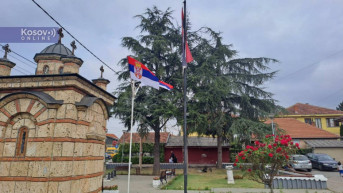
In the main street of Gracanica, worn-out Serbian flags were replaced with new ones last June, just ahead of Vidovdan. This year, however, the celebration of this important Serbian holiday was preceded by a ruling from the Basic Court in Pristina: the decision by the Municipality of Gracanica to display “the flag of another state” was deemed to “seriously undermine the unitary and constitutional character of Kosovo” and to “threaten public order and interethnic coexistence.” Analysts view the ruling as politically motivated and ask: why has such a ban not yet applied to the Albanian flag?
Written by: Dusica Radeka Djordjevic
At the beginning of June 2024, members of the Gracanica Municipal Assembly approved the display of Serbian community symbols for the Vidovdan celebration.
The initiative to replace old and tattered Serbian flags came from 13 non-governmental organizations involved in organizing the 2024 Cultural and Entertainment Summer and the Vidovdan commemoration. They cited Article 59 of the Constitution of Kosovo, which states that members of communities have the right to use and display community symbols, in accordance with the law and international standards.
On June 23, workers from the Public Services Department replaced the flags along Tsar Lazar Street.
One month later, the Ministry of Local Government Administration filed a lawsuit against the Municipality of Gracanica, asking the Basic Court in Pristina to annul the municipal decision to mark Vidovdan with Serbian flags and symbols, arguing that June 28 is not recognized as an official holiday or memorial day in Kosovo.
The outcome: on June 9, the court ruled that the Municipality of Gracanica had “exceeded its legally defined competencies” by authorizing the display of “the flag of another state.”
The ruling also served as a warning to other municipalities.
“The verdict is to serve as a model for future conduct by all other municipalities,” the court stated.
Is the Verdict Truly Neutral?
The largest Serbian party in Kosovo, the Serb List (SL), announced that Gracanica’s municipal authorities would appeal the ruling. The party contextualized the decision within the upcoming local elections and reminded the public that its MPs had for years submitted proposals to legally define Vidovdan as an official holiday for the Serbian people—proposals that were consistently blocked in parliament. SL also called on the court to apply its reasoning to cases involving the Albanian flag as well.
It should be noted that the Albanian flag has been displayed in the front row of the Kosovo Assembly chamber for two months.
The ruling was also criticized by Petar Petkovic, Director of the Serbian Government’s Office for Kosovo and Metohija, who stated that it directly targets the Serbian people and represents another instance of systematic and institutional disenfranchisement in Kosovo.
Dusan Radakovic, Executive Director of the Centre for the Promotion of Democratic Culture, told Kosovo Online that the court’s decision was political, made under pressure from political activists and the ruling party.
“I believe the court misinterpreted the situation. Nowhere is the use of national symbols explicitly forbidden. Why is the Albanian flag freely used at public gatherings across Kosovo and never banned? Vidovdan has been celebrated at Gazimestan since 1389, and now, all of a sudden, due to the current political context involving the Assembly and wider developments in Kosovo, the court issues a ruling banning Serbian flags—suggesting even possible arrests of those carrying the flag at Gazimestan or elsewhere,” Radakovic noted, expressing hope that the ruling would ultimately be overturned.
Without commenting on the legal viability of overturning the ruling, Kosovo Deputy Ombudsperson Niman Hajdari told Kosovo Online that the use of symbols must align with the Constitution and applicable laws.
“This matter is regulated by the Constitution and the laws, and I believe that government institutions should act accordingly,” Hajdari stated.
Historian Aleksandar Gudzic believes the ruling will only deepen the mistrust of Kosovo Serbs toward local institutions. If implemented, he warned, further arrests could follow.
“We all remember how, in previous years, the police used excessive force to prevent Serbs from entering Gazimestan with national symbols. We remember how the Kosovo authorities—particularly the Kosovo Police—took advantage of the heightened national sentiments among Serbs on Vidovdan to carry out arrests. The message was clear: Serbs from all around the world should not come to Kosovo on Vidovdan,” Gudzic said, reminding that Kosovo is a territory of profound national and historical significance for Serbs, marked by the 1389 Battle of Kosovo which shaped Serbian national identity.
Responding to the court's argument that the display of Serbian flags “seriously undermines public order and interethnic coexistence,” historian Stefan Radojkovic stated that interethnic coexistence, with few exceptions, has not existed in Kosovo since June 10, 1999.
“There is no genuine coexistence—only parallel lives. The court’s ruling should be seen as part of Albin Kurti’s promotional campaign, which uses discrimination, harassment, institutional pressure, and at times even physical violence to target the Serbian community and the institutions of the Republic of Serbia in Kosovo, in an effort to maintain his declining popularity among Kosovo Albanians,” Radojkovic said.
He added that the court’s interpretation carries a strategic intent—to render any future Community of Serb-majority Municipalities (CSM) void of meaningful content.
“There are three layers here: first, the tactic of blaming the victim for provocation. This is akin to the classic defense used by perpetrators of violence, claiming the victim provoked them. Second, there has been no tradition—at least since 1999—of genuine interethnic harmony or coexistence. And third, this is all part of Kurti’s political campaign, and now the target is the Vidovdan celebration,” Radojkovic summarized.
As for Vidovdan, he emphasized that it is primarily a religious holiday and a key element of identity for Serbs throughout the Balkans, and that it will be celebrated regardless of whether it involves the flag of the Republic of Serbia, traditional Serbian flags, or those of the Serbian Orthodox Church—so long as the Serbian people in Kosovo continue to observe the holiday as they always have.




comments