
Stalled growth plan: Is six billion Euros for the Western Balkans on the horizon?
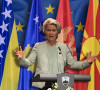
The Western Balkans belong to Europe. This was the message from the returning President of the European Commission, Ursula von der Leyen, following a working lunch with Western Balkan leaders on September 19th. The main topic was the dynamics of the Growth Plan for the region and the delays in disbursing the first tranches of the promised aid. These delays were expected, as sources for Kosovo Online point out, but they have different views on how consistent the EU will be with the additional conditions set before Belgrade and Pristina.
By: Arsenije Vuckovic
The first tranches from the Growth Plan were supposed to arrive in the Western Balkans as early as September. However, everything was postponed for a few months because Bosnia and Herzegovina had not submitted its project. This was the main reason for von der Leyen’s meeting with regional leaders on September 19th in Brussels, where the further dynamics of the EU's ambitious plan to invest six billion euros in the region by 2027 were agreed upon.
Despite the delay, the Serbian president did not hide his satisfaction after the meeting.
"I think only one country hasn't met all the criteria, and on the other hand, one entity refused to accept the CEFTA rules. No longer will one be able to endanger the others, and I like that principle," Vucic said.
Serbia’s Minister for European Integration, Tanja Miscevic, was much more specific, explaining that it was precisely the EU's Growth Plan for the Western Balkans that forced Serbia to draft a reform plan to be implemented by the end of 2027, reports Politika.
"This Growth Plan forced us to create our own reform plan. The reforms, which we will complete by the end of 2027 as promised, will strengthen both our and the entire process's credibility," Miscevic emphasized.
On the other hand, after the Brussels meeting, Prime Minister Albin Kurti stated that Kosovo had demonstrated an "unwavering commitment to European and democratic values."
"We have completed many reforms, shown unwavering commitment to European and democratic values, as well as a high level of institutional training. We have proven this through the Growth Plan, where we were the first to make progress with the necessary steps, such as submitting the Reform Agenda," Kurti said.
Special Conditions
In addition to all the conditions outlined in the Growth Plan for the Western Balkans, Belgrade and Pristina have an additional one – constructive engagement in the normalization process of their relations.
That’s why Srđan Graovac, a collaborator at the Center for Social Stability, believes that the EU will try to use the funds from the Growth Plan for the Western Balkans as a tool of pressure on Belgrade and Pristina.
The goal, he highlights, is to revive the negotiation process and finalize the Scholz-Macron plan.
"It’s obvious that the European Union will try to use these funds as an instrument of pressure on Belgrade and Pristina, with the aim of reviving the negotiation process, as it has currently been put on hold, and it is unlikely to resume until the elections in Kosovo are concluded. However, in any case, this will serve as a means of conditioning the continuation of these negotiations," Graovac told Kosovo Online.
The EU expects stabilization in the Balkans, and it envisions this through the Scholz-Macron plan.
"The goal of the European Union countries is, first and foremost, to finalize the Scholz-Macron plan, which they consider key to at least a temporary, if not permanent, solution to the issue of Kosovo and Metohija. They believe this will stabilize the situation in the region. Therefore, it will be used as a tool of blackmail for both Belgrade and Pristina," Graovac believes.
He emphasizes that, at this moment, it is a much greater burden for Pristina than for Belgrade.
"Belgrade has fulfilled all its obligations regarding the Brussels Agreement, while Pristina has not even fulfilled its obligations under the Brussels agreements, something that was agreed upon ten years ago. Everything has stalled with the Community of Serb Municipalities. Pristina will have a significant problem continuing to access or use these funds if it doesn't fulfill this obligation it has committed to," Graovac assesses.
He warns that by refusing to form the Community of Serb Municipalities (CSM), Pristina may eventually face the withdrawal of funds from the Growth Plan.
Nevertheless, he does not expect any positive progress in the dialogue process as long as Albin Kurti remains in power.
"He neither has, nor is showing, any intention of accepting the Community of Serb Municipalities, nor do I believe that it is in his political interest at all. This will be a serious problem and challenge for both Belgrade and Pristina when it comes to accessing these funds, but primarily for Pristina," Graovac says.
Regarding the first tranches from the Growth Plan, he is convinced that the Western Balkans will have multiple benefits.
The first benefit, he reminds, is the fact that most of the funds are non-refundable grants, with a smaller portion being the most favorable loans available at the moment.
At the same time, he emphasizes that the Growth Plan is a clear message from the EU that it counts on the countries of the Western Balkans.
"We can understand that the EU is trying to send a message to the Western Balkans that it counts on them, that they have a European future, no matter how unbelievable that might sound at this moment," Graovac says.
He reminds us that the EU is currently not seriously considering any expansion, and it is difficult to predict when that might happen.
That is why, he points out, the Growth Plan is a "small gesture" and a message to the Balkan nations that the EU counts on them.
"This is a small gesture that doesn’t cost them much, as these funds are not too significant for them. But on the other hand, it sends a message to the Balkan nations that they can count on the EU and should not give up on that European future. The EU has no intention of leaving the Balkans to other powers, as they consider this primarily their backyard. That is the message being sent to the Balkan nations. The Balkan nations, of course, primarily see the financial benefits they can gain from this, but they also understand the message," Graovac explains.
Graovac adds that the EU is sincere in this regard, saying through the Growth Plan that the Balkans are part of Europe and will not be abandoned. However, the key problem with the accession of new members is that the EU cannot resolve its internal functioning and decision-making processes.
"They cannot admit new countries into the European Union until they resolve the decision-making process, and we see how much trouble they have in making any strategic decisions. When you have this consensus-based decision-making process and such a large number of countries, it's enough for one to veto a decision, and you realize that it is impossible for the European Union to function in this way. This issue must be resolved first, and only then can the rest of the European integration process proceed. This is something we are waiting for," Graovac concludes.
The Comedic Triangle
Former President of the Kosovo Chamber of Commerce Safet Grxhaliu said in an interview with Kosovo Online that the Growth Plan is an attempt by the EU to instill a "new spirit" in the region, as it is increasingly returning to the 1990s.
Despite the good intentions, he emphasizes that the "comedic triangle" of mistrust between Serbia, Kosovo, and the EU remains.
"I think it’s time for a new spirit to prevail in the Western Balkans. Because if we look at what’s happening here, we’re increasingly returning to the 1990s—the era of nationalism, the era of intolerance. In this context, Europe is trying to provide support. However, there is a big problem when it comes to Kosovo, Serbia, and the EU. It’s a comedic triangle. Kosovo doesn’t trust either Serbia or Europe, Serbia doesn’t trust either Kosovo or Europe, and Europe doesn’t trust either Serbia or Kosovo. Therefore, it’s difficult to find any compromise, but compromise is the solution—there is no alternative. Especially now, when so much is happening on the geostrategic level worldwide," Grxhaliu told Kosovo Online.
Grxhaliu explains that the Growth Plan for the Western Balkans is a turning point in European Union policy.
"They simply realized that in the Western Balkans, they should not only engage politically but also implement various projects that will have a practical dimension. The mere fact that they plan to spend around 30 billion euros between 2010 and 2030 speaks volumes. That is a significant sum," says Grxhaliu.
He adds that for the period 2024-2027, six billion euros of investments are planned, but the first condition is political stability.
"The first condition for using these funds is political stability. Unfortunately, neither Kosovo nor Serbia has resolved certain open issues concerning dialogue. We see daily threats that if no agreement is reached, it will certainly be impossible to use these funds, and that money is needed by everyone—Kosovo, Serbia, and other countries in the Western Balkans. There is so much space for new projects, so much that needs to be done and implemented, that money is always needed," Grxhaliu concludes.
The 'Tactics' Game
A researcher at the Belgrade Center for European Policy, Djordje Dimitrov, believes that although Serbia and Kosovo have a clear condition for the funds from the Growth Plan—constructive engagement in the process of normalizing relations—the EU will still play it "tactically" and will not be overly demanding on this issue.
"They are not expected to be overly strict but rather to turn a blind eye. Unless there are serious problems, like last year's incident in Bajska. They don't want to create, as in the case of Bosnia and Herzegovina, a second-class member, and here there would be two second-class sides, which would, of course, negatively impact further reforms. So, they will likely play it tactically," Dimitrov told Kosovo Online.
Dimitrov explains that from the start, the EU conditioned the funds from the Growth Plan on the fulfillment of certain criteria.
"This is the first instrument of the European Union that actually conditions countries, meaning that they must fulfill the tasks outlined in the reform agenda in order to unlock the next tranche. So, the tranches will be disbursed twice a year, depending on the fulfillment of criteria. These criteria particularly emphasize the holding of fair and democratic elections, reforms in public administration, and similar tasks. However, for Serbia and Kosovo, there is a special criterion, which is the work on normalizing relations between the two sides," the researcher emphasizes.
Dimitrov says that there is a delay in the distribution of funds from the first tranche of the Growth Plan, which, he stresses, is due to Bosnia and Herzegovina, as it has not submitted its reform agenda.
By delaying payments, he notes, the EU is sending a message that it does not want to create "second-class members" in the region.
"Initially, in July, Bosnia and Herzegovina did not submit the draft because four cantons did not agree with the document. Now, in September, they have submitted a document that, according to the European Union, does not meet the criteria and everything that has been outlined. So, I assume that the EU does not want to create a second-class member, which would happen if Bosnia were excluded from the first tranche. I assume they want to give Bosnia a little more time to submit a complete document, and in this way, it can join the Growth Plan, that is, the first tranche, which should be paid at the end of October or the beginning of November, including all the countries of the Western Balkans," Dimitrov explains.
He reminds that the EU, through the Growth Plan, has offered an additional incentive to the countries of the region.
Out of the six billion euros, around 1.58 billion euros have been allocated to Serbia, and 800 million euros to Kosovo, as the funds for fulfilling the reform agenda are distributed based on the size of each country.
Nevertheless, the EU is also offering additional integrations in the sphere of the economy and the common market.
"SEPA is a very good initiative that allows for payments in the EU without additional costs, without commissions, and without some of those taxes. This will, of course, reduce transaction costs, which will provide a significant boost to the economy. There are also offers to participate in certain EU agencies and programs, which will certainly contribute positively to the Western Balkans," Dimitrov emphasizes.



comments