
Three months without a Constitutional Court response to the Serb List’s appeal: A replay in parliament, and possibly a crisis?
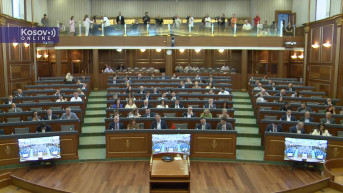
For a full three months, Kosovo’s Constitutional Court has failed to resolve the dilemma of whether regulations were violated in the election of a Deputy Speaker of the Assembly from the Serbian community in the previous parliamentary term, while the constitution of a new legislature is approaching. If a decision does not arrive soon, observers interviewed by Kosovo Online agree that the parliamentary benches will witness a replay of the events from October—but they differ on what would follow if the Court were to rule that irregularities had occurred. Some fear this would usher in a new institutional crisis; others believe everything would end with a repetition of the procedure for electing the Serbian Deputy Speaker.
Written by: Dusica Radeka Djordjevic
On 10 October, Nenad Rasic, leader of the Party for Freedom, Justice and Survival, was elected Deputy Speaker of the ninth term of the Assembly of Kosovo from the Serbian community, after none of the MPs of the Serb List—which held nine seats—secured a sufficient number of votes.
Rasic was not nominated by Serbian MPs, which the Serb List considers contrary to the rules; consequently, it filed an appeal with the Constitutional Court on 16 October.
Under the Rules of Procedure of the Assembly, a candidate for Deputy Speaker from the Serbian community is proposed by a majority of MPs from the Serbian community, which would mean that the candidate must have the support of at least six Serbian MPs.
The Rules of Procedure also provide that, if a candidate is not proposed, the proposal shall be determined by drawing lots, in the presence of MPs of the relevant communities.
Some lawyers in Kosovo believe it is important for the Constitutional Court to resolve the ambiguities in this case as soon as possible.
One of them is attorney Ardijan Bajraktari, who believes that a decision should be rendered before the start of procedures to constitute the new Assembly, in order to avoid potential uncertainties and a possible blockage of its formation.
Speaking on the matter, former President of the Constitutional Court of Kosovo Enver Hasani stated that the Serbian Deputy Speaker should come from among Assembly MPs who hold guaranteed seats for the Serbian community, and that Nenad Rasic represents the Serbian community, but not the majority of Serbian MPs in the Assembly.
“He (Rasic) may be a good man and a Kosovo patriot, reasonable and the like, but such qualities matter when one is being sought as a son-in-law, not as a representative of a Kosovo community. Representation is determined by votes and on the basis of the Constitution and the law,” Hasani said.
“The Need for the Court to Respond Has Not Disappeared”
Political scientist Ognjen Gogic assesses that the Constitutional Court has taken an unreasonably long time to deliver a decision.
“There has been no ruling for more than three months. Last year, the Constitutional Court ruled on three occasions regarding the crisis surrounding the constitution of parliament, and all of those issues were more complex to consider, yet it took the Court less time to respond,” he points out.
He believes that, in the interest of the efficient constitution of new institutions in Kosovo, as well as their legality, the Constitutional Court should issue its position on the Serb List’s appeal as soon as possible. The fact that elections have been held and a new Assembly is being constituted, he told Kosovo Online, has not eliminated the need or the obligation of the Constitutional Court to respond to that appeal.
According to Gogic, in ruling on this matter the Court essentially needs to build on its previous reasoning, since it has already addressed the issue of electing a Deputy Speaker from the Serbian community when it responded to the Serb List’s first appeal during the formation of the previous parliamentary term.
“All the more puzzling is the length of time it is taking, coupled with the fact that the Court has not made any statement as to when a ruling might be expected, nor has it introduced interim measures,” Gogic says.
In theory, he notes, the Court could uphold the Serb List’s appeal, in which case the previous parliamentary term would, in theory, never have been constitutionally constituted, nor could it have been dissolved.
“The Court could say that the elections that were held were themselves irregular, that they could not have been held, that everything is null and void. That would amount to an extraordinary constitutional and legal crisis for Kosovo, which makes it completely incomprehensible that the Constitutional Court has not taken into account the context in which all of this is unfolding,” he assesses.
If the constitution of the new parliamentary term, following the elections held on 28 December, were to begin without a decision by the Constitutional Court, Gogic believes that Rasic would again be elected Deputy Speaker of the Assembly, since this time it is simpler because Albin Kurti can form a majority without an agreement with other Albanian parties.
“Then the situation will likely be repeated, with the Serb List again filing an appeal,” he says.
The Role of Interim Measures
Whether the process of forming a new government would be blocked if the scenario from the previous term were repeated and the Serb List were to file another appeal, Gogic says, depends on whether the Court orders interim measures. He recalls that last time the Serb List filed an appeal, the Constitutional Court did not impose interim measures and did not suspend deadlines or actions.
“Had it imposed interim measures, the Assembly would not have been able to function, and consequently processes such as granting the mandate to form a government could not have taken place. So everything depends on whether the Constitutional Court decides this time to adopt interim measures that would halt all processes. If it does not, then everything continues, the Government can be formed, but with the risk that everything could later be declared invalid,” Gogic explains.
The issue of electing a Deputy Speaker of the Assembly from the Serbian community without the support of the majority of MPs from that community represents an important problem of constitutional interpretation, according to university professor Kolë Krasniqi.
However, he told Kosovo Online that a decision by the Constitutional Court on this matter is not expected before the start of the process of constituting institutions following the December elections.
The Constitutional Court, Krasniqi explains, is not bound by mandatory constitutional deadlines for issuing decisions and, in its practice, is particularly cautious when resolving issues of high political sensitivity.
“In such cases, it often exercises its decision-making authority after political processes have already begun, in order to avoid the perception of direct interference in political life. Based on an analysis of political developments, the most likely scenario remains that the Assembly of Kosovo will be constituted without waiting for a final decision of the Constitutional Court,” the professor believes.
The Genuine Political Will of the Community
From a normative perspective, he notes, the Constitution of Kosovo guarantees the representation of non-majority communities in the leadership structures of the Assembly of Kosovo, but does not contain an explicit provision requiring that candidates for these positions be proposed or supported by a majority of MPs from the respective community.
“In that sense, a strict interpretation of constitutional provisions can hardly lead to a decision that the election of a Deputy Speaker of the Assembly from the Serbian community must necessarily be carried out on the basis of a proposal and support from the majority of MPs of that community. However, if constitutional interpretation is not limited solely to a formal reading of the provisions, but is also guided by European standards for the protection of minority rights, then one may reach the conclusion that constitutional representation of non-majority communities should reflect the genuine political will of the community, and not merely the individual ethnic identity of the elected candidate,” Krasniqi explains.
If there is no decision by the Constitutional Court by the time the Assembly begins to be constituted, he believes there is a risk that the situation from the previous parliamentary term will be repeated.
In the absence of a Constitutional Court ruling, he says, the Assembly of Kosovo may continue with the same procedural practice for electing a Deputy Speaker from the Serbian community; in such a scenario, the Serb List will likely again challenge the legitimacy of the process by submitting new appeals to the Constitutional Court.
“Such a situation may produce undesirable consequences, including political blockades, institutional tensions, and further delays in the functioning of the Assembly and other state institutions. Accordingly, in the absence of final constitutional clarification, legal and political uncertainty not only persists, but is further deepened, violating the principle of institutional stability and legal certainty as fundamental elements of Kosovo’s legal, constitutional, and democratic order,” Krasniqi warns.
Programme Manager of the NGO New Social Initiative Milica Andric Rakic assesses that the new term of the Assembly of Kosovo may be constituted even before a Constitutional Court decision, with the possibility that certain procedures could subsequently be corrected after the ruling is published, should they be found to have been improper.
Given the prolonged wait for the Court’s decision, Andric Rakic says it is possible that the ruling may arrive before the start of the constitution of the new parliamentary term; however, even if it does not, she believes the constitution of the Assembly will proceed.
“If, for example, the constitution of the Assembly proceeds in the same way as in the previous term—by selecting Nenad Rasic by drawing lots for Deputy Speaker—and a Constitutional Court decision stating that this was not a proper method arrives afterward, I believe the procedure for electing the Deputy Speaker would simply be repeated,” she told Kosovo Online.
Bearing in mind last year’s experience, when the previous Assembly was constituted and the Constitutional Court did not impose interim measures, she assumes that the constitution will now proceed in a similar manner.
“Last time, a significant part of the legal complications surrounding the constitution of the Assembly was deliberately generated in order to delay elections until the most favorable moment for Self-Determination. Now they will complete this election quickly, unless for some reason they have an interest in delaying the process again. The timing of the publication of the Constitutional Court’s decision does not affect the constitution process in any way, because the Assembly can be constituted even before the decision, with certain procedures potentially corrected afterward,” Andric Rakic believes.
Had the Court believed there were serious violations of regulations, she notes, it would have issued interim measures last year and prohibited Assembly decisions until a final ruling was rendered—but it did not do so.
According to her, the Court should clarify the procedure for drawing lots.
“The question is whether the Court considers that, if the Serb List proposed its nine representatives and all were voted on three times and each was rejected by a majority of MPs, and the List does not wish to propose a tenth candidate—in this case Nenad Rasic—this constitutes a refusal of candidature, and whether in such a situation it is permissible to move to a draw. If the Court believes that, in such a case, it is permissible to proceed to a draw and, through that procedure, arrive at the tenth candidate whom a majority of MPs then selects, then procedurally there is no problem from the Court’s perspective. Therefore, this is the only additional clarification of procedures we can realistically expect at this point regarding how a Deputy Speaker is elected,” Andric Rakic explains.
A Swift Decision in Self-Determination’s Interest?
Asked whether it would be in the interest of the Self-Determination Movement and Albin Kurti for the Court to rule as soon as possible, regardless of the content of the decision, Gogic says he assumes it would be in Kurti’s interest for the Constitutional Court to be more efficient in issuing decisions, especially on this matter, as it would remove an obstacle to promptly forming a government.
“However, I do not think Kurti has any influence over the Constitutional Court. He is not the reason why the Court is inefficient in deciding this case. There are some internal reasons within the Constitutional Court, and we do not know what they are, but I do not believe political pressure is the reason why this ruling has yet to be issued,” he says.
Krasniqi also assesses that, from a rational and institutional perspective, it is in the interest of the Self-Determination Movement for the Court to adopt a decision on the Serb List’s appeal as soon as possible.
“A swift and final decision would avoid procedural delays, facilitate the process of constituting institutions, and create the conditions for the Self-Determination Movement to form a government quickly,” Krasniqi concludes.



0 comments