
"Too little, too late": What do three months of postponing the implementation of the CBK regulation (not) bring to the Serbs?
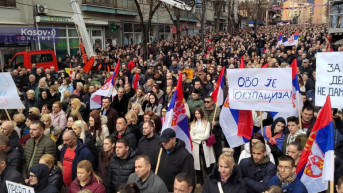
Kosovo Prime Minister Albin Kurti stated for Bloomberg Television that the government could not revoke the CBK decision but that the Serbs would be given time to adjust, adding that there would be no punitive measures during the transitional period of three months. Instead of accepting the "gracious" offer from the Kosovar Prime Minister, the Serbs protested yesterday in North Mitrovica. Interlocutors assess for Kosovo Online that Kurti is merely "buying time before the international community", although even that purchase seems to have not gone well - judging by today's statements from Hill and Escobar.
The Central Bank of Kosovo will take additional measures in the next three months to ensure a transitional period for implementing the regulation on cash operations, announced the institution. The offered "menu" includes an email for complaints, a dedicated Viber number, and several other measures, but no one seems overly thrilled - except for the Kosovo Prime Minister who stated in an interview for Bloomberg that the "preparations for the new regulation went smoothly, quite successfully".
"Even our US and European partners say that this measure is legal because it fights against illegal financial activities. We shouldn't be too hasty in its implementation," Kurti remarked.
However, partners immediately voiced their concerns today and reiterated their concerns about Pristina's unilateral moves.
The Special Representative of the United States for the Western Balkans, Gabriel Escobar, stated that his country had been entirely clear that there could be no unilateral actions and that such actions would have consequences. The US Ambassador to Serbia, Christopher Hill, also stated from Washington that the US government had been very clear about its concerns regarding the intention to ban the dinar in Kosovo and what it meant for the people living there, adding that normalization of relations must be achieved.
So, everyone was clear, but it seems that no one is actually clear on what the next three months will mean for the lives of the Serbs in Kosovo.
The interlocutors of our portal assess that the three months mentioned by the CBK are merely a "slogan" and "Kurti's buying of time before the international community", and that the decision to abolish the dinar is not in anyone's favor - not even the Kosovo Government itself.
Political scientist Ognjen Gogic states that everything the Central Bank of Kosovo has taken as measures to adjust to the regulation abolishing the dinar is "too little, too late" and adds that the announced measures might have made some sense if they had been implemented before the decision came into effect.
Gogic emphasizes to Kosovo Online that adjusting and informing citizens should be done in any situation before a measure comes into effect, and then some provisions and details should be adjusted on the go.
"What is sought is a way to actually adapt to citizens and meet their needs and expectations, and not after the decision has taken effect and after a Security Council session is convened on the matter, where a clear stance of the international community is seen that there is no understanding for such a decision. This is more of a crisis management or crisis PR of the Central Bank of Kosovo through which they are trying to somewhat mitigate the enormous dissatisfaction they have faced from various parts of the world. Even the states that support Kosovo's independence and even support CBK's right to regulate currency usage do not understand the way it was done. So, this is all improvisation meant to cover up and serve to remove stains because this decision has really damaged the reputation of the current government in Pristina," Gogic concludes.
According to his words, this will not in any way contribute to the citizens and will not make it any easier for the Serbs in Kosovo to navigate this situation. He warns that some provocative moves can be expected in these three months, such as disrupting the work of Serbian institutions, post offices, etc.
"Furthermore, what has been announced is unlikely to be achieved in the next three months. The question of licenses for institutions that could accept the dinar remains unanswered. These three months are not any kind of D-day because the dinar is already disabled and as such they mean nothing," he concludes, adding that the main thing is to tighten the noose around the dinar and Serbian institutions, and ultimately around the Serbs in Kosovo, and to somehow cut off their flow of funds from Serbia.
Economic expert Safet Gerxhaliu assessed for Kosovo Online that such a campaign had come too late, as, he emphasized, the issue of the dinar had already been politicized and Kosovo might incur the cost of extending European Union measures, as well as that it would be a topic of dialogue in Brussels.
Gerxhaliu emphasizes that it is wiser to learn from mistakes and "prevent some things, rather than cure them", and that there is no alternative to dialogue.
"The problem is that any relationship between the Serbs and Albanians, or between Kosovo and Serbia, can never have a purely economic character without political connotations, and it is precisely this politicization that brings the situation to where we are now. I think this decision was made in very difficult circumstances considering that dialogue is ongoing in Brussels and some agreements for normalization are expected. Considering that Kosovo is under sanctions, and measures of the European Union, and in that context, special results for normalization of relations in Kosovo should be achieved, to introduce such a decision, I think it is not in favor of either the Government or Kosovo, especially in terms of the normalization of relations between Kosovo and Serbia and between the Albanians and Serbs," Gerxhaliu said.
He emphasizes that perhaps it would have been different if there had been earlier announcements in that direction, and that now the whole process has acquired a political dimension.
"I have a strange premonition that this will certainly be a part of the dialogue in Europe, and considering that Kosovo does not have much political power or diplomacy to somehow slow it down, I think this problem will continue. I am glad that the Central Bank has started with some campaigns and statements, but I think it's too late and it should have been done a few months ago. Now we are where we are, and honestly, a compromise solution must be found. The important thing is that I see all countries, and economic powers, such as EU countries and the USA, are against such a decision of the Government of Kosovo, there will be great pressure, but the worst thing is, I think this will be another reason for EU measures towards Kosovo to last for a long time," Gerxhaliu said.
Executive Director of the NGO Advocacy Center of Democratic Culture from North Mitrovica, Dusan Radakovic, assesses for Kosovo Online that three months is insufficient to find a solution for the use of the dinar and adds that in this way Kurti is simply buying time before the international community.
"Believe me, three months is insufficient if there is no political agreement through Brussels to find a solution, primarily for pensioners, for social benefits, and for everything else. We will remain people living across the entire territory of Kosovo, but people in small communities, in villages, will have problems not knowing how to receive the pension they earned for 40-50 years or social benefits. So, if a solution can be found in those three months, then it's okay. But I fear that these three months are just buying political time, as we have had many examples in the past, like with the petition. I am afraid that these three months will only serve to satisfy the international community, without any plan on how a pensioner in Gorazdevac, Mitrovica, Gracanica can receive their pension or social benefits," Radakovic emphasizes.


0 comments