
Is Vjosa Osmani in a campaign, and for which position?
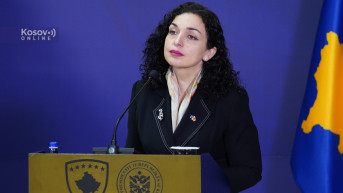
Just after finishing her visit to Switzerland, Kosovo President Vjosa Osmani traveled to Dayton. Before that, there were visits to Austria, Brunei, Malaysia, Finland... With a government in a technical mandate and a parliament that has not been constituted, Osmani is currently the only official performing her duties in full capacity, and her intensified activities can be interpreted in that light. According to sources from Kosovo Online, they could also be seen as part of a campaign—for a second term or another position.
Written by: Dusica Radeka Djordjevic
Political scientist Arta Tahiri-Beqa recently stated that she doesn’t believe Vjosa Osmani would retire from politics, but also that Osmani has realized her position isn’t stable enough to secure a second term. In her public statements, Tahiri-Beqa notes, there are “hints of a pre-election tone.”
Osmani’s five-year term ends on April 4, 2026, and according to the Kosovo Constitution, a new president must be elected no later than 30 days before the current president’s mandate expires—meaning by March 4 of next year, it should be clear whether Osmani will remain in the president’s office for a second term or pass on the role.
“We will talk about that at the beginning of next year,” Osmani responded in March when asked by reporters whether she plans to run for a second term.
In 2021, she was elected president as the candidate of the Self-Determination Movement (Vetëvendosje) in the third round of voting in the Kosovo Assembly, receiving support from 71 MPs, as she failed to secure the necessary two-thirds majority in the first two rounds. In the third round, only 61 votes are required, but at least 80 MPs must be present and voting. The second candidate proposed by Self-Determination, Nasuf Bejta, received no votes.
Belgzim Kamberi, associate of the Musine Kokalari Institute, told Kosovo Online that Osmani is not a politician who would easily walk away from her career, and it remains to be seen how she will continue it after her presidential term ends. He also pointed out that the political context in Kosovo is different now than it was five years ago when Osmani was elected.
“Osmani, it seems, no longer has the same constructive relationship she had with Albin Kurti as the leader of the largest party in Kosovo. It also remains to be seen which former opposition parties today would support her for a second term, given that she was elected with Kurti’s backing, as well as indirect support from Lumir Abdixhiku, who at the time helped ensure a quorum in the Assembly,” said Kamberi.
In his opinion, it won’t be easy for Osmani to secure a second term, but likewise, it won’t be easy for the parties in the newly constituted Assembly to elect a new president given their seat counts.
“The situation is still uncertain, but it appears that things are tighter for Ms. Osmani now than they were five years ago,” Kamberi believes.
According to historian Stefan Radojkovic, the large number of recent foreign visits and meetings with international officials by Vjosa Osmani are part of a political campaign aimed at showing the Albanian public in Kosovo that she can engage with the international community—unlike Albin Kurti. She is portraying herself as a figure who connects the various conflicting factions among Kosovo Albanians and has the support of the Albanian diaspora.
“By visiting European countries, Osmani presents herself as someone who has access to partners of the Pristina administration in Europe. It’s also important to note that she visits countries with significant Albanian diaspora communities—which is not a negligible factor. Additionally, she visits predominantly Muslim countries, especially in Asia. Not just because her religion is Islam, which she openly states and which is no secret, but to show her voter base that she respects traditional values in Kosovo, particularly in relation to the Islamic community, and to present herself as a desirable dialogue partner in the current political crisis,” Radojkovic told Kosovo Online.
If Osmani is not re-elected as President next year, he believes she will still remain an important political figure, as no Albanian political party would outright reject someone with such international weight—they would instead try to attract her to their side.
“In other words, she is now in a favorable position compared to the divided Albanian opposition and the current regime, and she has started campaigning in a timely manner ahead of what is likely to be her re-election attempt next year,” said Radojkovic.
He emphasized that it’s important for Osmani to establish herself internationally while maintaining dominance at home and positioning herself as an impartial president for all citizens.
If she does not receive a second term, he believes Osmani likely won’t be engaged by international organizations, but could potentially become one of the next ambassadors of the Pristina administration.
“We know that the Pristina administration has a practice of appointing women as ambassadors—one example being Professor Nita Luci in Norway. This serves to show not only a progressive image but also to complement the traditional one embodied by Vjosa Osmani. While Albanian society is predominantly conservative and Islamic, they aim to appear progressive by showing that women play equal roles in international affairs,” Radojkovic explained.
Osmani is, notably, the second woman to serve as Kosovo's president since its unilateral declaration of independence, following Atifete Jahjaga.

0 comments