
Waiting for the Constitutional Court: The Appeal of the Serb List as a guideline for future cases
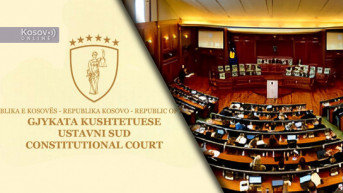
The appeal filed by the Serb List to the Constitutional Court regarding the election of Nenad Rasic as Deputy Speaker of the Assembly — which this party deems illegal — remains without resolution even after 20 days. The Court, as interlocutors from Kosovo Online point out, has no deadline by which it must issue a decision, and many believe that it is delaying the ruling because all indications suggest that new elections will be called. Nevertheless, whatever the ruling may be, it will serve as a guideline for similar cases that will almost certainly arise in the future.
Written by: Dusica Radeka Djordjevic
Ten members of the Kosovo Assembly argue that both the Constitution and the Rules of Procedure of the Assembly were violated when, on October 10, Nenad Rasic, an MP from the Freedom, Justice and Survival party, was elected Deputy Speaker representing the Serbian community.
In the vote, Rasic received 71 votes in favor, nine against, and 24 abstentions.
Rasic was nominated by Dimal Basha, the Speaker of the Assembly from the Self-Determination Movement, and since he lacked the support of the majority of Serbian MPs — the Serb List, which holds nine seats — his election is viewed as controversial and contrary to regulations.
The appeal to the Constitutional Court was filed on October 16, and the following day the Court announced that a decision would be made after all constitutional aspects of the request were reviewed.
Milos Pavkovic, Director of Strategy at the Center for European Policies in Belgrade, believes that the Court remains silent because it is being cautious and attempting to delay its response so as not to further destabilize the political situation in Kosovo.
According to Pavkovic, the Court is closely monitoring the political developments and outcomes, which explains its inaction. He also assumes that the judges are deliberating among themselves and that there is no consensus on the issue.
“It seems to me that the Constitutional Court’s position is to wait for the outcome — to see whether a new government will be formed or whether new parliamentary elections will be called. If new elections are held, this issue will fade into the background amid a new campaign and redistribution of political power,” Pavkovic told Kosovo Online.
After Albin Kurti failed for the third time to become Prime Minister, Self-Determination announced today that its new candidate for the position will be Glauk Konjufca, the former Speaker of Parliament. If Konjufca receives the mandate from the President of Kosovo, he will have 15 days to present his cabinet to the Assembly.
If, during that period, the Constitutional Court were to declare the election of the Serbian Deputy Speaker unconstitutional, Pavkovic points out that the entire process would have to go back one step.
“In that case, it would have to be declared either that the Assembly has not been constituted or that the vote for the Deputy Speaker must be repeated. However, the Court is also weighing the fact that the nine MPs from the Serb List did not receive a majority of votes in the election for Deputy Speaker representing the Serbian community. Therefore, the Constitutional Court is likely considering that such a decision could produce another political crisis. It seems to me that the Court is trying to postpone its response so as not to further destabilize the political situation in Kosovo,” Pavkovic added.
The most important reason why the Constitutional Court should ultimately make a ruling on this matter, Pavkovic emphasizes, is that a similar situation could easily occur again after new parliamentary elections.
“Two important principles are in conflict here — one, that a parliamentary majority is required, and two, that consultation with the strongest Serbian minority party in parliament is necessary when electing a Deputy Speaker representing the Serbian community,” he stated.
Attorney Tom Gashi explains that the Constitutional Court of Kosovo has no specific deadline for issuing a decision or ruling on any submission or complaint. In the case of the Serb List’s appeal, he believes it will be dismissed.
“I think everything was done in accordance with the law and that the matter is concluded. There’s no reason to repeat the election of the Deputy Speaker. I believe the Serb List is simply trying to obstruct the normal functioning of the Assembly for their own known reasons,” Gashi told Kosovo Online.
He also believes that the Constitutional Court knows it has no real means to annul or repeat the election of either the Speaker or the Deputy Speaker.
He doubts that there will be a problem if a draft law reaches the Assembly before the Court’s decision, since, as he explains, no one can propose new legislation until a new government is formed — because laws are proposed by the government. However, as he notes, “nothing is functioning at the moment.”
A different view of what the ruling might be is offered by Aleksandar Rapajic, Program Director of the NGO Center for Democratic Culture Advocacy from North Mitrovica.
“I think the Court’s decision should be that the Deputy Speaker representing the Serbian community must be elected by a majority of representatives from that community — not merely that he is ethnically Serbian, regardless of whether he enjoys majority support among Serbian MPs or not,” Rapajic told Kosovo Online.
He also believes that the Constitutional Court will issue its decision after the expected dissolution of parliament and the calling of new elections.
“I think the Constitutional Court will respond only after the Assembly is dissolved, and that ruling will not significantly affect this Assembly’s decisions, since it will no longer exist. But it will serve as a guideline binding future Assemblies on how to proceed in such cases,” Rapajic noted, adding that the Constitutional Court has no deadline for responding even to urgent appeals.
When asked what would happen to the decisions made by current MPs — including a potential vote on the budget for the following year — if the Court were to invalidate Rasic’s election, Rapajic said he does not believe the budget proposal will reach the Assembly.
“I don’t think the budget will be submitted to the Assembly, but if this Assembly were to adopt it, a much bigger problem would arise — the violation of multiple legal norms and the Constitution, since members of the Government are simultaneously serving in both the executive and legislative branches. That would mean that the same individuals vote for the budget in the Government and then again in the Assembly, which is a violation of the separation of powers and should not happen. I believe the Constitutional Court will act pragmatically and, if the Assembly is dissolved, allow the process to take its natural course,” Rapajic concluded.



0 comments