
War discourse of Kosovo Officials: Who benefits from new conflicts?
Kosovo officials have repeatedly stated that "Serbia has territorial pretensions towards Kosovo," while the U.S. State Department has expressed concern about the risk of local tensions escalating into serious political tensions in the Western Balkans. According to James O'Brien, the U.S. Assistant Secretary of State for European and Eurasian Affairs, one of the risks is the north of Kosovo. Interviewees of Kosovo Online believe that the statements of Kosovo leaders are political and directed at the international community, but for the U.S., the factor of stability in the region remains Serbia.
By Milena Miladinovic
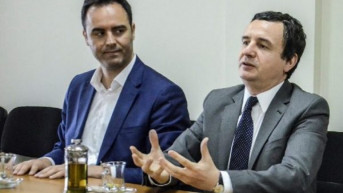
Kosovo Prime Minister Albin Kurti recently told CNN that Serbia is "very aggressive" and called on Western partners to put pressure on Belgrade. The President of the Assembly of Kosovo, Glauk Konjufca, frequently speaks about potential attacks from Serbia.
"Everyone knows that Serbia has territorial pretensions towards Kosovo. It has never abandoned these claims, but at the same time, Kosovo has never been more prepared to respond to security challenges," said Konjufca.
He claims that the warnings from Kosovo leaders about a potential war with Serbia are not meant to scare the citizens of Kosovo and that they can remain calm.
However, the opposition in Kosovo disagrees, stating that the claims of possible conflicts are political propaganda by the current government, which are neither good for the citizens' sense of security nor for foreign investors.
Deputy Speaker of the Kosovo Assembly from the Democratic Party of Kosovo (DPK), Enver Hoxhaj, stated that the war rhetoric of Prime Minister Albin Kurti is solely for electoral purposes and causes political, diplomatic, and economic harm.
"The war discourse supported by Prime Minister Kurti may be based on specific information and analysis of the security situation in the north of the country. But the Government of Kosovo, which has been talking about war for the past three years, needs to consider the political, diplomatic, and economic damage it causes to the country," said Hoxhaj.
Serbia's Perspective
From Belgrade, they argue that Pristina wants to drag Serbia into a direct conflict with NATO.
"Kurti is looking for a reason for the nonsense he speaks, to drag Serbia into a conflict with NATO. That is their political desire, and we must avoid it," said Serbian President Aleksandar Vucic.
Kosovo Defense Minister Ejup Maqedonci believes that the only solution is signing a peace agreement, which means that neither side should attack the other.
"This should become one of the points to be discussed before decisions are made on other issues within the dialogue," said Maqedonci.
Conflict Benefits One Side
The Executive Director of the Council for Strategic Policies, Nikola Lunic, pointed out to Kosovo Online that Pristina is the only party that would benefit from new conflicts, given that Serbia's official stance is completely opposite to what Kosovo Prime Minister Albin Kurti is stating.
According to Lunic, Serbia favors a stable Western Balkan region.
"At this moment, a potential conflict would only benefit one side, and that is Pristina, or more specifically, the current government in Pristina. Serbia does not benefit from any conflict; on the contrary, Serbia favors a stable Western Balkan region. As we recently heard at the NATO Summit, the Alliance does not support the transformation of the KSF (Kosovo Security Force) into the armed forces of Kosovo, but they practically ignore that. Unlike them, the USA supports the transformation of the KSF into the armed forces of Kosovo, but on some fundamental principles of democracy they hold, which are multinationalism, democracy, and the rule of law," Lunic said.
He recalls that Kurti contradicted this in his article published on the eve of the NATO Summit in the New York Times.
Kurti, he points out, refers to the percentage of Albanians and Serbs in Kosovo and states that Kosovo is not a multinational but a mono-national society.
"Thus, he is creating his own mono-national armed forces. This will definitely be a problem, but that problem is for the USA. Who and why are they supporting in perspective, and what are they doing in Kosovo in terms of supporting such an approach to creating armed forces that will be a source of destabilization in the region," Lunic believes.
He emphasizes that new incidents are possible if Pristina continues with the uncontrolled deployment of special units in northern Kosovo without consulting KFOR and NATO, or if it continues with further provocations.
He stresses that it is crucial for Serbs not to participate in creating incidents and to show openness to coordination with the West and the USA.
"The potential for incidents exists, but it can remain only at the level of an incident. It is important that Serbs no longer participate in creating incident situations. It is important that Serbs continuously work on stabilizing the situation, relaxing relations. To work with reliable partners and allies, which are the leading Western countries, because it is obvious that this cannot be done with Albin Kurti," Lunic emphasized.
Commenting on why Serbia is being highlighted as a factor of instability in the Western Balkans, Lunic says that at this moment, it is a pragmatic approach aimed at reaching a final agreement on the normalization of relations between Belgrade and Kosovo.
He explains that if only one side is condemned, then in such a situation, the possibilities for an agreement are closed.
"That is why the USA has a balanced approach to both sides at this moment, expecting a political agreement. A political agreement will sooner or later lead to the necessity of making a security agreement that we all need to be aware of, because if it is announced in Pristina that they have established two regiments in the KSF and that next year they are establishing a third regiment, and that in 2028 they are definitely establishing the armed forces of Kosovo, we must see with our American partners and the EU how to ensure transparency, multinationalism, structure, and bilateral relations," Lunic concluded.
He emphasizes that Serbia should build strategic relations with the USA regardless of which administration is in power in Washington.
"We even have joint forces in military cooperation in Sinai, and I think this will further deepen, and at least from the Serbian side, I think Washington represents a strategic orientation," Lunic said.
Serbia as a Factor of Stability
Stefan Vladisavljev, the program coordinator of the BFPE Foundation for a Responsible Society, pointed out that the lack of progress in the dialogue between Belgrade and Pristina has led to a deterioration in relations and that new incidents at the local level are possible. However, the U.S. still perceives Serbia as a factor of stability and a party ready for agreement and cooperation.
Vladisavljev indicated that Belgrade pursues a policy of peace and that escalation of conflicts is not in the interest of either side.
"The lack of progress in the dialogue and the failure to implement what was agreed between Belgrade and Pristina has definitely led to increased tensions between the two sides, which is evident in the narratives being promoted. Belgrade pursues a policy that always emphasizes peace and stability. This is a part of the narrative most frequently promoted by Serbian officials," Vladisavljev said for Kosovo Online.
However, he notes that there have been certain situations in the past year and a half involving the Serbian side that have led to increased tensions.
Taking this into account, as well as the rhetoric from Pristina, he believes that conflict is not impossible, but it cannot escalate into war.
"Starting from the premise that we have rather sharp narratives coming from Pristina, and a different type of narrative coming from Belgrade, but that there have been a few incidents involving the other side, we can definitely talk about the potential for conflict. How can this conflict evolve? I wouldn't consider war as one of the options. It doesn't seem that war will affect our region even though there are certain bilateral tensions. It seems to me that the actors within the region are focused on internal issues, developmental issues, and issues that will improve the living conditions of citizens within the Western Balkans, primarily referring to Serbia. War would serve absolutely no purpose," Vladisavljev explains.
If Pristina's approach in the dialogue does not change, he emphasizes, the current tensions could escalate into localized conflicts in Kosovo.
"Conflict is, unfortunately, one of the potential options if there is no change in Pristina's approach and to some extent the implementation of what was agreed in the Ohrid Agreement, the implementation agreement, and ultimately what would be the result of the entire dialogue process over the past ten and more years," Vladisavljev pointed out.
He reiterates that the official stance of Belgrade is to avoid any conflict and preserve human lives at all costs.
Unfortunately, he observes that the narratives from Pristina are sometimes very sharp.
"There is a possibility that localized tensions could gain a new basis. We had an incident in 2023 that was the result of long-term processes and expressed dissatisfaction primarily among Serbs in northern Kosovo, but also a reaction from the KSF (Kosovo Security Force) delegated by Pristina. If we had a loss of life in the incident that occurred in Banjska, we can say that this potential exists because something did happen, but the messages coming from Belgrade indicate that it is not anyone's goal, that it is not the goal to escalate conflicts or lose lives. Unfortunately, the narratives from Pristina in some situations are quite sharp," Vladisavljev said.
He observes that in the eyes of Pristina's institutions, Serbia is viewed as a threat, although there is no continuous narrative to justify this.
Incidents have been classified as incidents, a lot of time has passed since they happened, and it seems that such events will not repeat, at least not as presented and potentially expected by representatives in Pristina, he notes.
"Definitely moving out of this situation of tension and a position where it seems that neither side is satisfied with the position they are in is a prerequisite for such a thing not being a possibility in the future. It seems to me that some percentage of potential for localized conflicts that can reach a higher level, unfortunately, still exists," Vladisavljev believes.
He emphasizes that it is obvious that Serbia is currently viewed by the U.S. as a key factor of stability.
The U.S. knows, he adds, that the actions and moves Serbia makes will determine the stability or potential instability in the Western Balkans.
Stefan Vladisavljev noted that Serbia has proven to be a reliable partner to the USA and that relations between Belgrade and Washington are at a historically high level.
"Cooperation between the USA and Serbia has reached probably the highest level in recent contemporary history between Belgrade and Washington over the past few years. With the orientation of foreign policy and the messages sent by the Minister of Foreign Affairs, it seems there is a tendency for further development of partnership relations between Serbia and the USA. Serbia has proven to be a reliable partner to Washington on numerous issues, such as dialogue and de-escalating situations with elevated tension levels. I would say that if Serbia is potentially seen as a source of instability, Washington sees the solution by providing full support to Serbia to remain in its current position, as someone who ensures stability in the region by cooperating with its neighbors in the Western Balkans," Vladisavljev concluded.
Message to the International Community
Avni Islami, a professor of security studies, believes that the statements by Kosovo officials about a possible attack from Serbia are political and directed at the international community.
Islami emphasized that Kosovo officials are sending messages about a potential attack from Serbia out of "precaution" to prevent a repeat of the situation in Banjska.
"The statements from the political leadership of the Republic of Kosovo are political statements directed at the international community. We saw the death of a police officer involved in the Banjska action last year. Therefore, such statements are messages to the international community to prevent a similar case and to avoid further loss of human lives," he said.
Islami believes that an incident like the one in Banjska will not be repeated due to the cooperation of the Kosovo Police with EULEX and KFOR.
"I think such an incident, proclaimed by the state leadership of Kosovo, will not be repeated because the security forces of Kosovo, especially the Kosovo Police and the Kosovo Intelligence Agency, along with EULEX and KFOR, continuously monitor northern Kosovo and Kosovo as a whole, and will not allow such a surprise. Therefore, I do not expect another Banjska to happen. I believe there will not be an escalation of the situation in northern Kosovo," Islami said.
Regarding the statement from the State Department that northern Kosovo poses a risk of escalation, Islami said there is no need for panic, as "the security institutions of Kosovo are now operating under the laws in force."
"I believe there is no need for panic in northern Kosovo. It is known that organized crime operated in northern Kosovo. We have statistics on the destruction of drug laboratories, as well as arms and human trafficking—simply put, northern Kosovo was an oasis for organized crime and corruption. Therefore, the citizens in northern Kosovo, regardless of their national affiliation, are completely safe, as the security institutions of Kosovo act according to the law, and before the law, all citizens are equal. The Kosovo Police are in the service of citizens regardless of whether they are Serbs, Bosniaks, or Albanians," Islami concluded.



0 comments