
What determines whether Kosovo’s multimillion-dollar agreement with the U.S. MCC will survive?
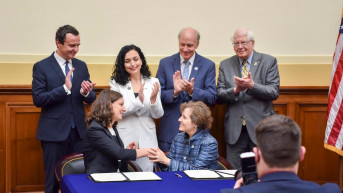
A $236.7 million agreement signed three years ago in the U.S. Congress between Kosovo and the Millennium Challenge Corporation (MCC)—touted by the authorities in Pristina as a path to a decarbonized future—is now hanging by a thread. According to American media reports, if Donald Trump’s administration shuts down the MCC, the agreement will remain in force only if Washington determines it serves U.S. foreign policy interests in the Western Balkans and aligns with its political objectives, which may not be publicly disclosed, sources told Kosovo Online.
Written by: Dusica Radeka Djordjevic
Elon Musk’s Department of Government Efficiency, as reported in the media, has informed the MCC that the vast majority of its grants will be terminated and that the agency’s staff will be significantly reduced.
The compact program with Kosovo, officially launched on May 1, 2024, involves a $202 million grant, with an additional $34.7 million contributed by the Kosovo government. President Vjosa Osmani promoted it as the largest investment in Kosovo’s energy sector in decades. The program focuses on transitioning to green energy and increasing energy security through the installation of energy storage batteries.
So far, the Kosovo government has not commented on the potential collapse of the MCC program. However, former Prime Minister Avdullah Hoti stated that the closure of the MCC would result in a $220 million loss for Kosovo. He blamed the government of Albin Kurti, claiming it ignored the Washington Agreement and refused to suspend import tariffs on U.S. goods.
Agim Shahini, president of the Kosovo Business Alliance, also believes that Kosovo risks losing this American investment due to strained relations with the new U.S. administration.
"Kosovo could have been a leader in utilizing funds from the United States. However, the relationship between the Kosovo government and the Trump administration is quite cold, and because of that, we risk losing over $220 million. This will have a major impact on Kosovo’s economy," Shahini told Kosovo Online.
If the MCC is shut down, according to Damir Dizdarevic, Program Coordinator at the BFPE Foundation for a Responsible Society, the agreement with Kosovo will either be terminated or revised so that the new U.S. administration can assess whether it aligns with U.S. national interests and foreign policy objectives in the Western Balkans.
In his view, a $236.7 million investment is extremely significant for a territory the size of Kosovo.
"Investments in the energy sector start in the tens of millions, go into the hundreds, and reach billions of dollars. A World Bank report, for example, says that around $37 billion is needed to decarbonize the Western Balkans by 2050. Compared to that, the amount allocated to Kosovo is not huge, but for Kosovo itself, it’s a massive sum," Dizdarevic told Kosovo Online.
He explains that for Kosovo’s energy system, the project that MCC was supposed to finance is very important because it relates to grid stability and energy security.
"It’s about batteries that should balance consumption peaks. Batteries are extremely important for integrating renewable energy sources into the system. When there’s no wind or sun, you simply release energy from the batteries to compensate, because the electricity grid always needs a balance between production and consumption. Batteries charge when there is surplus—when the sun is shining and the wind is strong," Dizdarevic notes.
Kosovo, he adds, plans to increase the share of renewables to 35% of total energy consumption by 2030, up from the current 6%. The project was recognized as strategic by the previous Biden administration, but it remains to be seen what the Trump administration will say.
He adds that while energy security and supply reliability are high on the agenda of Trump’s new administration, climate change is not a priority. Trump plans to increase fossil fuel production.
"From that standpoint, this MCC project probably won’t rank high on the priority list. But if we look at it through the lens of energy security—and we know that Kosovo’s system is quite outdated, with power plants over 50 years old, prone to breakdowns that will become more frequent—then there is a strong chance that the project will remain viable. It all depends on whether the U.S. administration sees the project as a climate initiative or one that enhances energy security in Kosovo and the broader Western Balkans. I’d probably bet on the latter, although there are other ways to ensure energy security using fossil fuels instead of batteries," Dizdarevic concludes.
He notes that the U.S. was once known for honoring its agreements—an essential foundation of the current international order—but that this is gradually changing amid shifting geopolitical dynamics.
Petar Donic, a contributor to Novi Treci Put, told Kosovo Online that the fate of the Kosovo–MCC agreement will most likely depend on an evaluation process that all MCC programs will undergo, based on specific political goals.
He pointed to the case of USAID, where 82% of programs were eliminated and only 18% retained.
"During the USAID budget cuts, program participants could request exemptions and explain why. Each case was then assessed based on the global relevance of the program and whether it supported U.S. foreign policy interests. That principle will likely apply here too, with the decision criteria remaining secret and politically driven," Donic said.
In his assessment, a $236.7 million investment is enormous for a small region like Kosovo.
"Everyone will have an interest in defending their position, but finding compensation, especially in the current market environment, will be extremely difficult. One MCC program in Nepal is also under threat, and the government there is petitioning for alternative funding. The broader agenda is to centralize all independent agencies under the State Department. Some programs will be retained, and some won’t, depending on political goals in each region," Donic explains.
He also recalls the agreement signed between Serbia and the U.S. International Development Finance Corporation (DFC) during Trump’s first term, which was supposed to bring $50 million in development projects to the region.
"When the U.S. administration changed, that agency ceased operations, so there is a precedent showing that when a new government comes in, it brings its own agenda and may easily review and cancel previous agreements," Donic notes.
The MCC was established by the U.S. Congress in 2004 and operates programs in nearly 50 countries. According to its website, the agency has invested about $17 billion worldwide in projects related to agriculture and irrigation, education, energy, transportation infrastructure, and more. It describes itself as “a partner to the world’s poorest countries that are committed to just and democratic governance, economic freedom, and investing in their people.”



0 comments