
What is the fate of five European "no"s for Pristina?
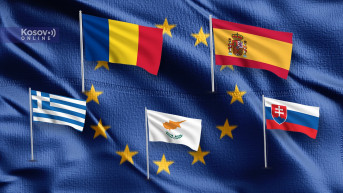
Five European Union countries are resisting pressure from Brussels and Washington to recognize Kosovo, as evidenced by the statements of their highest officials, while Pristina's expectations that at least one of them will back down remain equally persistent. This is confirmed by the statement of Kosovo's Foreign Minister Donika Gervalla, who expects that Greece "could soon move towards recognition" of Kosovo's independence, Blic reports.
Spain, Cyprus, Slovakia, Romania, and Greece are five countries that do not recognize the independence that Kosovo declared in 2008, out of 27 EU countries. This decision is influenced by good relations with Belgrade, as well as the fact that independence for each of them is an "Achilles heel" due to their internal issues.
Aleksandar Popov, Director of the Center for Regionalism, says for Blic that if there were to be new recognitions of Kosovo's independence, they would not occur individually, but all five countries would recognize it.
"To me, it seems that it will be a kind of package. It would follow as an agreement within the EU, and the consequence would be that these countries would not obstruct Kosovo's entry into international organizations, except for the United Nations. The key moment will be the formation of the CSM, as well as moving away from the implementation of the Ohrid agreement," Popov assesses.
Dragisa Mijacic, coordinator of the National Convention on the EU for Chapter 35, also believes that the Ohrid agreement plays an important role.
Mijacic believes that the agreement brought a lot of hope and expectations among EU representatives and those countries in the international community that were actively involved in the negotiations, including the United States, but that it is still too early to predict its effects.
"It is still early to predict, including the expectations that its implementation will lead to the recognition of the five EU countries that have not yet done so. Based on everything we have seen in the first days after the agreement was reached, new recognitions of Kosovo's independence would be a surprise. However, the agreement will certainly contribute to the international affirmation of Kosovo in a way that creative solutions will be found for its membership in many world, European, and regional organizations," Mijacic said for Euronews Serbia.
Mijacic points out that Greece has a specific position.
"As for Greece itself, for some time now, there has been an opinion present in diplomatic circles that Greece should regulate its relations with Albanians, that is, that it is in Greece's national interest to regulate its relations with Albania and Albanians in general. On the other hand, it should not be forgotten that the current government in Greece is under strong influence from Washington, so if Washington were to request something regarding this matter, I think that Greece will change its position," Mijacic said.

0 comments