
What kind of signals are sent by the European five that do not recognize Kosovo; Mijacic: Everything depends on the implementation of the Agreement
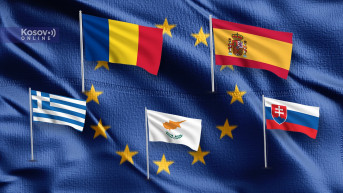
Despite the pressure from the West, which always existed at the diplomatic level, it had not affected Greece's position when it came to recognizing Kosovo's independence, Greek President Katerina Sakellaropoulou said during her recent visit to Belgrade. Indeed, there is no official recognition, but Athens has been developing better diplomatic relations with Pristina for some time, as evidenced by the fairly frequent official visits of Greek officials to Kosovo, Euronews Serbia reports.
In the last nine months, the Minister of Foreign Affairs of Greece, Nikos Dendias, paid an official visit to Pristina three times, which certainly benefits the narrative, but also the wishes, which can be heard among Kosovo officials.
This was recently suggested by the Minister of Foreign Affairs of Kosovo, Donika Gervalla when she said that she expected that Greece "could soon move towards recognition". The opposite position to Gervalla was expressed not only by the officials of Greece, but also by the other five EU countries that do not recognize Kosovo, but, despite this, the issue of those five members became topical again after Belgrade and Pristina supported the European plan for the normalization of relations and reached an agreement in Ohrid about its implementation.
The European proposal for the normalization of relations between Belgrade and Pristina was supported by all 27 EU member states, and as US Secretary of State Antony Blinken said, the implementation of the Ohrid agreement would pave the way for these five countries to do what they had not done so far.
Coordinator of the National Convention on the EU for Chapter 35, Dragisa Mijacic, says that this agreement brought a lot of hopes and expectations to the representatives of the EU and those countries, in the international community, that were actively involved in the negotiations, among them the US. He adds, however, that it is still too early to predict its effects.
"It is still too early to predict, including expectations that its implementation will lead to the recognition of five EU countries that have not yet done so. Based on everything we have seen in the first days after reaching the agreement, new recognitions of Kosovo's independence would be a surprise. However, the agreement will certainly contribute to the international affirmation of Kosovo, in such a way that creative solutions will be found for its membership in many world, European, and regional organizations," Mijacic said.
Each of these five countries has its own internal reasons for not recognizing Kosovo. Spain is often labeled as the country with the strongest position on the issue of Kosovo, and the motive behind its decision is the fate of Catalonia. Cyprus also, itself with territorial problems, has, from the very beginning, had the position that it would never recognize a unilateral declaration of independence outside the framework of the United Nations. A message recently arrived from Madrid that the outcome of the dialogue between Belgrade and Pristina was "a step forward", but that Spain remained committed to not recognizing independence.
However, the circumstances are changing, so there is a debate about what the remaining three countries will do. Bucharest currently claims that its position has not changed, and earlier such messages also came from Bratislava, but not completely excluding the possibility that Slovakia's policy may change at some point depending on the outcome of the dialogue between Belgrade and Pristina.
Certainly the most interesting was the position of Greece. Although it did not officially recognize Kosovo as a state, Greece accepted its membership in several international organizations. There were currents in Greece that believed that it was in the national interest of the country to regulate the relationship with the Albanians and that implied recognition, Nikos Palpas, correspondent of ERT, told EuroNews Serbia earlier.
"As far as Greece itself is concerned, there has been an opinion in those diplomatic circles for some time that Greece should regulate its relations with the Albanians, that is, that it is in Greece's national interest to regulate its relations with Albania and with the Albanians in general. On the other hand, we should not forget that the current government in Greece is strongly influenced by Washington, so if Washington asks for something in this regard, I think Greece will change its attitude," he said.
As Mijacic explains, Greece is interested in strengthening economic cooperation with Kosovo, especially in the field of energy, but also in other areas.
"The result of Greece's intensified diplomatic activities can be seen in the increase of its trade exchange with Kosovo, primarily in exports, which increased from 204.2 million euros in 2021 to 307.3 million euros in 2022. The growth of Greek exports to Kosovo continued in the first two months of 2023, if this trend continues, it may reach half a billion euros by the end of the year. This clearly shows Greece's economic interest in expanding into the Kosovo market. It remains unknown to what extent Greece's position on Kosovo's independence will affect trade exchanges. Recently, the reached agreement on the normalization of relations between Serbia and Kosovo can provide an answer to this question because it will enable the relaxation of relations and stronger economic integration of the region, while larger political issues will be left for the time when the Western Balkans are ready to join the EU," Mijacic said.
It was expected, he adds, that the signing of the agreement on normalization would bring Greek recognition of Kosovo, which was supported by extremely active diplomatic relations between Greece and Kosovo, which resulted in numerous high-level mutual visits.
"President Sakellaropoulou's statement confirmed Prime Minister Mitsotakis's earlier position regarding the recognition of Kosovo's independence, so it can be concluded that Greece would not change its position due to reaching an agreement on normalization," he pointed out.
And although analysts and connoisseurs of the situation do not have many doubts that there will be no formal recognition, at least for the time being, the question arises, what about Kosovo's membership in international organizations and institutions and how the achievement of an agreement between Pristina and Belgrade will affect the mood in the mentioned five countries when potentially membership of Kosovo is on the agenda of the Council of Europe, but also when the issue of membership in the EU is brought up.
The issue of Kosovo’s membership in the Council of Europe, let’s recall, was removed from the agenda several times last year and, as it seems, it depended primarily on the situation on the ground. As Euronews Serbia previously wrote, the US had also demanded that the issue of Kosovo's accession not be put on the table until "Kosovo adopts a more constructive position on the Community of Serb-majority Municipalities, which would pave the way for the proposal of a basic agreement between Belgrade and Pristina".
At the end of the year, Pristina officially submitted a request for membership in the European Union, although this is, officially, and legally debatable precisely because Kosovo is not a state in the eyes of all EU members.
Austrian Chancellor Karl Nehammer said at the beginning of the year that his government would try to convince the five EU members to support granting Kosovo the status of a candidate for membership in the Union.
There have been diplomatic activities directed towards these five countries before. Namely, after the so-called Franco-German plan was presented to the President of Serbia, the EU's Special Envoy for dialogue between Belgrade and Pristina, Miroslav Lajcak, met with the representatives of these countries.
When asked whether we could expect increased pressure on the five countries, Mijacic says that it depends on the implementation of the agreement.
"If the implementation of the normalization agreement comes to life, the diplomatic pressure on countries that have not recognized Kosovo will be reduced, but work will be done on modalities that will enable the integration of Kosovo in European and regional initiatives in the circumstances of the lack of recognition by the five EU countries," Mijacic said.
As he added, the agreement on the normalization of relations would enable a more affirmative approach to the five countries that had not recognized Kosovo regarding membership in international organizations and institutions.
"But everything depends on the implementation of the agreement, especially on the first 150 days when the CSM is expected to be formed. Only after the implementation of these provisions can we expect a more flexible approach to support Kosovo's membership in the Council of Europe and other organizations," he pointed out.
0 comments