
When a cry for help goes unanswered: Arlinda Zekaj’s killing must lead to systemic change
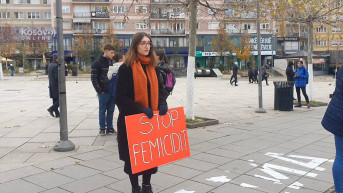
The killing of Arlinda Zekaj, in which her former brother-in-law is a suspect, has triggered a wave of protests in Kosovo, with citizens demanding justice, accountability and resignations while pointing to institutional failures, as the victim had repeatedly reported domestic violence. Kosovo Online’s interlocutors agree that the case must lead to systemic change, arguing that institutions are not doing their jobs effectively enough and stressing that every cry for help must be taken seriously because victims of domestic violence must be protected.
Written by: Katarina Saicic
Arlinda Zekaj was killed by her former brother-in-law on October 25 in the village of Vitomirica near Pec. On that same fateful day, she had reported her husband for violence. Both gave statements to the police, where he was detained for 48 hours. According to the police, however, she was returned to her home at her own request. But she was not safe there. At around 9:10 p.m., she was found dead.
Meanwhile, the Basic Prosecution Office in Pec said that on October 22 it had received a submission from Arlinda Zekaj requesting urgent action against certain officials whom she accused of failing to perform their official duties in handling her cases, including the enforcement of an earlier court decision.
That is what has particularly disturbed the public in Kosovo—the victim sought protection, but did not receive it.
Arlinda Zekaj is the eighth woman killed in Kosovo since the beginning of the year, and experts say that, relative to the size of the population, the figure is extremely high.
According to data from the Kosovo Ministry of Justice’s official domestic violence statistics database, 2,052 cases of domestic violence were reported to the police between January and September this year, involving 1,626 female victims.
The killing of the woman and mother of a young boy triggered a wave of protests. Eleven police officers and two prosecutors were subsequently suspended, Kosovo Police Director Gazmend Hoxha resigned, and a parliamentary committee of inquiry was established. The committee’s chairman, Burim Ramadani, said it would investigate failures in the handling of Arlinda Zekaj’s case, while Parliament Speaker Albulena Haxhiu called on all officials to respond to the committee’s summons and requested that the Special Prosecution Office become involved in the investigation.
Failures identified
In its review of the handling of the case, the Kosovo Police Inspectorate found that the police had failed to document the enforcement of a protective measure issued by the court on September 7. A second protective measure, issued on October 16, was not implemented until October 22, six days later, following intervention by the Inspectorate.
The Kosovo Prosecutorial Council suspended the Chief Prosecutor of the Basic Prosecution Office in Pec, Lumturije Vucetaj, as well as Arlinda Nalbani Gacaferi, the prosecutor handling the Zekaj case, following a proposal by Kosovo Chief State Prosecutor Zeynulah Gashi, who initiated disciplinary proceedings over the failures.
At protests, citizens demanded the resignations of Justice Minister Donika Gervalla and Interior Minister Xhelal Svecla. Both rejected those demands, arguing that their resignations would not contribute to improving the protection of women.
Every cry for help must be taken seriously
ACDC Program Officer Ines Aljovic said that institutions had for years failed to do their jobs adequately when it came to violence against women in all its forms. She stressed that coordination among the relevant institutions had long been inadequate, particularly when it came to communication between social welfare centers and other institutions.
“The fact is that, when we talk about violence against women in any form, institutions have not been doing their job well enough for years. In fact, we can look at this over a much longer period. I would not focus solely on the work of the police, which is certainly problematic and whose responsibility cannot be avoided. I would extend that responsibility to the prosecution, the courts, social welfare centers and victim advocates as well,” Aljovic told Kosovo Online.
According to her, the case of Arlinda Zekaj illustrates the consequences of institutional dysfunction and a lack of cooperation among the relevant authorities.
“This case is just another example of how institutional failures and insufficient coordination can, unfortunately, very easily lead to femicide—the killing of a woman,” she said.
Commenting on the resignation of senior police official Gazmend Hoxha, she said that such a move represented a moral and political act but did not, in itself, guarantee changes in the way institutions operate.
“I would focus more on what lies outside politics, namely reviewing the work of absolutely every institution involved in this case, as well as those generally involved in cases concerning family relations, particularly cases involving physical violence against women,” Aljovic said.
She singled out as particularly concerning the fact that Zekaj’s warnings about a potentially tragic outcome had not been taken seriously and that the prescribed protective measures had not been implemented.
Every appeal for help from a victim must be taken seriously, Aljovic stressed, adding that although the police were not the only institution responsible for protection, they had to respond and ensure that victims were connected with the other relevant services.
The killer is guilty, but institutions bear responsibility
According to Pristina residents interviewed by Kosovo Online reporters, the killer is responsible for Arlinda Zekaj’s death, but responsibility also lies with the institutions that failed to do enough to protect her, as well as with society as a whole.
“The killer is to blame for her death, but the institutions also bear responsibility. They should have helped and supported her. I am going to cry because it is so sad,” a Pristina resident told us.
Another resident placed responsibility on the institutions.
“Obviously, the state is to blame. The state is definitely to blame,” she said.
For another Pristina resident, the killing represented an institutional failure. She said the institutions had failed to allocate sufficient funding and that mechanisms for protecting victims were not functioning.
Another resident said responsibility also rested with society.
“We all bear responsibility as a society,” she said.
‘Honor killing’
Victims of violence should seek help from institutions, and once they do, they must be kept safe, Vanja Macanovic of the Autonomous Women’s Center in Belgrade said in reference to the Arlinda Zekaj case. She noted that, when the number of women killed was considered in relation to the population, the figure in Kosovo was significant.
“What women’s organizations around the world are calling for is for these cases to be reviewed and for it to be established where institutions failed. It is important to identify which links in the protection process broke down and where there was a lack of understanding,” Macanovic told Kosovo Online.
She explained that the Zekaj case was highly specific because of the complex circumstances surrounding the killing.
“She was not killed by her husband, who was in custody at the time; she was killed by her brother-in-law. This femicide is effectively linked to what is known as an ‘honor killing.’ She allegedly brought dishonor upon her husband’s family by reporting him and having him detained, after which she obtained an interim order granting her custody of the child. In ‘honor killings,’ it is often the youngest male member of the family who is instructed to carry out the killing,” Macanovic said.
Risk assessment is crucial
Macanovic noted that emergency restraining orders also existed in Kosovo but stressed that much more needed to be done to improve the protection of women from violence.
“Risk assessment is crucial. Assessing how dangerous someone may be does not apply only to the perpetrator. Members of the perpetrator’s immediate family should also be assessed, and this should be discussed with the woman. When victims of violence contact us, the first thing we do is conduct a risk assessment. There are certain red flags indicating that you may be seriously injured or killed,” Macanovic explained.
She stressed that victims must be kept safe after reporting violence.
“A plan must be put in place to ensure that the victim remains safe after making a report. Unfortunately, institutions still do not understand this, nor does the wider public. Whatever a victim of violence does, it is never considered good enough, and there is always something to criticize. Finding yourself in a situation where you are a victim of violence is neither easy nor straightforward. I urge everyone who knows women living with violence to encourage them first to contact women’s organizations, which also exist in Kosovo,” Macanovic said.
Not an isolated problem
When it comes to accountability, Nevenka Rikalo, President of the Ruka Ruci Women’s Association, told Kosovo Online that violence against women was not an isolated problem but a serious social and institutional challenge, not only in Kosovo but throughout the region, and that femicide was a warning that the system for protecting women must function effectively.
The Zekaj case has raised serious questions about the responsibility of institutions that have a legal obligation to protect women’s lives, Rikalo said.
“I believe it is essential to urgently, thoroughly and impartially examine the actions of all relevant institutions, from the receipt of reports and risk assessment to the exchange of information and implementation of specific protective measures. Every report of violence and every warning from a woman must be taken seriously. No report must go unanswered, and no woman seeking help should be left to fend for herself,” Rikalo said.
Femicide is the most extreme outcome of violence against women, Rikalo added, and preventing it requires more effective cooperation among the police, prosecution, courts and social welfare centers, continuous risk assessment, consistent implementation of protective measures and accountability for any failures that may occur.
“The case of Arlinda Zekaj must be a catalyst for concrete and lasting change, rather than yet another case that the public will remember for only a few days. Protecting women’s lives must be a priority for institutions, and accountability for their work must be an obligation, not a choice. We must not allow help to be sought only when it is already too late,” Rikalo said.




0 comments