
When language becomes a political instrument – What lies behind Kurti’s address to Serbian journalists?
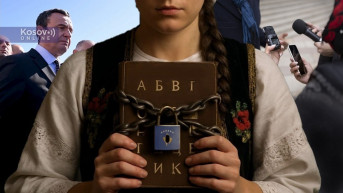
“Language is the sustainer of a nation,” wrote Vuk Stefanovic Karadzic, pointing out that as long as a people have their language, they live, remember, and endure. Perhaps more than ever, this thought illustrates the position of the Serbian people in Kosovo, which has once again been shaken by a call from caretaker Prime Minister Albin Kurti for journalists from Serbian newsrooms to ask questions in Albanian as well. Prominent journalists from Kosovo and central Serbia warn that such messages not only jeopardize the work and safety of the media, but also represent the culmination of decades-long discrimination against the Serbian language within Pristina’s institutions, calling into question what, in Karadzic’s words, constitutes the very core of a nation’s survival.
Written by: Petar Rosic
Three years ago, at a roundtable entitled “Kosovo as a Multilingual Society,” Albin Kurti told a journalist from a Serbian newsroom—who had pointed out violations of the Law on the Use of Languages—that he would never cynically tell her to learn Albanian, because, as he himself emphasized, that was her personal choice.
That same year, on the European Day of Languages, he promised that the Government of Kosovo would double its efforts to ensure protection of the right to use official languages.
Last week, however, at the opening of a new pedestrian bridge over the Ibar River connecting South and North Mitrovica, he told journalists from Serbian newsrooms that they could occasionally ask questions in Albanian as well.
“I speak Serbian—why wouldn’t you speak Albanian as well?” Kurti said.
His “invitation” provoked sharp reactions from the Serbian public. Jovana Radosavljevic from the NGO New Social Initiative described his statement as a form of institutional belittlement, saying it demonstrated a lack of understanding of the concept of equality.
“He shifted responsibility for communication from representatives of official institutions onto journalists and citizens, instead of onto the institutions themselves, which are obliged to respect the law and provide equal access to information for citizens and journalists,” she said.
Veljko Odalovic, President of the Serbian Government’s Commission on Missing Persons, also reacted, stating that Kurti chooses any means necessary during this election campaign to strengthen his position, and that everything he has done during his mandate amounted to a campaign against the Serbs.
“Kurti told them that he speaks Serbian, but that it is very important for them to learn Albanian as well. The so-called constitution provides for two official languages. I have been in public life since the 1980s and 1990s. Never has any politician, at any level, said anything like this. Kurti is the last person who should be doing this. Perhaps a local politician could do so in Srbica, Malisevo, Glogovac, Kacanik, and so on—places where people may not be sufficiently informed—but there is always an interpreter to handle such matters,” Odalovic said.
A Message “Between the Lines”
Journalists from Kosovo see Kurti’s message as additional pressure and warn that the equality of the Serbian language has been violated in numerous ways for decades. In addition to the lack of translation in institutions and the prevention of the use of Serbian in official communication, they also point out that where Serbian is used, it is often employed in a “distorted” form that does not correspond to the norms of the standard Serbian language.
“The Prime Minister, as Prime Minister, has no obligation to speak Serbian, but he can always have an interpreter to translate. The same applies to the other side. On the other hand, it is not his role to advise journalists on which language to ask questions in, given that Kosovo is characterized as bilingual, with both languages officially in use,” Zoran Stankovic, a journalist from RTV Gracanica, told Kosovo Online.
He stressed that journalists from Serbian newsrooms face numerous problems in institutions because no one knows the language, and they also lack interpreters, which prevents them from addressing officials.
“That is why, in many places, they do not receive answers at all,” he said.
He added that Kurti’s message should be “read between the lines.”
“It can be a message like: learn the language, and then maybe tomorrow, or in ten years, another message will come—change your surnames, completely lose your identity, and become what we are. Which, of course, we will not accept, just as we do not accept this statement,” he said.
He noted that this was not the only controversial statement by Kurti and that many of them in recent times have affected the work and safety not only of journalists, but of all Serbs in Kosovo.
“It seems to me that the situation has changed in recent years and that it is no longer what it once was; I even think it is much worse. Politicians and their language often incite hatred, especially extremists who are waiting for a spark that will give them the confidence to act,” he said.
He emphasized that no journalist from a Serbian newsroom feels comfortable at a press conference or event where the majority of officials are Albanian.
“My colleagues and I have never had so many problems, but provocation is very often felt from politicians—if not in the tone of their address, then in a sentence, or in their attitude, which I believe they try to demonstrate in every possible way, especially over the past few years,” Stankovic said.
The President of the Journalists’ Association of Serbia (UNS), Zivojin Rakocevic, who lives in Gracanica, also assessed for Kosovo Online that Albin Kurti’s call to journalists from Serbian newsrooms represents the peak of long-standing institutional discrimination against the Serbian language.
“There are very few of those unfortunate laws in Pristina that Albin Kurti has not violated. He has violated everything that could be violated, and now he has reached language as well. He has reached what is one of the constitutive elements that both foreigners and Serbs cling to, and the entire system that says Serbian is equal to Albanian and that these are two official languages in official use. What he said is an announcement of a reckoning with the Serbian language at that level,” Rakocevic said.
Discrimination Lasting Two and a Half Decades
He added that the reckoning with the Serbian language has been ongoing for 25 years.
“From the police and judiciary, through poor translations, signage, and discrimination in any job where language is concerned… In fact, Albin Kurti encapsulated all forms of discrimination when he said: ‘Excuse me, you can ask questions in Albanian too,’” Rakocevic stressed.
He reacted unequivocally to Kurti’s message.
“No—if he does not know Serbian, he is obliged to have an interpreter. No—if a police officer does not know Serbian, he is obliged to find an officer who does. No—if someone in any institution, whether in a municipality or an electricity distribution company, does not know Serbian, they are obliged to find someone who does. It is completely irrelevant whether you know Albanian or not. What matters is that the system recognizes the person who wants to receive a service in their mother tongue,” he emphasized.
Rakocevic was explicit that language cannot be imposed by force.
“The mother tongue is something sacred, something no one can impose on you. There are legal rules, and they must be respected. Everything beyond that is discrimination. A language cannot be learned by force. Languages are not a matter of coercion, but of relationships, affection, trust, and communication. Do I want to read a brilliant writer in Albanian? Yes. But do I want to learn Albanian because Kurti, a police officer, a judge, or a clerk demands it? No. I will never learn a language if someone forces me to,” he said.
He stated that Kurti’s remark is the crown of discrimination and a projection of a system that finds language inconvenient.
“That system is legally regulated and language must be equal, but since everything is being dismantled, why not abolish that language as well? Whether he speaks Serbian does not interest me at all, nor should it interest journalists. What interests us is whether his statements violate the law—and they do. Do they discriminate against someone? Yes, they do. It is hard to find a law that this system and this government have not violated,” Rakocevic said.
He emphasized that the Journalists’ Association of Serbia insists on linguistic sensitivity.
“These are terrifying messages. We know what we have gone through over the past 25 years because of the use of our mother tongue, and we have developed a reflex in its use. Eighty percent of Serbs in Kosovo, when heading into areas where Albanians live, think: ‘Should I use my mother tongue, and will someone react to my Serbian?’ And then we come to institutions and receive the answer: ‘Just learn Albanian.’ What kind of message is that for journalists and for ordinary people? It is a violation of the law, but again—it is hard to find a law that this system and this government have not violated,” Rakocevic concluded.
Vladimir Radomirovic, editor-in-chief of the Pistaljka portal and a former UNS president, also pointed out that the rights of Serbs in Kosovo are being systematically annulled, including the right to use their language and script.
He assessed Kurti’s statement to journalists from Serbian media as a continuation of pressure and a message to the entire Serbian community.
“Above all, it is a hypocritical call, because although Albin Kurti speaks Serbian and speaks it well, the rights of Serbs in Kosovo and Metohija are systematically being annulled, including the right to use their language and script,” he told Kosovo Online.
Journalists Under Constant Pressure
Radomirovic pointed out that the disregard for the Serbian language is evident in the everyday practice of Pristina’s institutions, particularly in their official communication.
“When we look at the websites of institutions in Kosovo and Metohija, we see that sections in Serbian are always in Latin script, in some pseudo-language that is not Serbian—there is no Cyrillic anywhere—and that language is completely distorted and does not correspond to the standard Serbian language. Albin Kurti would be better off using proper Serbian in the official communication of his institutions than asking Serbs to speak Albanian,” he said.
He assessed that statements like this are not incidents, but part of a long-term process of suppressing the Serbian language, and that responsibility for such a situation does not lie solely with the authorities in Pristina.
“This is discrimination, and this statement is a continuation of discrimination that has lasted for decades. Even after the 1974 Constitution, the Serbian language was marginalized, and now the situation is even worse for Serbs in Kosovo and Metohija. The problem also lies with Western institutions and Western governments, which fail to notice this issue or sweep it under the rug, even though they know that the Serbian people in Kosovo and Metohija are currently the most endangered ethnic group in Europe, yet they take no action to improve their position,” he said.
Speaking about the position of Serbian media, he warned that journalists are under constant pressure, and that Kurti uses them to send a message to the entire Serbian community.
“Serbian journalists have long been unable to participate equally in events organized by the authorities in Pristina because they are not provided with interpretation and cannot ask questions. They are the most exposed part of the Serbian community, and through them a message is sent to the entire Serbian community in Kosovo and Metohija—that they should remain silent and accept all irregularities, illegalities, and discrimination coming from Pristina, which are supported by Western countries,” Radomirovic concluded.


0 comments