
When life stops in two words – silent pogrom
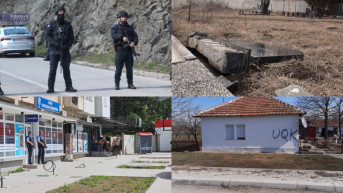
Pressures, provocations, wrongful arrests, desecrated ancestral cemeteries, unease. While there is no violence against Serbs in Kosovo as overt as during the March days of 2004, it is systemic, and therefore much more dangerous, say the sources for Kosovo Online. Moreover, it is overlooked by Western powers. The true definition, according to many, is the silent pogrom.
Written by: Dusica Radeka Djordjevic
Unpunished crime repeats itself. Attempts to erase Serbian Orthodox heritage in Kosovo, the breaking into churches, attacks on the property of returnees, stone-throwing at Serbian schools, graffiti reading UÇK on family homes once and for days on end over the past two decades. The abolishment of the dinar and Serbian institutions without offering alternatives, with indifferent reactions from international representatives.
According to officials in Belgrade, 15% of Serbs have left northern Kosovo in recent years.
On March 17, 18, and 19, 2004, eight Serbs were killed, at least 170 were injured, more than 4,000 were expelled, around 900 Serbian homes were destroyed, and 35 religious buildings were set on fire. No one excludes the possibility of a similar scenario repeating, but the question remains whether it would benefit the authorities in Pristina and their allies, who do not want the narrative of a “democratic and multiethnic Kosovo” to collapse.
Aleksandar Mitic, a scientific associate at the Institute for International Politics and Economics in Belgrade, tells Kosovo Online that what happened on March 17, 2004, was an orchestrated attack on the Serbian people and the most visible form of ethnic cleansing. However, what has been happening since then is ethnic cleansing that has been much quieter, in some ways even more dangerous, because it has been happening under the radar and was systematic.
“March 17, 2004, was an extremely violent, rapid, coordinated, and efficient form of ethnic cleansing. Today, various elements of ethnic cleansing are visible through the complete usurpation of private property, through the criminalization of any possible civil resistance, the complete obstruction of the return of Serbs to Kosovo and Metohija, and the rendering meaningless of Serbian political engagement, as we saw after these elections. Various elements, along with the undermining of the institutions of the Republic of Serbia, contribute to the continuation of this ethnic cleansing. It did not start with Albin Kurti, but it is systemic from Pristina and coordinated and overlooked by major Western powers,” Mitic points out.
He says that in 1999, after NATO's aggression, when he was a journalist in Kosovo and Metohija, he witnessed silence, tolerance, and perhaps even tacit encouragement of ethnic cleansing by Western forces and officials, and that it was clear to him that this was a model that would repeat itself later, which indeed happened in every phase of ethnic cleansing over the past quarter-century.
"The fact is that, on one hand, there is a political desire to maintain certain stability in the Balkans and stability in Kosovo and Metohija, in order to present a form of multiethnicity and claim that the Kosovo model succeeded and did not lead to the ethnic cleansing that Serbs constantly talk about. However, this is an absolute farce. On the other hand, there is a political desire among leading Western states, primarily the Quint countries, to finalize the territorial integrity, as they say, of independent Kosovo. To achieve this, it was necessary to completely discourage Serbs, destroy the institutions of the Republic of Serbia, and do everything to suppress the resistance that had been smoldering until recently," says our interlocutor.
Aleksandar Sljuka, a member of the NGO "Nova drustvena inicijativa," says that if we look at everything that has been happening to Serbs in Kosovo in recent years, from economic pressure to pressure from the security apparatus, we can say that a silent pogrom or silent exodus is taking place.
"Under the pressure of all these factors, people are leaving, primarily from the north of Kosovo, and this is a trend that is, most problematically, irreversible. In other words, the people who are leaving, for the most part, do not return. Even if some conditions change, it is very hard to expect that these people will come back," Sljuka points out for Kosovo Online.
The Serbian people, he adds, are disappointed with the international community.
"The Serbian people are also angry with the international community because it was supposed to be the guarantor that all rights would be respected when the Western partners of Kosovo supported independence in 2008. Serbs saw that this was not happening," he states.
As he points out, if most international actors are content with the situation remaining as it is, without undermining stability and the narrative of a multiethnic Kosovo they want to promote and believe in, they will not interfere too much, condemn, or react when various forms of violence are being carried out against Serbs.
"Precisely because of this, the silent exodus is happening. There is no widespread violence like before, but people are slowly leaving, and in that way, the story of multiethnic Kosovo is fading away. Whether consciously or not, international actors are doing nothing to prevent this," says our interlocutor.
Before the chaos of the pogrom on March 17, 2004, as writer and journalist Zivojin Rakocevic points out, the concept that the international community had, and all the laws, essentially vanished.
"The future of Kosovo and Metohija burned in the pogrom of March 17 because 50,000 soldiers, tens of thousands of officials, intelligence agencies, perfect global laws, appeals to rights and democracy simply disappeared. At that moment, it was understood that the concept of institutions had failed. In Kosovo and Metohija, there are supra-institutions, institutions, and sub-institutions. Supra-institutions are the U.S. Embassy and embassies, institutions are the visible municipalities, the government... and sub-institutions are tribal criminal structures. On March 17, these parallel worlds and structures united in order to carry out the final reckoning and make Serbs, with their culture, their lives, and their civilization, disappear," says Rakocevic for Kosovo Online.
After March 17, 2004, as he points out, it became clear that there was not a single point, not a single holy site, nothing important in the lives of Serbs in Kosovo and Metohija that could not be hit or destroyed.
"From that moment on, Serbs in Kosovo and Metohija have been prisoners of the pogrom," says our interlocutor.
Could the suffering of 2004 repeat in the same form?
The violence of 2004, as Rakocevic assesses, could be organized again in a few hours because institutions essentially do not exist, just as they did not exist in the March days 21 years ago. He says that there has been no development of democracy or institutions, nor the return of Serbs to the cities.
"It is completely clear that in such a situation, you can do whatever you want," says Rakocevic.
Explaining that March 17 was actually meant to accelerate the process that would lead to Kosovo's unilateral declaration of independence in 2008, Aleksandar Mitic assesses that it is certain that at this moment, many Quint countries, Western leaders, do not want such visible and massive violations of human rights and such widespread violence.
"Much more suitable is this ethnic cleansing below the radar, outside of media visibility, where families themselves decide, in one way or another, not under dramatic circumstances, but rationally, sometimes even thinking about the future of their children, to leave Kosovo and Metohija. This is truly something terrifying; it is perhaps the most perfidious form of ethnic cleansing, this psychological war being waged against Serbs in Kosovo and Metohija," points out Mitic.
Although, he says, ethnic cleansing is denied and called propaganda coming from Belgrade or from Serbs in Kosovo and Metohija, the facts are there, and no one can deny that there is a very clear political agenda behind the entire process.
Aleksandar Sljuka hopes that the violence of March 2004 will not repeat and emphasizes that the circumstances in 2004 were different because there was greater frustration among Kosovo Albanians regarding the unresolved status of Kosovo, as it was unclear whether Kosovo would return under the authority of Serbia or gain independence.
"They used the support, primarily from the United States, to exert pressure and say: 'Look, we are dissatisfied, we will do everything to show our dissatisfaction, and we want you to support us in terms of supporting the independence of Kosovo.' That moment has now changed. We see that the U.S. has changed its approach on the global stage, and it is no longer realistic to expect support for such violence. It would be perceived completely differently in the international community, and for that reason, I do not believe it would be repeated. Also, while many think that the March violence was organized by institutional structures, these were primarily attacks by individuals, and now institutional violence, systemic repression is being carried out through Kosovo's apparatus. The approach has changed, and that's why I don't think it's realistic to expect such a scenario to repeat," says Sljuka.
21 years after the pogrom, Rakocevic points out that it is crucial what Serbs have learned from March 17.
"It seems that we have learned something. Throughout these years, in different places, what was destroyed is creatively being restored. In the Monastery of the Holy Archangels, we have a colony of painters who paint; we have people who preserve memory and care about drawing lessons from the greatest peacetime crime in Europe after World War II, because never in our history has the Serbian Orthodox Church, nor we as a people, perhaps experienced the disappearance of so much life and everything we had in just two days," he concludes.



0 comments