
Who really undermines security in the Western Balkans, and is there reason for concern?
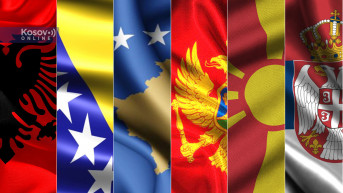
For decades, world diplomats have often referred to the Western Balkans as a “powder keg,” but how accurate is such a description today—and will the U.S. and the EU allow this part of Europe to once again descend into instability and armed conflict? Interviewees of Kosovo Online are convinced that Washington and Brussels will not allow that to happen.
Written by: Veljko Nestorovic
The situation today is entirely different from that of the late 20th century, when we witnessed the breakup of Yugoslavia. However, fiery statements from regional leaders are often heard for daily political purposes, suggesting that someone is once again threatening the security of the Western Balkans.
Of course, one should not forget that current U.S. President Donald Trump has repeatedly stated that he “prevented a war between Kosovo and Serbia.”
Kosovo President Vjosa Osmani recently said at the EPC Summit that preventing Serbia’s destabilizing tactics is key to ensuring a safe and stable Europe. Yet, given that statements by officials from Pristina about Serbian drones and troop buildups have routinely been denied by NATO, such claims, according to analyst Risto Nikovski, should be viewed as part of Pristina’s political rhetoric.
He believes that Washington is the key architect of the Balkans’ fate and situation, and told Kosovo Online that the United States will not allow any destabilization of the region.
“Let us not forget that a world war started here—right in the Balkans. But the context she presents is absurd. On the contrary, Serbia is doing everything it can to find a solution for Kosovo, which was illegally separated from Serbia—that must be emphasized. However, there is no understanding from the Kosovo side. Therefore, her rhetoric is entirely misplaced, and Serbia is the least of all the countries to threaten the Balkans’ security,” says the Skopje-based analyst.
According to him, Osmani’s statements that Serbia, after Russia, is the greatest threat to the security of the Western Balkans and Europe are part of Pristina’s official rhetoric.
“That’s part of their policy, which in fact no longer applies. We know what’s happening with the U.S., which is suspending certain important projects it has been conducting with Kosovo. But the key fact is that new axes are being formed in the Balkans—new agreements for a so-called peace—which, in reality, are creating preconditions for war when three countries make an agreement on a kind of military cooperation against Serbia. This undermines peace in the Balkans at the expense of the long-term interests of all nations, and what intrigues me most is Croatia’s role. We know about the misunderstandings, problems, and history between Croatia and Serbia, and forming any kind of pact against Serbia is absurd. This is how the peace and security of the Balkans—and of Europe as a whole—are being orchestrated,” he stressed.
Security studies researcher Nikola Vujinovic believes that Europe’s security depends on maintaining peace in the Western Balkans, and that frequent accusations by Pristina officials claiming Serbia threatens stability in the region are merely a case of shifting blame.
He emphasized that Kosovo’s President Vjosa Osmani and acting Prime Minister Albin Kurti use such narratives to justify their “treatment of the Serbian community in Kosovo, whose political and human rights are being violated.”
“They claim that the Serbs deserve such treatment—because of their past sins. But before the European Union, our supposed ‘sin’ is in the present—our conduct in international relations today, where we refuse to impose sanctions on Russia and seek to maintain a neutral status,” Vujinovic explained.
He added that, besides Kurti and Osmani, the same narrative is used by various leaders in Bosnia and Herzegovina, Montenegro, and elsewhere in the region.
“It’s the old saying—‘the thief crying stop thief.’ They’re trying to prove that the guilt for what’s happening now actually lies in what’s supposedly yet to come,” he said.
When asked whether the security of the Western Balkans is truly endangered—or could become so—Vujinovic replied:
“I don’t think there’s any cause for alarm. The essence is that we see the Middle East slowly calming down. This will certainly lead to de-escalation on the Ukrainian front as well, which suits Europe. Thus, Europe will be preoccupied with other matters rather than the Western Balkans. My belief is that European leaders will compel—if I may use that term—the Kosovo Albanians to stop the violence they are committing, will restrain Mr. Schmidt in Bosnia and Herzegovina, who is committing abuses there, and will encourage them to treat the Serbian community properly. That way, we’ll avoid any escalation of (in)security. What must be noted is that Serbia is the main stabilizing actor here, and as long as Serbia remains patient and avoids escalating the situation, there will be no real escalation.”
Professor of European Law at the University of Pristina Avni Mazreku told Kosovo Online that no one in the Western Balkans rejects NATO or EU membership—except the Republic of Srpska and Serbia.
“Serbia is neutral in terms of NATO membership but not in its choice of weaponry. The logical question is—why is so much being invested in arming Western Balkan countries? Against whom will these weapons be used? There are some explanations presented to citizens or officials of these countries, including Kosovo and beyond, about the interests behind military investments. In Eastern Europe, we have seen leaders from countries such as Poland, Estonia, Lithuania, Belarus, and Russia expressing readiness for war. Such a situation across Europe has not occurred since the end of World War II. We have never had such sharp rhetoric and certain actions relating to Europe’s instability as a whole,” Mazreku said.
He further argued that “in this context, Serbia can be qualified as playing a destructive role in maintaining peace in the Western Balkans.”
“And as long as Serbia is not constructive, it will be perceived as a conflict-driven state—one that has generated wars and remains distinct from Europe. In this case, I would agree that this region should be called Southeastern Europe rather than the Western Balkans, because the connotation fits better.
Therefore, Serbia must demonstrate sustainable peace, which can only be achieved by recognizing Kosovo and aligning itself under the so-called ‘transatlantic umbrella.’ The idea is for Serbia to become a full member of the EU, but also a full member of NATO, since NATO, since 1949, has been the only guarantor of peace and security on European soil,” Mazreku concluded.

0 comments