
Why does Biden connect the situation in Ukraine and the Balkans, and what does Kosovo's armament have to do with it?
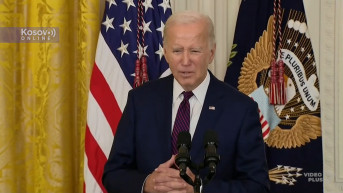
The fact that US President Joseph Biden linked the situation in Ukraine with the potential outbreak of new instabilities and security crises in the Balkans has caught the attention of many. This is particularly notable given that the region is not immune to heightened tensions, and these warnings from the White House came just a few days after the announcement that the US would arm Kosovo with anti-tank missiles, namely "Javelins".
Kosovo Online interlocutors, and experts on US foreign and security policy, believe that it's not the time to "sound the alarms". They point out that the key motives behind Biden's statement should be sought on the domestic political scene in the US, considering the upcoming presidential elections in November and a significant "fatigue" regarding support for Ukraine. However, they also emphasize the need for a careful analysis of Biden's messages.
According to them, some assessments are too strong, such as the one made by the President of Republika Srpska, Milorad Dodik, who claimed that Biden's statement was "calling for war in the Balkans". They stress that it is not in the interest of the US to open new fronts.
The US President stated that cutting financial aid to Ukraine could lead to crises in other places, including the Balkans.
"If we go, and Russia withstands their attack and defeats Ukraine, what do you think will happen in the Balkan countries? What do you think will happen from Poland to Hungary?" Biden asked in an address at the White House, warning that such a situation would "change the dynamics".
Assistant Professor at the Faculty of Political Sciences, Milan Krstic, believes that Biden's message about the potential ripple effect and the spillover of the conflict into other parts of Europe is given for domestic political purposes in the US.
"It seems that this statement is given in the context of the conflict of various opinions within the executive branch, led by President Biden and Congress, especially the House of Representatives, where Republicans have the majority, all about whether to continue funding the war in Ukraine. This is one of the debates relevant in the context of the upcoming presidential elections. Therefore, President Biden is now trying to raise the stakes, to depict how there will be a domino effect if, allegedly, Ukraine is not supported and how the conflict could spill over into other regions. So, the fear is actually heightened to win this domestic battle, which then has foreign policy repercussions because Ukraine is highly dependent on Western funding," Krstic highlighted.
When asked to comment on whether he thought Biden's stance was invoking war, as interpreted by the President of the Republika Srpska, Milorad Dodik, Krstic was firm that this was not the case.
"I think Dodik is making that statement for domestic reasons, so this is not a call to war, but it is, as I've already said, a kind of political exaggeration. In theory, this is called securitization or hypersecuritization when you designate something as an extreme security threat and attribute greater existential significance to it, as if it were a huge threat of war, more than it probably is at this moment, in my opinion. Dodik uses it, on the other hand, to show how such a statement is a threat to stability in the region, it's the same thing, just in the mirror," our interlocutor said.
Krstic emphasized that after Banjska, America's approach to the security situation in the region had been slightly recalibrated, and that it was one of the reasons why the "Javelin" had been put into procedure, i.e., the reason for the decision to deliver these anti-tank missiles to Kosovo.
"The 'Javelin' has not been officially delivered yet. America is now more focused on trying to create some balance on the ground. Of course, it is far from possible to create a balance on the ground and far from being legal, given UN Security Council Resolution 1244. I think that this decision is not good for stability in the region, but it is an indicator of a changed perception that did not come immediately after Banjska but is probably a long-term consequence of what happened in September in Kosovo and Metohija," Krstic concluded.
Vice President of the Forum for International Relations, Branka Latinovic, says for Kosovo Online that one should consider the conditions and context in which the statement about the spillover of the Ukrainian conflict to other regions was made. She also noted that this message came from the US President, who would not make such a statement lightly.
"Likely, this is the result not only of assessments of the situation on the ground but also of their vision, the vision of the US and Western circles, of how things could unfold on the European continent if Russia were to emerge victorious in the war in Ukraine," Latinovic says.
She emphasizes that the European landscape has changed and is no longer the same as in 2022 or 2023. Not only are things changing in Europe, but also in its surroundings. Latinovic refers particularly to the conflict in the Middle East between Israel and Hamas and the potential risks and wars associated with it. She notes that the risk persists, although not at the same level as before, but that future development remains uncertain.
"All of this shows that the Balkans retain their geostrategic importance as they always have. You can have a left, right, pro-Western, or Eastern government, but the Balkans, as a geostrategic area, always maintains its place because it leads to Greece, Turkey, and the Middle East. Probably, it was considered that the Western Balkans is not consolidated, not just in terms of not all countries in the region being NATO and EU members but also having two sensitive points - Kosovo and Bosnia and Herzegovina. This is primarily related to the political actions of Milorad Dodik, his performances, and the statements he makes. Most analysts today consider Bosnia and Herzegovina a greater risk than Kosovo, considering that Kosovo is under international security forces, primarily NATO forces, under control, and attention toward Kosovo has increased after everything that happened last year. I'm referring to the increase in the number of KFOR members, among other activities," Latinovic states.
She does not believe that the West, especially the United States, wants the security and political risk to increase in the Balkans because that would mean a failure of their post-conflict conflict resolution model, into which they invested a lot, including financial resources and human lives, as a significant number of their citizens were engaged in peace missions in the former Yugoslavia.
Latinovic disagrees with assessments, such as those of the President of Republika Srpska, Milorad Dodik, who claims that Biden is invoking war in the Balkans. She reminds that the Dayton Agreement was an American project, and the United States invested authority and other capacities to end that war with a peace agreement and to maintain that peace. She also highlights that Russia used its status as a witness in the Dayton Agreement to increase its political and geostrategic influence in Bosnia and Herzegovina, primarily through Republika Srpska and Dodik.
When asked if the intention of the United States to arm Kosovo with Javelin missiles could be related to Biden's statements linking Ukraine and the situation in the Western Balkans, Latinovic responds, "To some extent, yes".
She recalls events on the ground in Kosovo during the past year, conflicts with KFOR members during protests in the north, events in Banjska, and the stationing of a larger number of Serbian Army members and weapons in the Ground Safety Zone area, which, according to Latinovic, obviously was not synchronized with the main international actors and led to certain suspicions.
"That decision is, in fact, a kind of warning. It is an announcement; we do not know if it will actually happen and to what extent, but in any case, it has been announced, and one should carefully consider all its consequences. The methods of the international community are not the same as they were in the 90s or, if you will, a few years ago. There are not as many warnings or strong statements; they gradually unfold, but then you have surprises. Like the F-16 flights over Banja Luka during the celebration of RS Day, then the announcement of the sale of Javelins to KSF, the opening of a NATO base in Bulgaria near our border, and what is happening in Beli Manastir. A completely new approach is being created, a new method adapted to today's European military, security, and political landscape," Latinovic concludes.
Senior researcher at the Belgrade Centre for Security Policy, Vuk Vuksanovic, believes that the possibility of the conflict in Ukraine spreading to other parts of Europe, including the Western Balkans, is not realistic.
He tells Kosovo Online that it is not clear to many whether the President of the United States was actually referring to the Baltic or the Balkans. Our interlocutor points out that Biden has been a politician "notorious for rhetorical gaffes even in his younger days, and in recent years, it is noticeable, as a result of his age, that he sometimes confuses terms in his statements".
"Regardless of whether he meant the Baltic or the Balkans, or other parts of Europe he mentioned, such as Poland and Hungary, I don't see a real possibility of the conflict spreading. The Russian army has been struggling for two years to occupy Ukraine, so I don't see how they can have the capacity to go beyond that. Especially when we consider that the Balkans, including countries that are not NATO members, are covered by that security umbrella. I don't see what the real mechanism is based on which there could be some automatic repetition of war or any kind of security crisis," Vuksanovic emphasizes.
He highlights the context in which Biden made this statement, suggesting that it was likely in the service of internal political life in America.
"President Biden is primarily trying to overcome the opposition to further support for Ukraine by rhetorically 'inflating' the alleged Russian threat, given that there is an evident fatigue in both the domestic public and certain political entities in Washington and other Western capitals when it comes to this conflict," says Vuksanovic.
Asked about interpretations, such as the one expressed by the President of Republika Srpska, Milorad Dodik, that Biden is "calling for war in the Balkans," Vuksanovic sees Dodik's stance primarily as a "reaction for the sake of reaction, primarily to justify himself to his voters and to show himself as a strong leader."
"I won't say that I am 100% comfortable regarding instability in the Balkans, whether in Kosovo or Bosnia and Herzegovina, but I also have a moderately realistic view that it is a distant option for a full-scale war conflict to occur here," Vuksanovic states.
Regarding whether the US favors stability in the Balkans or not, our interlocutor points out that he is not sure if America can afford to open any new crises at a time when it is stretched into three major conflicts: the Ukrainian conflict, the Gaza conflict, and the intervention against Houthi rebels in Yemen.
"At a time when America is torn apart, when many are talking about the depletion of US weapon reserves, internal political crises, division in the US, especially in the context of the upcoming elections in November, I don't believe it is at all realistic to talk about such an engagement of Washington in the Balkans. On the contrary, I think it is in their interest to worry as little as possible about regions that are otherwise peripheral to US foreign policy," Vuksanovic is convinced.
He emphasizes that the US decision to supply weapons to Kosovo is multifaceted.
"On the one hand, it may be interpreted as a kind of political message from Washington to Belgrade: 'We cooperate with you, but be careful what you do.' It should also be noted that, for now, only the State Department has decided not to oppose the sale of 'Javelins' to Kosovo. The final decision on this is yet to be made in Congress. Also, in such a polarized and politically dysfunctional America, it is a question of how long congressional procedures can last. Even more importantly, even when the procedure in Congress is completed, the question is when this weaponry can be delivered, considering that the US has depleted significant strategic reserves of a whole range of its weapon systems through its support for Ukraine. 'Javelin' is a weapon system that is somewhere at the end, and it needs to be replenished," our interlocutor points out.
He adds that there are many uncertainties, but that there is no doubt there were multiple factors that certainly influenced those who gave the green light for the decision to deliver this weaponry to Kosovo.
"Anxiety about Ukraine partially contributed to that, the conflict in Banjska also partially contributed, and partially, the fact that the foreign policy elite in Washington is still somewhat divided on how to approach the ruling coalition in Belgrade, which some see as a potential problem and others as the only true partner in Belgrade," Vuksanovic concludes.



comments