
Will the Hague verdict on Thaçi and other KLA leaders affect relations between Belgrade and Tirana?
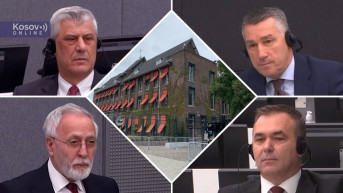
Serbia and Albania hold fundamentally different views on the goals and nature of the Kosovo Liberation Army, which is why the forthcoming verdict of the Kosovo Specialist Chambers in the case of Hashim Thaçi and three other former KLA leaders is unlikely to satisfy either side. Regardless of the decision expected soon, analysts in Belgrade and Tirana assess that each side will interpret it in its own way, but that it will not negatively affect relations between Serbia and Albania.
Written by: Dusica Radeka Djordjevic
In a show of support for former KLA leaders — Hashim Thaçi, Kadri Veseli, Rexhep Selimi, and Jakup Krasniqi — thousands gathered in central Tirana in October last year.
The position of Edi Rama toward the Special Court has been clear since its establishment. He has sharply criticized it, calling it a “theater of shame of international justice,” while regarding former KLA leaders as figures of a liberation struggle.
After Chief Prosecutor Kimberly West on 9 February requested that the accused be found guilty on all ten counts and sentenced to unified terms of 45 years’ imprisonment, the Assembly of Albania adopted a declaration on 12 February expressing concern that such a request risks creating a dangerous distortion of history.
From Belgrade’s perspective, however, the KLA is viewed as a terrorist organization responsible for numerous crimes against Serbian civilians. Commenting on the case, Milovan Drecun, Chairman of the Serbian Parliament’s Committee on Defence and Internal Affairs, expressed confidence that the Specialized Prosecutor’s Office has proven the accused responsible for crimes against humanity and war crimes.
The first-instance verdict is expected no later than July. According to Aleksandra Joksimovic, Director of the Center for Foreign Policy in Belgrade, the ruling will certainly resonate, but regarding its impact on Serbia–Albania relations, she notes that the two countries have found a way to bypass the contentious issue of their respective stances toward Pristina.
Joksimovic emphasizes that Hague court rulings have historically had a significant impact on the broader region, but in this specific case, she believes the decision will primarily affect internal political dynamics in Kosovo.
“As the English would say, Serbia and Albania have an ‘elephant in the room,’ which is their relationship toward Pristina. However, I believe a modality has been found to circumvent this issue so that all other aspects of cooperation can develop appropriately, as needed for the region,” Joksimovic told Kosovo Online.
She added that any verdict will be subject to differing interpretations.
“Everyone will interpret it in line with their own perspective. Will it resonate? Yes. But will it have long-term impact? I don’t believe so, because such rulings are eventually overshadowed by new political dynamics,” she said.
According to her, relations between Serbia and Albania currently exhibit a new dynamic, particularly in light of the joint letter sent by the two countries’ leaders to the European Union.
“These relations have their own dynamics and constantly shifting amplitudes,” Joksimovic concluded.
Albert Rakipi, President of the Albanian Institute for International Studies, shares the view that the Hague verdict will not negatively affect Albania–Serbia relations, but will instead influence political developments within Kosovo.
“I hope and believe the decision will be in favor of Kosovo’s leadership, as initial accusations and investigations into organ trafficking and other matters proved completely unfounded. Of course, the Hague decision will impact internal politics in Kosovo for some time. But I do not think it will affect relations between Albania and Serbia, because Kosovo is a third country—for us,” Rakipi said.
On a scale of one to ten, Rakipi rates Albania–Serbia relations at seven, describing them as currently in a form of status quo.
“I use the same grade for my students—not to punish them, but to encourage improvement. There is room for Albania and Serbia to develop relations, always avoiding debates and issues that are not directly part of their bilateral agenda,” he added.
Rakipi recalled that during the past decade there were positive developments, particularly in 2014–2015, when relations advanced under the pragmatic formula “we agree to disagree.”
“Many of us believed that both leaderships would continue to build relations on that basis. Unfortunately, over the past ten years, they have moved away from this approach and instead adopted intermediary and populist methods regarding a third party—Kosovo,” he said.
He also pointed to Federica Mogherini, who in 2015 took the initiative to mediate between Albania and Serbia, questioning the necessity of such mediation.
“There is no conflict, territorial dispute, or similar issue between Albania and Serbia, as Kosovo is a third country. So the question was—what exactly was being mediated?” he noted.
Deliberations in The Hague in the “Thaçi et al.” case are currently ongoing. According to a statement issued two weeks ago by the Specialized Chambers, judges have begun confidential deliberations following the conclusion of the trial.
“Following the closing of the trial, deliberations have commenced. In accordance with the Rules, during confidential deliberations, each judge presents their views and conclusions on each issue under consideration. The judges will assess each piece of evidence in light of the totality of evidence presented at trial. Guilt is established only if the Trial Panel is satisfied that it has been proven beyond a reasonable doubt,” the Specialist Chambers stated.
The indictment against the four former KLA leaders charges them with war crimes and crimes against humanity allegedly committed between March 1998 and September 1999 at multiple locations in Kosovo, as well as in Kukës and Cahan in northern Albania.


0 comments