
Lucic: Telekom has remained in Kosovo thanks to the Brussels Agreement, despite pressure from Albin Kurti
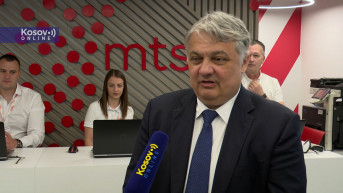
The CEO of Telekom Srbija, Vladimir Lucic, stated that the company has remained operational in Kosovo thanks to the Brussels Agreement, adding that Telekom is “a thorn in the side” of acting Prime Minister Albin Kurti.
“The Brussels Agreement is an excellent framework, and it is regrettable that the international community in Europe and the United States was not sufficiently resolute in pressing the Albanian side to implement all of its provisions, as that would have made things much easier for us. Telekom Srbija has endured as a company that now employs around 250 people and provides services to 30,000 households. Those households have internet, television, and mobile telephony thanks to that agreement,” he told Newsmax Balkans.
According to him, Kurti’s administration is causing significant harm to the Serbian community.
He recalled that one key provision of the Brussels Agreement has not been implemented in the field of telecommunications—namely, the tender for a third operator license.
“They are unwilling to announce a tender for the third license because they know we would win. They are also aware that we are technologically and financially far stronger than the two existing operators. They even face issues with their sole state operator, which originated from the seizure of Telekom Srbija’s assets in 1999. But what is taken unjustly brings consequences. Their position is so weak that the state must subsidize them every year, so they know that a large share of the Albanian population would use our network. Our company operates flawlessly there, and our service functions without interruption. Our employees in Kosovo and Metohija are heroes, and I must thank them for their continuous dedication over the years,” Lucic said.
“The ultimate objective of Kurti’s administration is to push out Serbs and make their lives as difficult as possible. We are a kind of obstacle for them. With the support of the U.S. and Brussels administrations, we have managed to defend our position thanks to the Brussels Agreement, and currently we face the greatest challenges because Kurti’s administration is reluctant to allow our expansion,” he added.
Speaking about Telekom’s projects, the CEO highlighted the planned launch of a Serbian telecom card in the United States.
“It will be a U.S.-based card with a package priced at $29, allowing users to watch television channels as well. It is a very attractive package for the U.S. market, offering unlimited domestic calls. With a U.S. number, users will be able to call subscribers in Serbia, Bosnia and Herzegovina, and Montenegro without limits, and vice versa. When you come to Serbia, you will not need an additional card, as this one will have no roaming charges. For $29, users will get a card with a significant amount of data in the U.S., free domestic calls, and access to our TV channels. I believe it will be highly competitive,” Lucic said.
Asked whether it is realistic to expect the abolition of roaming charges with the European Union as early as next year, he said he remains hopeful.
“Roaming prices are already significantly lower than before. Once we become integrated into the single market, it will mean you no longer have to think about roaming at all. The price of your package in Serbia will apply anywhere in Europe. I believe this will happen by 2027, and of course the European Commission plays the key role. I am pleased that telecommunications have taken the lead in this process. It is encouraging that the single market will first come to life in the telecommunications sector between the Western Balkans and the rest of Europe,” Lucic concluded.
0 comments