
Elek: Outstanding result – Serb List won 42,166 votes in Serbian areas, Rasic 3,411
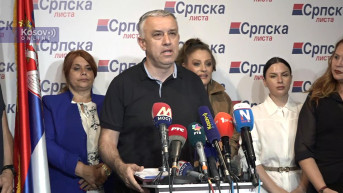
President of the Serb List, Zlatan Elek, stated this evening that the party had achieved an outstanding result in the snap parliamentary elections despite arrests and pressure. He pointed out that the Serb List won 42,166 votes in Serb-majority areas, while the party of Nenad Rasic received 3,411 votes, noting that Pristina was once again engaging in political engineering by adding votes from Albanian-majority areas to Rasic’s tally.
At a press conference, Elek announced that, according to preliminary results, the Serb List had secured 42,166 votes.
“These are votes from Serbian communities. In December last year, the Serb List won 41,989 votes,” he added.
Elek noted that Nenad Rasic received 3,411 votes in Serbian communities, compared to 4,083 votes in December.
“I would like to thank the Serbian people throughout Kosovo and Metohija for these excellent, outstanding results,” he said.
He also conveyed congratulations from Serbian President Aleksandar Vucic and the state leadership on the election results.
Elek presented detailed, albeit still preliminary, voting figures from Serb-majority municipalities. According to these figures, the Serb List won 5,094 votes in North Mitrovica, while Nenad Rasic’s party received 248 votes.
In Zvecan, the Serb List won 3,148 votes compared to Rasic’s 124, while in Leposavic, 5,475 voters supported the Serb List and 615 voted for Rasic’s party.
According to figures from Zubin Potok, the Serb List received 2,831 votes, while Nenad Rasic won 149.
In Gracanica, 7,655 voters supported the Serb List, while Rasic received 841 votes.
Likewise, in Strpce, the Serb List won 3,973 votes compared to 432 for Rasic’s party, while results from Novo Brdo show that the Serb List received 3,173 votes and Rasic’s party 90.
“Unfortunately, as has become standard practice, votes from exclusively Albanian areas are now being added. We are witnessing extremely serious political engineering by Pristina,” Elek stressed.
He cited figures from Albanian-majority municipalities where, according to him, Serbs have not lived for decades. In Decani, Rasic won 30 votes; in Gjakova, 77; in Glogovac, 13; and in Kacanik, seven votes. In South Mitrovica, where Elek said only one Serbian Orthodox priest and his family reside, Rasic’s party received 73 votes.
“The absolute record was set in Prizren, where Rašić won 432 votes, while in Suva Reka he received 76 votes,” Elek said.
He emphasized that the Serb List was highly satisfied with the result despite what he described as electoral engineering.
“I am grateful to the Serbian people and to the activists of the Serb List for their tireless and dedicated work. They have demonstrated their love for their country, for President Aleksandar Vučić, for the Serbian tricolor, and for the Serb List. All trends show growing trust in the Serb List. I believe that, as it has done so far, the Serb List will continue to represent every Serb. We will fight with even greater determination for every Serbian family,” Elek said.
Asked whether he had any additional information about the two Serbs arrested in Goraždevac, Elek replied that he knew nothing beyond what had already been reported publicly.
“We know nothing more. They have lawyers, but it would not surprise me if they were also placed in detention for up to 30 days, because that is Pristina’s established pattern—that every Serb is considered guilty before it is even determined whether they are actually guilty,” Elek said.
Regarding the low voter turnout across Kosovo but high turnout in Serbian communities, he recalled that Serb List representatives had consistently called for unity and solidarity during campaign rallies, which, he said, had been achieved. As for the results in Albanian-majority areas, he said he would refrain from interpreting them.
Elek added that it was too early to discuss any form of cooperation with Albanian political parties and stressed that the Serb List’s election results remained the most important issue at this stage.

0 comments