
Rasic: Who the Prime Minister is should not concern us; It’s time for Serbs to return to the police and judiciary
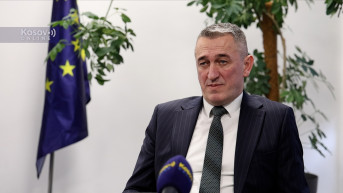
Nenad Rasic, a candidate from the For Freedom, Justice, and Survival party and its leader, expects that efforts will intensify after the elections to achieve more concrete results in the dialogue between Belgrade and Pristina. He emphasized that it is time for Serbs to return to the police and judiciary because, without Serbian representatives, the security of Serbs will not be at an adequate level.
In an interview with Kosovo Online, Rasic stated that the dialogue between Belgrade and Pristina still exists and that he expects concrete steps regarding the Association of Serb Municipalities (CSM) after the February 9 elections.
He added that the return of Serbs to Kosovo institutions is always timely, but it will take a long time to restore the situation to what it was before Serbs withdrew from certain institutions in the north.
What is the fate of the dialogue, and how can it be revived?
The dialogue is ongoing. From time to time, we see some results, even though they are small steps, and even though they do not address the numerous accumulated issues, things are still moving forward. I know that after the elections, in the spring, diplomatic efforts will intensify to achieve something more practical, concrete, and dynamic.
In this regard, I expect new topics to be brought before the negotiators, and likely one of the key issues post-election will be the Community of Serb Municipalities, which could inject new momentum into the process. The entire concept of the CSM has been a central point in discussions so far. In my opinion, it will be part of a broader set of agreements, rather than a standalone issue.
I have previously mentioned that the Prime Minister conditionally accepted the CSM's design about a year and a half ago, but the details still need to be worked out—especially regarding the unpublished draft that surfaced. It is expected that this will be discussed in more depth after the elections.
Is it time for Serbs to return to institutions (police, judiciary)? What are the prerequisites, and with which potential candidates for Prime Minister could this be realized?
The time is always right. Fortunately, in the judiciary and prosecution, a technical error was avoided, unlike in the police force. Police officers were forced to sign official resignations, which were processed through the system, making their return legally difficult under Kosovo’s civil service laws.
This was a major mistake, as now, even if young Serbian officers are recruited, it will take four to five years to restore the previous operational level. More importantly, it is not just about numbers—what truly matters is the presence of Serbs in command positions—chiefs, commanders, officers—who should serve within the system. Personnel policies within institutions are crucial.
We should not be concerned about who becomes Prime Minister. What matters is having clear goals and demands, which any Prime Minister should be expected to address—namely, the return of Serbs to institutions and the strengthening of Serbian representation in critical sectors such as the police and judiciary.
In the judiciary, the situation is somewhat more favorable because judges and prosecutors did not officially resign with stamped and verified resignations. To my knowledge, the Judicial Council has not received nor confirmed any resignations, meaning that these professionals can still return to their positions.
This should be our top priority after the elections. Perhaps organizing meetings, consultations, or direct discussions with former judicial and law enforcement personnel would be beneficial—to understand their concerns and conditions for returning.
I've previously stated that rebuilding Serbian personnel in the police force will take four to five years, but in the judiciary and prosecution, it will take even longer—between seven and ten years—to fully train a judge. These processes are difficult and require time. We must engage with judicial and prosecutorial bodies, appeal to them, and explore ways to reintegrate Serbian professionals into the system.
How to Improve the Security of Serbs in Kosovo?
Without Serbian presence in the police, judiciary, and prosecution, many legal issues can be misinterpreted or left unresolved. There is a lack of trust in the system, particularly concerning security incidents in northern Kosovo. However, similar concerns exist in southern areas, where Serbs also face violations of their basic rights.
These issues cannot be solved by an individual minister or politician—they require systemic solutions.
As a reminder, when we adopted the Strategy for the Protection of Community Rights and Interests, one of the main objectives was to ensure proportional representation of non-Albanians in public administration.
If this principle is not upheld, then legal uncertainty and institutional mistrust will continue, making it even harder for Serbs to feel safe and secure in Kosovo.
From a technical standpoint, this means that Serbs must be present in key institutions such as the Ministry of Health, Ministry of Justice, police, and Ministry of Internal Affairs, as well as all other bodies responsible for protecting rights and enforcing laws.
If we do not have Serbian representatives in institutions, we cannot effectively protect citizens. It is crucial to have qualified professionals who share the same goal within our representative structures—the protection of fundamental human rights. This is not just about non-Albanians or minority rights but also about safeguarding vulnerable and marginalized citizens.
Legal provisions can often be interpreted differently, and while laws may be written the same for everyone, in practice, some articles of law are enforced selectively. There have been numerous instances where Serbs were the disadvantaged party due to such legal interpretations.
Law interpretation is crucial, which is why we must have experts who understand their roles and apply the law as it is written, without bias or political influence.
Kosovo Online invited all six Serbian parties participating in the upcoming elections to answer several key questions concerning the Serbian community in Kosovo. By the deadline, representatives of three lists responded, while the Party of Kosovo Serbs, Serb List, and the Civic Initiative "People’s Justice" did not provide answers to our portal.


0 comments