
Dacic: Kosovo will never become a member of the OSCE, because Serbia will not agree to it
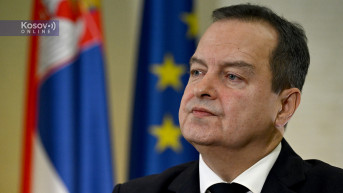
The Minister of Foreign Affairs of Serbia, Ivica Dacic, emphasized in an interview for Kosovo Online that Kosovo would never become a member of the Organization for Security and Cooperation in Europe (OSCE) because decisions in this international institution were made by consensus, and Serbia would never agree to it.
Do you expect the region and the relations between Belgrade and Pristina to be on the agenda of the OSCE Ministerial Council, given the acute hotspots in the world? Will you point out the current situation in Kosovo during the meeting in Skopje?
Certainly, that is an integral part of what we discuss. We constantly deal with it since the headquarters of the OSCE are in Vienna, and it is discussed at every meeting. We condemn the decision not to allow voting in Serbian elections in Kosovo because it is absolutely contrary to everything we agreed upon in the Brussels Agreement. After the Brussels Agreement, elections were organized, and this refusal is now an obvious intention of Kurti's regime to reject anything that has any indications of an agreement and to show that they are an independent state. The only thing they can discuss with us is recognizing Kosovo, which is absolutely unacceptable for us. Of course, there is also the OSCE mission in Kosovo. We ask them to be objective, status-neutral, and contribute to the protection of the Serbs living there.
There have been several attempts to enable Kosovo's membership in the OSCE; what is the current situation?
There have been verbal statements, especially from Albania. What is good about the OSCE is that Kosovo can never become a member of that organization because consensus is required for it, and Serbia will never agree to it. The decision-making process is such that decisions are made unanimously. This means that Serbia should agree to it, and Serbia will never agree to it. It is absolutely impossible.
The OSCE Ministerial Council is taking place at the end of the week; what do you expect from that meeting? What conclusions do you expect at this summit?
Unfortunately, the OSCE has become an organization where there is a great disagreement, considering the decision-making and functioning, and the fact that it is an organization that emerged from the need to overcome conflicts between two blocs at that time. The principle of decision-making by consensus was introduced, making it almost impossible to make any important decisions concerning security in the area stretching from Vancouver to Vladivostok. There are many unresolved issues important for the organization's functioning, such as the budget, the election of new leaders for several key segments of the OSCE, including the question of the Secretary General, the head of ODIHR, the High Commissioner for Human Rights, and the Representative on Freedom of the Media. Everything is in question about what can be agreed upon in the coming days. As far as I have seen, they allowed the overflight to Russian Minister Sergey Lavrov, which means that there will be a changed situation compared to the previous ministerial meeting in Poland, where he was not invited. This was done out of the need for everyone to sit together and try to reach certain compromise conclusions.
Is the agreement on Malta becoming the next OSCE chair indicative that it is still possible to reach conclusions and decisions in Skopje?
I think negotiations are still ongoing regarding whether that will indeed be the proposal that everyone will agree upon. This is one of the unresolved issues, still being discussed until the last moment. Conflicts that exist, significant mistrust, and the blockade of the work of certain institutions within the OSCE lead to questioning whether this organization can function at all. I would like to remind you that this organization was supposed to be an institution aimed at conflict prevention and as a platform for dialogue between different parties. This is currently not being utilized, and the very essence and reason for the existence of such an organization are being called into question. Serbia will, of course, be constructive. We have always been constructive, and we are a country that was among the founders. Right after the Helsinki Conference, a conference was held in Belgrade, and Tito participated in the first conference in 1975. We will strive to contribute to a consensus that will be very difficult to reach.
Serbia chaired the OSCE in 2015 when the world was already facing the Ukrainian crisis. At that time, you said, "We are facing one of the greatest challenges since the founding of the OSCE. Instead of the spirit of cooperation, mistrust now prevails”. Is the situation now even worse?
Now it is even worse because, in the meantime, there has been a full-scale war between Russia and Ukraine. This has practically led to the paralysis of the work of many international organizations, with the OSCE being the most affected. The OSCE also has its missions in the field. This entire crisis calls into question the existence of all these missions, from budget to personnel issues, and especially the issue of making certain decisions, which is impossible under these conditions. The situation today, eight years after our chairmanship, is even worse.
In these circumstances, how much can the OSCE continue to exist, considering that the Treaty on Conventional Armed Forces in Europe, one of the main documents on which the OSCE relies, is also suspended?
It can continue to function only if there is a political will to engage in mutual dialogue. It can exist as a good platform for discussion. If that is lacking, then the essence and purpose of the organization are called into question. I hope that there will be some progress in Skopje, at least in terms of everyone participating and with Russia being there so that certain decisions can be made. The Minister of Foreign Affairs of North Macedonia, the current chair of the OSCE, Bujar Osmani, stated that Western countries, including the United States, had initiated allowing Lavrov to attend, to provide a platform for discussion. I don't know if there will be bilateral meetings at that level, but there will certainly be a multilateral gathering where each will present their perspective. Certainly, there will be a lot of debates, and on most issues, they will not agree, but we hope that there will be at least some reduction in tensions.
Can a small country like Malta achieve consensus during its chairmanship?
There were other countries in the running. There was no agreement from one hemisphere or the other. Perhaps Malta was a compromise solution acceptable to both sides. The size of the country is not as important as whether there is a political will to engage in dialogue.
The deadline for voter registration abroad has expired. How many people have applied, and how many polling stations will be open?
The unified voter register has not been finalized yet, but more than 40,000 people have applied to vote abroad. There will be 81 polling stations open in 35 countries, which is the highest number of both applicants and polling stations since 2004 when such voting became possible. We are satisfied with how it has been handled. Some polling stations are in diplomatic and consular representations, and others are in locations for which the host countries have given consent. I hope there won't be any issues, and everyone will be able to exercise their right to vote. Unlike previous years, more people have applied, and there will be more polling stations open. I agree that 40,000 is a small number compared to the total number of people living abroad. However, for voting, they need to register and apply. This is something we all need to work on together in the coming period.
0 comments