
Escobar: Kosovo to form the CSM, and Serbia to stop blocking the European and international integration of Kosovo
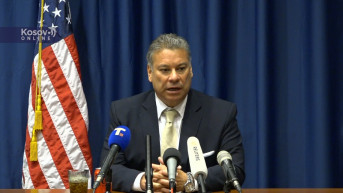
The Special US Envoy for the Western Balkans, Gabriel Escobar, says that a way must be found to de-escalate the situation and to implement the Ohrid Agreement - for Serbia, this means to stop blocking Kosovo's European and international integration, and for Kosovo, starting the process of implementing the Community of Serb-majority Municipalities.
Escobar, in an interview for the Institute for Politics and Economics of Southeast Europe (IPESE) from Belgrade, which recently started its work, said that the United States of America would continue to advocate for the progress of the Western Balkans and see it as an area of enormous opportunities that should be fully integrated into the European Union.
If the United States of America, Escobar pointed out, had a greater role in decision-making, by 2030, the entire region would be within the EU. He sees a very positive future for Serbia and the region as a whole and wants Serbia to be more firmly "anchored in the community of friends that the US has in Europe". When it comes to the relationship between Belgrade and Pristina, Eskobar points out that it is necessary, without delay, to start the process of implementing the Community of Serb-majority Municipalities.
The current situation in Kosovo - turbulence, tensions, what can you tell us since you were there, I think two or three days ago? What is the situation? What's going on there? What can we expect?
Yes, what we had in Ohrid - we reached an agreement. A legally binding agreement that opened the door to a peaceful, constructive, and predictable relationship between Serbia and Kosovo according to European rules. When we left Ohrid, we left optimistic. In the two months since we reached that agreement, we have had many political crises, and I would say that they were all predictable and could have been avoided. So we have to find a way to de-escalate the processes immediately, to de-escalate the situation, and immediately return to the focus on the implementation of the Ohrid Agreement. For Serbia, this means to stop blocking Kosovo's European and international integration. For Kosovo, this means the beginning of the implementation process of the Community of Serb-majority Municipalities. We need to work on both things immediately.
Ambassador Hill noted that now the Serbian side was cooperating in a very good way, and that Serbia was a reliable partner. But he also added that he was not sure that Mr. Kurti, the Prime Minister, was, as he said, "our partner", i.e. that he was a partner of the United States of America.
I have to make this clear - Mr. Kurti is our partner. He is sometimes a difficult partner, but he is a partner. Kosovo is our partner. Serbia is our partner. So, in the future, we want to use the good relations we have with Kosovo and the improvement of relations we have with Serbia to find a way, to find a mutually acceptable and mutually beneficial way so that both can be part of the European Union together. And not only that but for both of them to help open the door to integration for the rest of the region. So we want to use our good relationship to help the mediation in the future.
In the last few years, the governments of the United States of America, research centers, and politicians have been advocates of long-term prosperity, stability, and healthy diplomatic relations in the Balkans. Will the United States continue to pursue these goals?
Absolutely. We will remain very engaged in the Western Balkans. So I want to start by saying that even though the news is dominated by tensions and political problems. For the United States government, the Western Balkans remains an area of tremendous opportunity. The defining characteristic of the Western Balkans right now is really strong economic growth and strong economic potential. The region has the potential to be a leader in IT, transport, energy, infrastructure, and even tourism. The region has excellent universities, a talented workforce, and a relatively young workforce. So we will continue to invest in that and hopefully, that investment in the future of the region will help overcome some of the political problems.
At the beginning of your term, you were very enthusiastic. You even said that you would do your best to bring the countries of the Western Balkans into the European Union. Do you still have that enthusiasm?
I have and I think young people in the region have that same enthusiasm. Look, to be honest, in terms of growth rates, the region is a market of about 20 million people, an economy of about €120 billion with an average growth rate of seven percent or more. That is almost five percent more than in some larger countries of the European Union. So the Western Balkans, when fully integrated into Europe, will be a driver of economic prosperity, a driver of job growth, and I'm still very enthusiastic about that. The challenge now is whether the region's leaders also see that possibility, or whether they will remain entrenched in their current mindset of ethnic rivalry and political crisis permanently.
Could you tell us how you see Serbia in 2025-2030?
If the United States had a greater role in decision-making, by 2030 the entire region would be within the European Union. But in the meantime, by 2030 we expect investment in the economy to start creating real opportunities. I assume that by 2030, all the countries of the region will be on a good path to fulfilling all the conditions for full membership in the European Union, that they will go a long way to reduce corruption and open opportunities for young people to have a long-term economic future in the region. So I see a very, very positive future for Serbia and the region as a whole.
Can you tell us something more about the Open Balkan as the basis or beginning of the cooperation of the countries in the Western Balkans? There is still no Montenegro, no Bosnia, and that means it is not complete.
You see, I think the most important part of any economic integration plan has to be alignment with the European Union. The European Union, that is, trade with the European Union, accounts for about 70% of the region's total trade. So, in other words, focusing on the European market is absolutely crucial. The European Union has already set some guidelines and metrics through the Berlin Process. Therefore, the Berlin process must be in focus, but in the meantime, we support all economic items that bring the region closer to Europe, as long as they do not undermine the countries' commitment to the European Union, and as long as they are open to everything. In a way, you can say that if two or three, or four countries decide they want to do their homework in advance, then that's fine as long as that homework is within the requirements of the Berlin Process. So, we do not support one or the other, or one more than the other, but we support everything that brings the region together.
Can the Serbian population, the Serbs, and the Serbian state count on the US to continue to cooperate closely with Serbia and help Serbia to achieve membership in the European Union?
Yes, absolutely, we will be strong advocate for membership. As for our relationship with Serbia - for more than 140 years, the United States of America has had a strong relationship with Serbia. All that time, it was a very positive relationship with the exception of the years of Milosevic's rule. So, that was the only period in which the US and Serbia were not close friends. On the American side, the door to reestablishing that relationship is open, and at the same time, our relationship with Serbia should not endanger anyone else. We continue to have strong strategic partnerships with Montenegro, North Macedonia, and Albania. And we want the same relationship with Kosovo and Bosnia and Herzegovina. Therefore, we want Serbia to be more firmly anchored in the community of friends that the US has in Europe.
Is there anything exclusive that you can share with us or is there nothing exclusive after all? We read in the paper that you visited the White House this morning.
I was invited to give a briefing to the White House about the results of the trip to Belgrade and Pristina. Based on progress, or lack thereof, we will have to decide our course of action.
There are elections in Montenegro. Let's hope the right party wins.
I hope. Every party in Montenegro that is focused on European integration, that is opted for Montenegro's membership in NATO and is dedicated to the fight against corruption, can count on our support.

comments