
Gärtner: The Board of Peace cannot replace the UN; the U.S. is creating allies this way
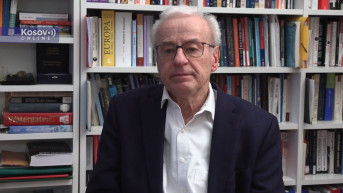
It appears that today the law of the stronger prevails, but that does not mean international law no longer exists, and one can still hope that the world will return to it, says Heinz Gärtner, Professor of Political Science at the University of Vienna, in an interview with Kosovo Online.
Speaking about the Board of Peace, initiated a few days ago in Davos, he describes it as an attempt by Donald Trump to create his own world as a counterweight to China and to create allies for himself, which is why he does not believe it can replace the United Nations, nor help resolve the Kosovo–Serbia issue.
What does the international order look like at the beginning of 2026?
It seems that the law of the stronger prevails, because there have been many violations of international law—the entry of Russia into Ukraine, the bombing of Iran by the United States, and the abduction of President Nicolás Maduro in Venezuela. However, when major powers do not adhere to international law, the fault does not lie with international law itself, but with the major powers. That does not mean that the norm of international law disappears. The fact that great powers behave as they do does not mean that international law does not exist. We can still hope that the world will return to other norms, instead of the law of the stronger.
We are in a world of polarization, in which conflicts among great powers exist. Great powers fear decline. Russia’s incursion into Ukraine shows Russia’s fear of falling out of the competition among great powers. Russia is no longer a great power, but a regional power with nuclear weapons. It is surrounded by NATO states, has lost allies in Latin America, and has lost economic strength. We once had three great powers; now only two remain—the United States and China. We are moving toward U.S.–China bipolarity.
Can the Board of Peace replace the United Nations?
I do not think so. The United Nations have a completely different concept; they are founded on the sovereign equality of member states. All countries of the world are represented in the UN General Assembly, and there is a Security Council agreed upon by the member states. In the Board of Peace, there are only a few countries that have effectively bought their place. In a bipolar world, this appears to be Trump’s attempt to create his own world as a counterweight to China. There is an imperial relationship within it, similar to Rome’s relationship with its provinces. Of course, there is indirect voluntariness in joining, although it is costly. The Board of Peace is an attempt to create a separate world, but it will not be able to replace the UN Security Council. The only veto right in the Board of Peace belongs to the United States.
Is there a risk that the United States might leave the United Nations or stop paying, thereby weakening the UN?
I do not believe the United States will withdraw from the United Nations. However, major powers no longer adhere to UN decisions; in major conflicts, they use their veto. At the same time, they want to retain the right of veto. We are dealing with a parallel world. Yes, the UN Security Council has been weakened by the behavior of the great powers. The United States will try to keep one foot in the UN. Of course, it will try to weaken the UN, but I do not believe it will succeed through this Board of Peace. It seems to me that the Board is a new alliance with dominant American influence and has no multilateral effect. Multilateralism means that all states have equal rights, which is not the case here. Through the Board of Peace, the United States is creating allies for itself.
Donald Trump has said he ended eight wars and now wants to end the war in Ukraine as well. Can the Board of Peace deal with preventing and ending wars instead of the UN?
The states that are represented can already do that. Qatar, for example, has taken on mediation roles in the past and helped build bridges in major wars. These mediation capabilities already exist among states. The eight wars Trump claims to have ended are probably only short-term agreements between states, and if there are no substantive peace agreements, those conflicts will start again. The United States can, like smaller states, act as a mediator. It has economic leverage and Trump gladly uses it. But this does not resolve the underlying issues that caused the conflict.
The Kosovo issue has not yet been resolved. It was first under the UN, and now negotiations are conducted under EU mediation, without success. Can the Board of Peace bring a solution?
I do not believe the Board can achieve what others have tried and failed to do in Kosovo. The parties to the conflict are not represented there, so any solution would be imposed. When mutual disputes are not resolved internally, there is no sustainable peace. There are other mediators as well; it does not have to be the Board . The European Union has greater capabilities than the Board of Peace.
Has the European Union been weakened by its confrontation with Trump?
The European Union was restrained when it came to violations of international law in the bombing of Iran and the intervention in Venezuela. Trump clearly does not want to consult the EU. On Greenland, the Union threatened countermeasures if the United States were to take over Greenland. A sale is still on the table, and there is no intention of a military takeover. Public sentiment in the United States toward Greenland is negative. I believe Trump made an agreement—not with the EU, but with NATO. Most likely, NATO will assume the costs of U.S. bases in Greenland. Greenland will probably be integrated into NATO strategies. NATO will bear the costs, while sovereignty over the bases remains with the United States, because in the NATO Council the United States has the strongest voice. Europeans will bear the costs. That now seems to be the arrangement.
Could Austria, as a neutral country, join the Board of Peace, and should it do so?
Austria has the capacity to act as a bridge-builder, but it has not used it. The question is how compatible this would be with Austria’s neutrality if the Board were to have a military component. Austria has advantages: it is the only EU country with the same status as most states of the Global South—it is non-aligned and does not possess nuclear weapons.
Historically, only Yugoslavia played the role of mediator in the 1970s and 1980s. Yugoslavia was active in the process of the Conference on Security and Cooperation in Europe (CSCE) and had a leading role among the Non-Aligned Movement. Austria should assume such a role within the EU. I see no advantages for Austria in joining the Board of Peace.
How will international law develop in the future?
After every conflict, the world has tried to establish new common rules. After the First World War, this was the League of Nations; during the peak of the Cold War, it was the CSCE/OSCE, which attempted to introduce rules for East–West conflict, common norms and principles. Common security was placed at the forefront, and terms such as “enemy” or “opponent” were avoided.
As for the future international order, it should build on that principle. We saw what happens when the principle is violated, for example during the Cuban Missile Crisis, when Cuba asserted its sovereignty and deployed Russian missiles. As far as Europe is concerned, there needs to be an understanding of how this principle can be reapplied. The Board of Peace does not have it, which is why it cannot bring peace. It does not contain the principle of the indivisibility of peace and security. As an alternative to the Board , Europe could strengthen the OSCE again.
The Greenland issue showed that European countries demanded respect for territorial integrity and sovereignty, which was not respected in Serbia’s case. Was that a precedent that led to frequent violations of international law?
NATO’s intervention in Kosovo, carried out without UN approval, is not the reason Russia entered Ukraine. Russia had its own reasons. The European Union applies double standards. In the case of Greenland, it emphasizes the inviolability of borders and sovereignty, insists on international law, and rejects a violent solution. Yet the Union remained silent on the bombing of Iran and the intervention in Venezuela. These were clear violations of international law. The EU was engaged in response to Russia’s invasion of Ukraine. Now it stresses sovereignty and the prohibition of the use of force regarding Greenland, while in other cases it did not speak up. That causes damage to the Union.




comments