
Kupchan: A model of autonomy that satisfies the Serbian community in Kosovo must be found
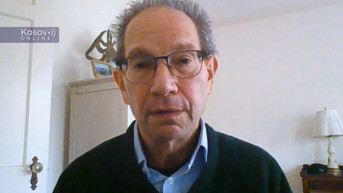
Charles Kupchan, a member of the American Council on Foreign Affairs and a professor at Georgetown University, in an interview with Kosovo Online, says that it is obvious that there is pressure from the US and the EU on both sides, both on Pristina and Belgrade, in order to reach an agreement, but he also points out that he does not want to predict whether and what will be signed at the next meeting in Ohrid.
"I think that for those of us who would like to see the normalization of relations between Kosovo and Serbia, there was some disappointment with the outcome of the meeting in Brussels. We expected that Kurti and Vucic would sign the agreement, but they still did not do it. Now, having said that, what we could see from the media reports and the actors' statements, the glass is still more half-full than half-empty in the sense that both parties did not give up on the agreement but expressed broad support, but refrained from finalizing it while waiting for details, especially about the CSM and the modalities and the presentation of the Serbian communities within Kosovo. The words in the agreement that have been made public are self-governance for the Serbian community in Kosovo. There are many different ways in which self-governance can be expressed and institutionalized. I suspect that it will take a lot of effort from both sides with the help of the US and the EU to reach an agreement about the institutions and the distribution of responsibility between the Kosovo authorities and the CSM, which is acceptable to all parties. I still think that the dialogue is going in the right direction. The US and the EU have together over the last few months applied significant pressure on both sides, so I'm optimistic that we'll see a signed deal in the coming weeks," Kupchan believes.
How do you view President Aleksandar Vucic's statements that Serbia would not recognize Kosovo and that Serbia would not allow Kosovo to enter the UN? Is it possible to reach an agreement with these two red lines of Serbia?
You know, I think we are at a stage where Kurti and Vucic have to deal with each other, as well as the US and the EU, but they also have to deal with domestic circumstances and coalitions at home. I think the way the process seems to work is to go through certain sequences that seem to be part of the EU plan, where in the first part Serbia would not recognize Kosovo, but would no longer block Kosovo's entry into international institutions. Like West and East Germany - while Germany was divided. I think that in the end, before joining the EU, Serbia will be asked to recognize Kosovo as an independent state, but that is at the end of the process and not where we are now. That's why I don't see Vucic's statement as a game over, but as a signal that we are at a moment when the parties are trying to gain an advantage and strengthen the hands they have at the negotiating table.
Do you expect concrete results and something more than what we saw in Brussels at the next meeting in Ohrid?
I hope, various events added pressure on Pristina and Belgrade to reach the goal. This includes the war in Ukraine, which changed everything in terms of Serbia making decisions about long-term interests and whether to continue turning to Russia one day and the EU the next. I think that the pressure coming from the EU and the US plays its role. Moscow very skilfully uses the tensions between Kosovo and Serbia, Republika Srpska and Bosnia and Herzegovina, tensions between North Macedonia and Greece, tensions in Montenegro... Russia is very good at exploiting internal divisions. The US and the EU are putting pressure to drive Russia out of the region. The US and the EU speak to Pristina and Belgrade in strong terms, and I think that pressure is very important to force Kurti and Vucic, even if reluctantly, to reach an agreement. Now, whether that agreement will be finalized in North Macedonia, I would not like to speculate.
Escobar stated that more carrots than sticks were needed for both sides. We recently saw the visit of Varhelyi to Serbia and a grant of 600 million euros. Do you think that such an approach by Washington and Brussels is what is needed to reach an agreement?
There is no question that there has to be a mix of carrots and sticks. The EU offered both a carrot and a stick to the Serbian government in terms of - you will not receive certain investments, and will not have access to funds if you do not move forward in closing the deal with Kosovo. There is no doubt that this has an impact on Vucic and that at the end of the day, it is clear that Serbia's long-term interests lie in orientation toward the West and integration into European institutions, where security and economic security lie. I think Vucic understands that, he just has to figure out how to get there. The same applies to Kosovo. A few months ago, Kosovo played a hard game regarding documents and license plates, which is why the US and the EU put pressure on Kurti. So there is pressure, but also a green light at the end in terms of integration into European and transatlantic institutions. It's an incentive that we've seen work in Central and Eastern Europe.
In Pristina, they criticized Prime Minister Kurti for the European proposal and not only regarding the CSM, but also when it comes to the status of the Serbian Orthodox Church, so some say that the church will get a status like the Vatican. Is that possible?
I think that Kosovo, as well as any other country, cannot tolerate a state within a state. That is why the devil is in the details and that is why the parties must be at the table and create a plan, a model of self-governance for the Serbian minority in Kosovo that satisfies the minority's desire for self-governance, a form of autonomy without threatening the integrity and sovereignty of Kosovo's state institutions. Republika Srpska is an example, a model where the power of Republika Srpska has become too great and really threatens the integrity of the state. On the other hand, we have models in many other countries in Europe and elsewhere where minorities enjoy a degree of autonomy and self-governance that does not threaten the state. You sometimes see tensions on these issues, whether it's Quebec, Basques, and Catalans or various communities in Belgium... It's a work in progress, but many examples in the world have self-governance for minorities that allows the state to function successfully as a multi-ethnic and that should be the goal for Serbia and Kosovo.
Do you think that the civil rights of the Serbs in Kosovo are threatened? There is a long list of incidents - attacks, burglaries, that the Serbian community is right when it demands greater protection of its rights.
I think that, in general, since the declaration of independence, Kosovo has done a pretty good job of keeping the peace above and below the river and that the Serbian community enjoys relative security. There are certainly challenges ahead and there are good days and bad days. I think the challenge lies in the integration of the four municipalities in the north, which will be particularly difficult, because there is a very dominant Serbian community and there is a very small number of non-Serbs, and those municipalities have been deeply integrated in Serbia for the past few decades. There is a lot of hard work to be done, but I am convinced that the parties can create a formula that will provide the Serbian minority living inside Kosovo with the autonomy and security they want. In the end, it is in Kosovo's interest to reach that formula because it is the path towards the normalization of relations between Kosovo and Serbia and the entry of Kosovo into international institutions and recognition as a fully independent state.
Is the accumulation of special police units in the north of Kosovo the right way to achieve security? As we have seen over the last year, bases have been built, and the Serbs are complaining because numerous incidents have been recorded.
I agree with that, Kosovo sometimes took steps that fueled tensions and one of the issues that should be discussed is Serbian representation in the police and other public institutions. As I said, we had seen many examples around the world where such issues could be resolved, and when you look at it, I think that there is a successful path that can be followed when it comes to Kosovo and the Serbian minority, and it is obviously very important to get the "entry" of Belgrade. Belgrade must be satisfied with the plan that emerges, not because of the agreement but because of the way it views the north of Kosovo and in orded to encourage the Serbs in the north to fully integrate into an independent Kosovo. The stakes are high, but I am optimistic that the momentum, at least for now, is going in a positive direction.
Can there be an agreement if Serbia does not recognize Kosovo and do you think some Serbian politician may one day sign the recognition of Kosovo?
You know, what is considered possible today and tomorrow can often be different. As a consequence, it makes sense in normalization process sequences to seek to make incremental steps rather than attempting one big leap. And if for now, you can get the first step, the signing of an agreement and the entry of Kosovo into a number of international institutions and deeper economic exchanges, then you can reach the moment when Serbia will be able to formally recognize Kosovo as an independent state. As far as I understand, that step is still a prerequisite for Serbia's entry into the EU. But as they say, let's not count the chickens before they hatch. It is necessary to go step by step in building that trust and inter-social contact to enable full normalization one day.


0 comments