
Kurti: I was not invited to the discussion on the CSM; we were warned about the reduction of Western support if we are not constructive in the dialogue
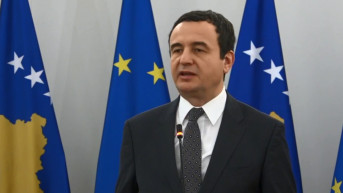
The Prime Minister of Kosovo, Albin Kurti, said that he had received warnings about the possibility of a reduction in Western support, if Kosovo was not constructive in relation to the negotiations between Kosovo and Serbia, and added that he had not been invited to the meeting that would be organized by the American Embassy in Pristina on January 31, at which the Community of Serb-majority Municipalities would be discussed.
In an interview with Radio Free Europe, Kurti said that the meeting had been the result of the insistence of the United States Special Envoy for the Western Balkans, Gabriel Escobar.
"I expect Escobar to say in Belgrade that Serbia should recognize Kosovo, and not to say in Pristina that the Community will be formed, regardless of my position," Kurti said.
Speaking about the European plan for the normalization of Kosovo-Serbia relations, Kurti said that it had not been presented to him in the form of "take it or leave it", but as a platform for further discussion.
He repeated that the European proposal was a good basis for talks, but said that it did not contain everything that Kosovo would like.
Kurti also said that he expected an intensive dialogue with Serbia in order to reach an agreement within the mentioned time frame, which, according to him, was March 2023.
What is now called the European plan for the normalization of relations, supported by the United States of America, was proposed to Kosovo and Serbia. Do you accept this plan?
Back in the autumn of last year, I said that the proposal of the European Union, which was supported by France, Germany, and the US, was a good basis for further discussions, and that it was a suitable platform and framework to move forward. Therefore, I have always been constructive in approaching this proposal, which has the language of, so to say, universal concepts such as independence, territorial integrity, sovereignty, then democracy, rule of law, and self-determination - so, the things that we have always affirmed as the Republic of Kosovo and as a people, over the years and decades.
Can it be said that this plan is a draft agreement, a framework agreement, or does it contain principles on which a general agreement can be made?
There are five sentences in the preamble and ten articles. I also sent my comments since I was never told that this was a "take it or leave it" proposition. Therefore, there was never such an ultimatum.
Therefore, we said that, in principle, we considered it a good basis for further discussions, which we would engage in whenever we were invited to Brussels. Of course, much needs to be clarified here because an agreement is viable when ambiguities are removed, and only when it is stable in that way, can it really be implemented.
At the last meeting on January 20, I insisted that there be five states, those that would change their position through an act of consent because full normalization would be supported precisely through the recognition of five states that had not yet joined the majority of EU member states.
So, my main objection, and there are others, but the main objection I mentioned at the last meeting, concerns the universal recognition we need within the EU and NATO, where we aspire to join.
Can we talk about the other objections you mention? You say it's a good basis for further discussion, but what points are you skeptical about?
I spoke at the meetings and also made written comments, so it is not appropriate to compromise the confidentiality of the conversation now. But I know that it is not true that the other side accepted this proposal. And they gave their objections also.
My impression is that the repetition that Belgrade accepted the European proposal is more in the function of exerting pressure on Kosovo than the real truth because they submitted demands that move us away from normalization. So, they filed objections that move us away from normalization, while the objections that I filed are objections that bring us even closer to the agreement on normalization.
You know that US President Joe Biden, and German Chancellor Olaf Scholz, said that we needed a legally and internationally binding agreement, which would bring a complete normalization of relations with reciprocal recognition in the center.
What did the other side object to?
Again, I can't say that on behalf of the other side, but I know that they sent their comments and objections and it's not true that they fully accepted the proposal. In the meantime, let's not forget that on October 27, actually officially, by voting at the session of the National Security Council in Belgrade, the proposal was unanimously rejected.
Therefore, everyone who participated in the session of the National Security Council in Belgrade, where the President of Serbia, the Prime Minister, the Minister of Foreign Affairs, and many state institutions were present, unanimously rejected the proposal of the European Union. However, now, on January 20, they were more positive, but it is not true that they fully accepted it, because they made their remarks, which, according to my firm belief, are abnormal.
Have there been any substantial changes in the proposal since then?
I believe that the basis (for the dialogue) is the one (proposal) of September 9 last year, which came three weeks after the meeting in Brussels on August 18, which was very important because the agenda was clear with a logical sequence. The first item is the general framework of the agreement, the second item is current issues. Therefore, in the function of the general framework of the agreement, the special envoys Lajcak, Ploetner, and Bonne proposed on September 9.
I expected more regular monthly meetings, as we agreed on August 18. That didn't happen. I believed that maybe it was because of Serbia's refusal, but maybe the mediators have some plan that we don't even know about. But it is a mistake that the meeting from January 20 did not take place on September 20, and at the same time I think it is not the right way to replace direct meetings in Brussels with mediators by shuttle diplomacy in Pristina and Belgrade.
International delegates said after last week's meeting that they expected more understanding from you. What did they mean, and for what parts you did not have an understanding?
I didn't say something they didn't expect, given the comments I sent and my public statements. Now, if they expected something more, they should have said so. From my point of view, everything was correct, the meeting was very comprehensive.
But, first of all, I do not agree that with the 33 Brussels agreements, which were signed a decade before I came to power, a hierarchy is being created among them because that is not right. They have a chronology, but not a hierarchy. All 33 Brussels agreements belong to the horizontal plane and you cannot choose by dividing the desired agreements that benefit someone.
Before we get to the past agreements, Mr. Lajcak said in his last interview that with the European plan, Kosovo gained a lot and lost nothing. Do you share this opinion with him?
Kosovo cannot lose because we are here as the Government of Kosovo to protect and elevate Kosovo.
Are we talking about a proposal as such?
But not everything is what we want. Therefore, it is not that Kosovo is losing, but that Kosovo is not achieving what we believe is right, not only desirable. But when we start the talks and when the issue of the agreement is opened, based on the European proposal, then we will be able to discuss those details. But that does not mean that we interpret the agreement as the Serbian side, or even as mediators.
Versions of this plan published so far do not mention mutual recognition. Is that a moot point for you?
Undoubtedly, for us, any agreement that does not have mutual recognition at the center is not a complete agreement on full normalization, and on the other hand, the proposal of the European Union does not pretend to be a final agreement. It is not even called a final agreement, and I rightly believe that it is not, because it has to be discussed. It is a common platform for conversations. It's not a take-it-or-leave-it final version. Neither we, nor in Brussels, nor Pristina were told so.
However, according to the special envoys, there was an opportune moment that they considered a step forward. March is mentioned as the time when it will be known how to proceed. Do you think there will be significant progress in that direction by March?
On November 18 last year, I was in Tallinn, on an official visit to Estonia, and there I received an invitation to participate in the meeting in Brussels on November 21. That's when I saw March 2023 for the first time, as the deadline when we would have to agree. For me, it is completely reasonable that we reach an agreement as soon as possible, but for that, we have to have intensive discussions. That's why I'm surprised how, on the one hand, they work on the proposal, and on the other hand, they don't insist on frequent meetings.
Lajcak also said that by March it would be known which side might be uncooperative in the process. He had even mentioned sanctions against Kosovo or Serbia, depending on which country would not cooperate. Were you told about the possible sanctions if there was no success in these negotiations?
Kosovo has joined the European Union, the United States of America, and Great Britain in imposing sanctions against the Russian Federation and its invasion of Ukraine. Serbia has not imposed sanctions on the Russian Federation, and perhaps we should think about the sanctions that should be imposed on Serbia because it is not imposing sanctions on Russia.
Of course, certain processes can lead to delays, but I believe that the most powerful guarantee that the Republic of Kosovo has is the last Progress Report from October last year, which is the best report we have ever received as an assessment of our country.
In this case, it should be emphasized that there is no field in which we have either regression or stagnation. It's just about different types of progress. Therefore, the assessment for Kosovo should be based solely on what we do in our country in terms of European values and economic growth, and not in terms of obedience, let's say to a political or any official.
I repeat the question. Have you been told that Kosovo could face sanctions such as loss of support or reduction of international support if no progress was made?
Look, we don't have anything concrete. But they may have implied or hinted that the expected support for Kosovo would not be the same if Kosovo, for example, was not considered constructive. However, in addition to being very constructive, we are also dedicated and creative.
The international factor recently increased the pressure for the formation of the Community of Serb-majority Municipalities. You said that you did not want to have Republika Srpska inside Kosovo. However, the US insists that it will not allow Republika Srpska in Kosovo. Why don't you trust the American guarantee?
Of course, Belgrade wants Republika Srpska within Kosovo, as it has in Bosnia. You know that Serbia de jure recognizes Bosnia and Herzegovina, but de facto does not recognize it. And they do not hide their intention to create the Republic of Serbia within Kosovo. We believe that such a risk exists, but we must be careful, and vigilant, and not allow it. But, not forgetting that if something is a little better than Republika Srpska, it is not necessarily good. So, even if we say that there will not be a Republika Srpska, it is not a guarantee that, if there is no Republika Srpska, our work will be very good.
I have repeatedly emphasized that we did not deny that our ancestors had made big mistakes and left us the situation we are in. However, on the other hand, we must repeat that the CSM, as long as it is a single-ethnic community, does not support the constitutionality of Kosovo, which is based on the proposal of Martti Ahtisaari.
Then, there is no way that Serbia will say that the state of Kosovo is fake and give me the real CSM, so there is no logic for that insistence. And also, when Serbia is looking for something for the Serbs in Kosovo, it should think very seriously that the principle of reciprocity cannot be neglected.
There are more minorities in Serbia than minorities in Kosovo, and only four percent are Serbs in Kosovo. 15 years ago Kosovo was declared multi-ethnic and insisting on a mono-ethnic community is really not right. I advocate that all the Serbs protect their rights; that we listen to their demands and meet their needs. However, I cannot compensate Serbia for losing the war in the spring of 1999.
On January 31, the American Embassy in Kosovo will organize a meeting to discuss the CSM. Will you attend this meeting?
I was not invited to that meeting, but those who were invited should go to that meeting and talk about it. But, I repeat, out of the 33 Brussels agreements, none can be chosen because there is no hierarchy. No artificial hierarchies can be created, except in chronological order. However, on the other hand, even in the proposal of the European Union there is no article, which is considered to include the Community of Serb-majority Municipalities. Therefore, I believe that this meeting is a consequence of the insistence of the official of the US State Department, who is also the special envoy for the Balkans and who stated that, regardless of the Prime Minister of Kosovo, the CSM had to be formed.
I expected that it would be declared in Belgrade that, regardless of the president of Serbia, Serbia should recognize Kosovo instead of saying in Pristina, regardless of the prime minister of Kosovo, that the CSM should be formed.
Are you saying that while you are the head of the government, there cannot be a Community of Serb-majority Municipalities?
I'm not the only one saying this. The CSM, without opening the issue of a final, legally binding agreement, with mutual recognition in the center, a CSM based on the same ethnicity, a CSM with illegal structures in the north, which blocked 16 illegal roads, such a CSM is neither sustainable nor of course acceptable.
But is there any kind of a community that is acceptable to you? In what format would you accept some kind of community of municipalities or Serbian community in Kosovo?
We have the Community of Kosovo Municipalities and there are also municipalities with a Serbian majority. I am for communities that are developmental, democratic, based on European values, and not on a national basis, ethnicity should not be the basis of the Community of Municipalities.
You know that even the proposal of Martti Ahtisaari gave the right of veto for so many things in the Assembly of Kosovo to the representatives of the Serbian minority precisely so that the territorialization of rights would not be allowed. The Community of Serb-majority Municipalities does not aim to increase the rights of the Serbs but to territorialize those rights, as they did in Bosnia and Herzegovina. Therefore, in Bosnia, they have the right of veto, but at the same time, they have the territorialization of their presence. This is what they are striving for in Kosovo while continuing to not accept the crimes committed during the war in Kosovo and to maintain good relations with the Kremlin in Russia.
The US Special Envoy for the Western Balkans, Gabriel Escobar, said on December 13 that, quote, "The community will be formed, the US will be part of the process, and the Government of Kosovo can develop this discussion with alternative partners." Who do you think could be alternative partners and is this a message for you?
I think you should ask him. You should ask Mr. Escobar what he thought. I know a lot of things, but it's not okay to talk about what other people thought when they said something. I think it's better to ask them.
The international insistence on the formation of the CSM continues. Your insistence is that such a Community should not be formed. Could the Community be the trigger for your resignation?
I don't think that CSM is just a project, which only has the prime minister as an obstacle. It is an obstacle to constitutionality, legality, and democracy, for the people of Kosovo, and I do not believe that Kosovo urgently needs it.
Kosovo urgently needs mutual recognition with Serbia.
Those who talk day and night about the Community and Serbia says that it will never recognize you, are helping it. It is not fair to the suffering people of Kosovo. You can't put “the cart before the horse”. Mutual recognition is central. President Biden said that the normalization of relations had been achieved through an agreement aimed at mutual recognition. It is a big mistake in political and public discourse to remove mutual recognition from the center and place the Community there. I can't accept this. President Biden gave other instructions and we should love our country, our homeland, even more than President Biden, not less than him.

comments