
Mikasinovic: A Trump victory would signal a move in a positive direction, he views Belgrade more positively than the Democrats
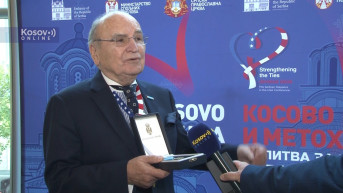
A victory for Donald Trump in the U.S. presidential elections would be a plus and mark a move in a positive direction, as he views Belgrade more favorably than the Democrats. If Kamala Harris wins, then Joseph Biden's policies will continue, which will be either indifferent or negative for Serbia, said Branko Mikasinovic, a long-time journalist for "Voice of America" and former professor of Russian language and literature at universities in New Orleans and Tulane.
"The World Economic Forum's 2024 report ranked social and political polarization as one of the top three global risks over the next two years, emphasizing that deepening ideological and cultural divisions threaten societal stability, polarize decision-making, and shake the economy. As America approaches the presidential elections, concerns are growing about potential political violence and the contestation of results. Political tension is also spilling into private life, as even close friends currently struggle to hold conversations if they support opposing candidates," Mikasinovic said in an interview with Politika.
However, in this uncertain race for the White House, Mikasinovic believes that the key to the election does not lie in the hands of staunch Democrats or Republicans, but with undecided voters—several hundred thousand of them who will tip the scale to one side or the other at the last moment.
You've been in the United States for over half a century. How does this campaign differ from some of the previous ones?
The situation is unique because we have two candidates who are at completely opposite poles. I believe that most Americans will ultimately decide to support Donald Trump because of the chaos happening in the country, including two assassination attempts on him... He is like Don Quixote, fighting against the entire political structure and the deep state, which supports Kamala Harris, who has been practically pushed into the position of being the Democratic candidate.
But Trump also has some influential supporters. It seems that Elon Musk is his biggest backer in the campaign. On the other hand, there was news that Taylor Swift had endorsed the Republicans, which turned out to be fake, and she later publicly supported the Democrats. How much influence do public figures have on elections?
I think Musk's support is extremely important because he is a very powerful and extraordinary individual—thinker, activist, you name it. But Trump’s problem is still the deep state, which is well-organized and has enormous financial resources, much greater than his. As for Hollywood’s influence, it is significant for the Democrats but not for the Republicans. Hollywood is, in itself, a strange, avant-garde world. They embrace things like transgender ideology and lean toward extremes, which is contrary to the Republicans.
Your acquaintance John Bolton, the former National Security Advisor in Trump’s administration, has publicly mentioned the division of Kosovo as an option multiple times...
I’ve known Bolton for many years, he is a good friend and understands our stance on this issue. Once, Sveta Stojanovic and I visited him and discussed the matter. At one point, Sveta said, “Come visit us,” to which Bolton replied, “Alright, but who’s inviting me?” It’s a shame he never received an official invitation, because he’s someone you can have a conversation with. Even though Bolton is no longer in the administration, he continues to write for newspapers and is still influential, which could be useful.
What is the position of our diaspora in the U.S., and how much lobbying is being done for Serbian interests?
The number one problem is that the diaspora is not sufficiently organized, and we need to build much stronger connections in this area. There used to be such an organization led by Miroslav Djordjevic, the founder of the Serbian Unity Congress, which connected many influential Serbs and was a significant voice in Washington. Since his passing, that organization has disbanded, and now we don’t have a unified representative—only individual efforts. On the other hand, Serbia, as the homeland, should strengthen its ties with the diaspora and use our influential people to improve our position.
Compared to us, how do other nations lobby, and are their activities more intense?
I believe the Albanians have more influence, primarily because they invest significant financial resources into it, build connections, and have people in key positions. Some American politicians may be financially motivated and act accordingly. The most prominent and best example of effective lobbying is, of course, the Jewish community. They have their own lobby in America, but this is because they are well-organized and wealthy. The impact is evident in the ongoing conflicts in the Middle East. However, we are not in the same situation. We also have some wealthy individuals, but I’m not sure how aware they are of the need for political support for Belgrade.
There is speculation that Richard Grenell, the former envoy for the Belgrade-Pristina dialogue, could be appointed to a high position in the state administration if Trump wins. Do you see this as beneficial for us?
He is an exceptional person and will probably get a position. He’s familiar with Serbia, and on top of that, he has connections through business ventures. I believe he would be a good solution... From my numerous interviews with American politicians, I’ve gotten the impression that they generally aren’t interested in many issues and aren’t sufficiently informed. Take, for example, a congressman—why should he know so much about Serbia? Their main focus is on being re-elected and serving their constituencies. Foreign affairs are secondary to them and not particularly important. As for our diplomatic activity, it needs to be much stronger, and we must establish closer ties with American think tanks, for instance. But all of this requires funding, and the question is how much we are willing to invest in it.
0 comments