
Moore: Suspension of US-Kosovo strategic dialogue resulted from Kurti’s negative behavior

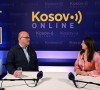
Former US administration official Jonathan Moore told Kosovo Online that the suspension of the US-Kosovo strategic dialogue was a result of the negative behavior of acting Prime Minister Albin Kurti and other senior officials in Kosovo.
Moore said he expects much more progress in Kosovo after the local elections, adding that people must have representatives at the local level. He noted that progress in the Belgrade-Pristina dialogue, while supported and monitored by Peter Sorensen of the European Union, is not possible without the formation of a government in Kosovo. He emphasized that it is long overdue to establish the Community of Serb Municipalities.
Your stay in Kosovo coincided with the election campaign. Based on these first messages we’ve seen, what can we expect until October, and what after October?
Thank you for the question, I’m already glad to have this opportunity to speak with you. First, of course, I must remind you, I am just a private individual, I was once an ambassador, I was also an American diplomat for more than 30 years, and now I speak only in my own name. To begin with, let me say I am here by coincidence. I did not come because the election campaign is starting now. I have been here many times since 1991. In fact, even a few months ago. I am now a private consultant, I work with employers, various companies, and so on. And since I had the chance to be in the region, I thought it was time to visit Kosovo as well. We hope, of course I personally hope, that after these local elections there will be much more progress all over Kosovo. I had the opportunity to visit North Mitrovica, and I was glad to hear directly from local authorities, local politicians, and journalists that everyone expects participation in these elections on October 12. That would mean that in all municipalities there will be voting and participation. That is very important. Naturally, people must have their representatives at the local level, and it seems this will be the case in all municipalities. This is an essential matter and an improvement compared to, for example, the earlier phase without those local mayors and so forth. As for higher-level authorities, there is no coalition, I don’t know when there will be one, for the sake of progress for everyone. But in Kosovo, it is crucial that there be more and more positive steps until some capable coalition is formed.
Was the US Government’s decision to suspend the strategic dialogue with Kosovo a surprise for you, and what could the consequences be for Kosovo?
I don’t think this is really a question of consequences for Kosovo; it’s about the reactions to the fact that Mr. Kurti is not doing his job and is behaving very negatively, not only toward the US but also toward Kosovo. That is a huge problem. Of course, I cannot speak on behalf of the US government; you have representatives of the US here in Pristina. They are better sources than a private person like me. But no, it was not a surprise to me. It is the result of the behavior of Mr. Kurti and others at a high level in Kosovo.
Kurti did not react to earlier warnings. Do you think he will change his policy after this US move?
Of course, he has that option, and he had it several years ago. Here in Pristina, there was a very capable American career diplomat, in the role of ambassador, until January this year, Jeff Hovenier, a very intelligent man who knows the Balkans perfectly well. He sent many excellent messages and made requests, not personal requests, but requests on behalf of the US government and President Biden. And so, before Trump, he resigned and returned to the US. But there have been more than three years without progress because Kurti, as prime minister, did not want to react positively, did not do his job, as was said. The consequence is that relations between Washington and Pristina, even now under the Trump administration, are very poor. But the target of such a step is Albin Kurti.
Will Kurti even have a say, given the long political crisis? How do you think it can be resolved? Are elections the only solution?
When it comes to solutions, that is, of course, a matter for the local politicians, to do their jobs. They seek power through elections, they seek the support of their voters. Then, when they get all that, and have their nice offices and salaries, they must do their job. Sorry if that sounds repetitive, but… Well, that would mean forming a coalition at the higher level, of course. Self-Determination Movement cannot do it alone, so it must be with various minority parties, with opposition parties. You have many in Kosovo, including PDK, LDK, AAK, the Serb List, and so on. It is high time to form a coalition at this stage before the local elections. I understand why this is difficult. Everyone in politics is focusing their energy on the local elections, but they have already lost months, since the February elections, and now it’s September 15–16, with no progress. It is high time to form a coalition, a government, and respond to the requests of the international community, the European Union, the United States, for there to be any progress in the dialogue between Belgrade and Pristina. It is high time. Belgrade and Pristina have the attention and support of Peter Sorensen from the European Union, but without a coalition, a functional coalition here in Kosovo, progress is simply not possible.
What has been happening with the dialogue during all this time? Last week, there was a meeting in Brussels, but on the same day there were raids on the Pension and Health Insurance Funds in the north of Kosovo. What room for maneuver do the EU and Sorensen have in such circumstances?
Naturally, the international community will not intervene every moment for every possible event. People have seen phases of provocation or other actions from many sides, in the north and elsewhere in Kosovo. Everything must be resolved through dialogue, and in this pre-election phase, political authorities, particularly Kurti, must show restraint and act more professionally.
Yesterday, the first Deputy Prime Minister in the caretaker government, Besnik Bislimi, said they were working on transferring the health system that operates under Serbia to the Kosovo system. How do you assess this? We know that for Serbs these are red lines. How would Serbs in Kosovo function if the health system, and later perhaps also education, were transferred to Kosovo’s system?
These are very sensitive issues, and I cannot pretend to have a solution for you. I have no authority at all in Kosovo. I am just here in passing, during my travels through the Balkans. These are indeed very important and sensitive issues, and that is why it is crucial, after these local elections and after the formation of a national coalition, that the time will come in Kosovo, and in the context of the dialogue, to discuss such matters.
Could the Community of Serb Municipalities solve this, if it were finally formed after so many years?
Since 2013, and even earlier, there has been much discussion of this idea of the Community of Serb-majority Municipalities. It is high time it was formed. Albin Kurti did not do it, he did not offer, as far as I know, a draft for it. This is not an impossible mission; it is something very practical. All municipalities in Kosovo have equal rights and also the right to cooperate at the municipal level. This is a practical matter; there should be a draft. I am told that even the Constitutional Court must approve it, but that would be only a formality, because, of course, it would not contradict anyone’s constitution. And then there will be more steps, not only from Pristina but also from Belgrade. I was just in Belgrade, and I understand that many people there also intend to make more progress through dialogue with Pristina. It is high time for that, but at this stage, it is very clear that most people abroad, in Brussels and Washington, expect, after more than 12 years, the formation of such a community.


0 comments