
Moore: Difficult to make progress in Dialogue with Kurti
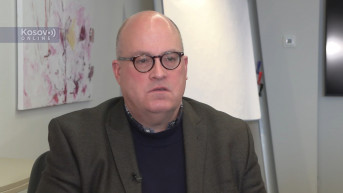
Kosovo's Prime Minister Albin Kurti is unsuccessful not only for Kosovo but also for relations with the U.S., and it will be very difficult for the new EU envoy for dialogue, Peter Sørensen, to achieve progress in the talks with him, observes senior fellow at the Atlantic Council, Jonathan Moore, in an interview with Kosovo Online. He suggests that it would be beneficial for opposition parties, along with Srpska Lista, to form a new Kosovo government.
Commenting on the situation in Kosovo, particularly unilateral measures such as the closure of Serbian institutions and the lack of progress in dialogue, Moore states that even in Washington, it remains incomprehensible how Kurti has failed not only Kosovo but also its relationship with the U.S.
He recalls former U.S. Ambassador to Pristina, Jeffrey Hovenier, whom he describes as "brilliant," but notes that even Hovenier was unable to achieve anything positive with Kurti, who rejected everything.
"Even ten years ago, Kurti was negative. Citizens voted for him, probably because he is not corrupt and is modest, but the result is that no positive steps have been taken when something depends on him. This is evident in the dialogue," Moore observes.
He adds that there was hope that the recent elections would bring a new government and prime minister.
Moore admits he hoped that the opposition in Kosovo would receive more votes and be able to form a coalition.
"It would be beneficial to form a government with Srpska Lista and have a new prime minister. I hope that the opposition, if they want progress for their citizens—including those in the north—will form a coalition and pursue better policies toward Europe and America," says Moore, a former acting assistant U.S. Secretary of State.
He considers it a positive development that Sørensen will mediate the dialogue, as he is highly intelligent, but emphasizes that achieving progress with Kurti will be very difficult for him as well.
Regarding U.S.-Kosovo relations, Moore points out that no one in the American administration can foresee a successful future for Kosovo with Kurti in charge.
He recalls that Richard Grenell, a figure close to former President Donald Trump, who still plays a significant role and enjoys Trump's trust and respect, has repeatedly mentioned Kurti, with whom he has not had the best relationship.
"Others occasionally comment on the situation in Kosovo as well. Even for Biden, the signal was clear that no one in the U.S. administration can foresee a successful future for Kosovo with Kurti. If voters believe he is the only politician who should be prime minister, it is their decision, but it means there will be no progress in terms of the economy and trade relations, not only with the EU and the U.S. It should come as no surprise or secret that neither North Macedonia nor Albania can be satisfied with Kurti's behavior," Moore stated.
He emphasizes that while he cannot interfere in Kosovo’s internal affairs, he does say:
"If you want him as prime minister, you are choosing to exclude a positive future for now."
When asked about the worsening position of Serbs in Kosovo and whether he expects Sørensen and Washington to pressure for the long-overdue formation of the Community of Serb Municipalities (CSM), Moore affirms that this remains a key task and that the CSM must finally be established after 12 years.
He argues that some mistakenly interpret the CSM as a potential new Republic of Srpska, clarifying that the competencies of municipalities are defined by the constitution. The CSM concerns specific local issues such as education and healthcare, without any foreign policy implications.
"Even the governments before Kurti did not establish the CSM. However, there were more positive steps regarding administrative border control and trade... But then came Pristina’s negative actions—closing banks, institutions, appointing mayors… Serbs are not only in the north but also in the south. I hope for better developments in the future," Moore said.
When asked if a new Washington Agreement could be expected given that Trump is back in the White House, Moore says he can only speculate on the matter.
However, he is convinced that what most in Brussels and Washington seek—recognition—will not happen, and that instead, efforts should focus on de-escalation and dialogue.
"Changing borders, 'trading' territory, I don’t think that’s the best option. De-escalating tensions, yes, and establishing some form of dialogue," Moore added.
He also mentions that during a recent visit to Tirana, he saw that the Albanian government was frustrated with Pristina's positions.
"I hope the U.S. can play a positive role. But there are so many challenges and priorities on the U.S. president’s desk that I’m not sure what the next phase will be. There are no ambassadors in Pristina or Belgrade, nor a permanent Assistant Secretary of State for Europe. I hope that with new people in the embassies and State Department, along with Sørensen and other partners, the situation will be addressed," Moore stated.
He does not see the defense cooperation agreement between Croatia, Albania, and Kosovo as a threat to regional stability, emphasizing that it poses no danger to Serbia or anyone else.
Noting that such agreements should not be surprising, he clarifies that this agreement does not include a provision like NATO’s Article 5, which mandates mutual defense among members.
He adds that while international cooperation discussions can be useful, as a former diplomat, he recognizes that much of it remains mere rhetoric.
"This kind of cooperation is nothing new, but how important it will be for the future—I won’t comment on that," Moore said.
When asked what the Balkans can expect from Trump’s second term, Moore explains that both the pace and priorities of his administration are significantly different now. Since Trump is constitutionally barred from a third term, he wants to accomplish as much as possible quickly, particularly given the possibility that Republicans might lose their Senate majority in the next elections.
He notes that the Balkans are not currently a priority, as international and domestic challenges—such as Ukraine, the Middle East, China, tariffs, and migration—dominate the agenda.
"Trump and Putin have had a conversation, which is a step forward, even though not everything has been resolved. But it's important that a change in approach has occurred, because at the beginning of the war, Biden said it would last indefinitely. The time has come to at least achieve a ceasefire. As for the Balkans, Marco Rubio is now Secretary of State, and he has followed developments in the region while in the Senate. This year marks the 30th anniversary of the Dayton Agreement, signed in Ohio, where Vice President J.D. Vance is from. We’ll see what opportunities arise to commemorate that anniversary. The Balkans have support and attention, but they are not at the top of the list," Moore summarized.
Regarding the situation in Bosnia and Herzegovina, Moore describes it as highly complex, with many unresolved issues.
He stresses that the Republic of Srpska has no right to independence and that this option is off the table.
"For years, we’ve heard rhetoric from Milorad Dodik expressing dissatisfaction with the role of the High Representative—both past and present—and some in the Republic of Srpska dream of independence and unification with Serbia. But that option is ruled out by both the Dayton Agreement and the Constitution. The Republic of Srpska has no right to independence. I know the broader context well. The topic of secession is complicated. According to Dayton, there’s no chance for it. Looking at the map, you can see that the Republic of Srpska is divided into two parts, with Brcko in between, which belongs to neither side," Moore explained.
However, he acknowledges the frustration, calling it unfortunate that politicians in Bosnia—whether from Banja Luka, Sarajevo, or Mostar—have not reached any agreement or consensus.
He recalls past efforts to amend Bosnia’s Constitution, which were supported by Milorad Dodik, Bakir Izetbegovic, and Dragan Covic but were blocked by Haris Silajdzic and others, preventing constitutional reform.
"The Dayton Agreement is both a success and a cage, as it prevents politicians from running across Bosnia and fuels nationalism and reluctance to compromise," Moore states.
He emphasizes that he would like to see more Bosniak politicians in Banja Luka and more Serbian politicians active in other parts of Bosnia.
"But unfortunately, it is easier to remain divided. Everyone claims they are good while others are bad. Nationalism plays a key role for Dodik, as well as for Bosniaks and Croats. Everyone blames others for not doing their job, which is a poor excuse for incompetence," Moore concluded.

0 comments