
Divided by the same culture: Croatian-Serbian music war
Written for Kosovo Online by Srdjan Garcevic, founder of The Nutshell Times
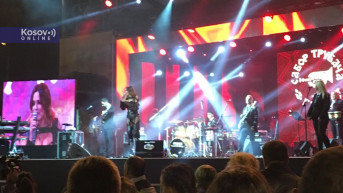
In 2016, when I had just returned from the UK to Serbia and wanted to have the time of my life, I went to the globally famous brass music festival in Guča, which that year was headlined by Severina Vučković, a Croatian pop music sensation.
It was a weird but fun mix, both musically and politically. Guča, in many ways, symbolizes the essence of Serbian culture, while Severina is the ultimate Croatian star for people of my generation, and who, throughout her artistic and political career, tried to cast herself as the main voice of post-1995 Croatia. She has been very successful: through her strong-minded, split-born femme fatale persona, she took Serbia and the region by storm even in the early 2000s while offering a liberal but still patriotic side to her fans back home. In line with the somewhat controversial popularity of Serbian folk and turbo-folk (aka cake) in Croatia, she self-consciously embraced the aesthetic and sound in the mid-2010s, cooperating with Goran Bregović and working to establish herself as the successor to the pan-Yugoslav turbo-folk stars like Lepa Brena.
Her headlining, Guča, was very much a symbol of her pan-Yugoslav ambitions but also edgy due to the official Croatian elite disdain for cake. There was also disdain from the Serbian side, evidenced by the relatively low attendance, partly due to purism and partly due to politics and an uneasy relationship with Croatia. A Guča-loving friend of mine, already uneasy at the show, winced when Severina started singing her hit, Generale, which includes a rather funny, edgy line, "Oh my general, you are shooting a civilian “, which he (erroneously) saw as a reference to the Croatian Operation Storm and its main mastermind, Ante Gotovina, which saw hundreds of thousands of ethnic Serbs being ethnically cleansed from Croatia in August 1995.
Eight years later, Severina was stopped at the Serbia-Croatia border crossing for questioning by the Serbian border police, and although eventually let into Serbia, she decided to turn back. In an Instagram post, she described being questioned about her political views, including her thoughts about the wars in the 1990s and her various statements in which she criticized the Serbian state and government, and she vowed never to return to Serbia until its government is changed.
This incident was the latest shot in what is shaping up to be the regional music war.
For a long time, Croatian officials have sought to suppress the Serbian cultural influence in the country, which is the strongest in popular music. This struggle started to affect music fans, some of whom are jailed for listening to Serbian Krajina music, which deals with the grievances of the 1990s as well as WWII. The pro-Axis Independent state of Croatia systemically persecuted Serbsatia. The Croatian government considers this offensive and disrespectful of the Croatian state and statehood and actively penalizes it.
The most recent example, which rattled the Serbian public, was the arrest of Nemanja Berić, a Belrade-based lawyer with Krajina roots, by the Croatian police for a Facebook post in which he sings Krajina in his car. Berić’s case was only the latest and higher profile in a string of similar arrests due to musical social media posts. Last year, Rajko Lalić and Davor Olujić, performers of traditional Krajina music, were arrested and fined by the Croatian police for vague crimes against the Croatian state relating to their social media accounts. These vague crimes and their (over)policing are a deterrent for the Krajina Serbs to keep a connection with the small community that remained in Croatia for fear of persecution.
However, while Krajina music has been especially singled out for its political implications, Croatian officials in recent years have been taking steps to suppress even apolitical Serbian music.
Last year, the mayor of Pula, Filip Zoričić, a city famed for its Roman arena, as well as relative tolerance, outright banned a nearly sold-out concert of turbo-folk music headlined by a Croatian singer from Split, citing that he does not want "Serbian trash", which could charitably be interpreted as a verdict against the music, or less charitably, as chauvinist slur against Kuliš’s guests who were mostly Serbs, and who included Severina’s former father in law. Zoričić's insistence that the ban came from his intention to keep Pula as a city of Mediterranean and Central European culture, however, rhymes with the thoughts of the 19th-century Croatian ideologue Ante Starčević, who referred to the (politicly self-identified) Serbs as "Slavoserb breed“ which he saw as more problematic for the Croatian “race” than even the Jews. The mayor of Osijek followed Pula's example, and the Croatian Minister of Culture supported both decisions as "normal, natural and expected". The problems for Serbian artists have gone beyond turbo-folk. Bajaga and Instruktori, a Serbian rock band, was banned in 2018 from a gig in Karlovac, while Severina herself fell foul of the Croatian cultural apparatchiks for being too "pro-Serb". She was allegedly banned from singing at the main event commemorating Operation Storm in Knin in 2009, because she had concerts in Serbia, despite her support for HDZ and Tuđman during the war.
While Croatia has been the most steadfast in its muscular cultural policy, it is far from the only one in the region where countries have worked hard to police their identities after the fall of Yugoslavia. While Slovenia took steps as soon as it sought Independence in effectively erasing more than ten thousand non-ethnically Slovene residents and does not recognize the cultural minority rights of anybody but Hungarians, Italians and Roma, it is fairly relaxed about cultural performances. On the other hand, Montenegro, especially during the long reign of Milo Đukanović and DPS, had a long list of mostly Serbian intellectuals and singers who were banned from entering the country even though they may have been born in Montenegro, such as pop musician Vlado Georgiev. Priština authorities regularly ban Serbian cultural figures, from the Patriarch of the Serbian Orthodox Church to actors such as Nenad Jezidić, while seeking to demonize existing local Serb cultural institutions.
Although Serbia has had a more laissez-faire approach, it has been tightened since 2020. The country has outright banned several Montenegrin and Bosnian performers who participated in what it saw as displays of anti-Serbian or unruly behaviour, as well as foreign public figures who engaged in protest in Belgrade, such as the Bosniak actor Feđa Štukan or wanted to display signs of organizations Serbia considers terrorist (such as the Kosovo Liberation Army), as was attempted during one the controversial festival "Miredita, Dobar dan” which ended up being banned this year, due to security concerns.
Reflecting on the past eight years since seeing Severina Guča, it is sad to see the most pragmatic and vibrant part of our culture, turbo-folk, affected by petty politics. Even during the 1990s wars, turbo-folk and pop singers cooperated across borders. Before penning the former Bosniak anthem "You Are the One and Only", Dino Merlin, a Sarajevo-based musician, also wrote the hit single "Beograd" for Ceca, arguably the greatest star of turbo-folk, who was married to Žerljko Ražnjatović Arkan, a leader of Serbian paramilitaries. Sadly, this spirit of fun is much drained by the cultural elite disdain for turbo-folk, which thus pushes its performers to try to opine on political issues and make themselves palatable, such as Severina’s fiery support for Montenego’s independentist culture.
However, some of it is because South Slavic folk music, whose latest iteration is turbo-folk, is a very potent cultural and political force. This was best recognized by Vladimir Dvorniković, one of Yugoslavia's most impressive anthropological minds, an ethnic Croat who studied philosophy in Zagreb but eventually chose Belgrade as its home. Almost exactly a hundred years ago, in his essay “Psyche of the Yugoslav Melancholy”, he hypothesized that the South Slavic folk music preserves the tragic and indomitable Yugoslav spirit. He saw the early attempts of suppression of folk music during the Austro-Hungarian empire, but also among various Yugoslav modernizers who sought to steer the country towards the West by the "cargo cultish" aping of Europe and thought they could only leave the country devoid of its soul and vitality. Sadly, much of the regional ire towards turbo-folk coincides with nation-building, which seeks not only to invent cultures whole-cloth but also turn them against their own roots, which are often then projected onto the country’s perceived political rival, especially if it has a more potent cultural industry and market.
I certainly would not give up hope that next year, for the 100th anniversary of Dvorniković’s essay, we will have Severina sing once again at Guča, Serbs not persecuted for their music and culture, and everybody refraining from poisoning the well through petty politics. To paraphrase Shaw, former Yugoslav countries, especially Serbia and Croatia, seem divided these days by a common culture. Yet, I hope we go back to celebrating what unites us, as we did only a few years ago.



0 comments