
Female genealogy
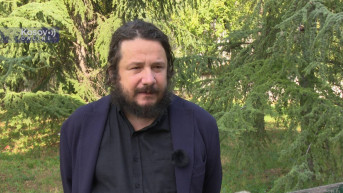
Writing for Kosovo Online: Muharem Bazdulj
Recently, literary historian Vladan Bajceta published an interesting "creative biography" of Slobodan Selenic, which, of course, includes a lot about Selenic's commercially probably most successful novel: "Friends". Since it is a novel "about the tabooed friendship of a Kosovo Albanian, Istref Veri, and the last descendant of the old Serbian, Belgrade Hadzislavkovic family, Vladan Hadzislavkovic, an Oxford student", some theorists have long been developing the idea that this novel, among other things, encapsulates the typical attitude towards Albanians as a people, bluntly speaking, "less spiritual than Serbs". Particularly radical variations on this theme can be found in a novel by Djordje Balasevic, where one of the characters utters a frequently misused line ("Evil is there. Immigrants from the neighboring darkness, from land without history, without birds, without painters, ballerinas, cellists.") and in a notorious entry from Dobrica Cosic's diary that almost had legal consequences.
In Serbian public opinion, there is still a misconception that in the West, Albanians (in a positive context) exist only as a handful of top footballers or two globally famous pop singers (Rita Ora and Dua Lipa). Fortunately, this is not the general attitude. So, thanks to two Belgrade publishing houses, the local reading audience can now get acquainted with the works of two very interesting authors of Albanian ethnic origin.
I say "of Albanian ethnic origin" instead of the simpler "two Albanian writers" because the books I want to write about were not written in Albanian but in Italian and English. However, the authors are undoubtedly Albanian, and their themes are inseparably linked to Albania.
I had the opportunity to personally meet the first author at a joint literary event in Germany about fifteen years ago. Even then, she had a reputation not only in Germany but also in the English-speaking world. Her name is Ornela Vorpsi, and her most famous novel, with which she gained worldwide acclaim, was recently published in Belgrade under the title "The country where one never dies". Translated into Serbian by Aleksandar Levi, the publishing house is "Strik". The novel revolves around the protagonist's coming of age in Albania during Enver Hoxha's era, in a country where people never die because they are so strong, primal, and unbeatable, but where it is dangerous to be a beautiful woman or an uninformed child who readily accepts sweets from the elderly or a person who will speak their mind at the wrong time and place. In this country, and many others, people do not die – they simply disappear. According to a New York critic, the novel is a collection of anecdotes, short stories, and vignettes from 1980s Albania that simultaneously illustrate the burden of totalitarianism and the perishability of "human material" or the character flaws of people under the pressure of political burdens.
Ornela Vorpsi was born in 1968, while Lea Ypi is eleven years younger. Her autobiographical book, titled "Free" with the subtitle "Coming of Age at the End of History", was published in Serbian by Belgrade's "Geopoetika". The translation is credited to Ivan Jankovic. The two mentioned books are suitable for parallel reading as they are somewhat similar yet somewhat different. Differences arise from the generational gap between the authors and the genre's legalities. Ornela Vorpsi's book is still a novel, despite its autobiographical elements. On the other hand, the book written by Lea Ypi is clearly non-fiction, a memoir. Spending her formative years in Durres, in Enver Hoxha's Albania, this author comes from a very prestigious family, as her great-grandfather was the Albanian Prime Minister in the 1920s. In 2022, the book received the Ondaatje Prize from the Royal Literary Society, the Slightly Foxed Prize for the best first biographical work, and was shortlisted for the Costa, Baillie Gifford, and Gordon Burn prizes.
Both Ornela Vorpsi and Lea Ypi belong to the "first echelon" of today's European artistic and academic scene. In addition to being a writer, Vorpsi is also a renowned photographer, while Lea Ypi teaches political theory at the prestigious London School of Economics. Although they do not write in their native language as literary authors, their work, in a broader sense, belongs to the corpus of Albanian culture. For several reasons, it is good and beneficial that their books have appeared in translation into Serbian. On the one hand, both offer valuable reading experiences and on the other, they can help dispel prejudices that some of our public still harbor towards Albanians. Geography is destiny, and Serbs are destined to live either with Albanians or alongside them. In either case, it is useful to know more about these people.

comments