
FEUILLETON 25 years of NATO bombing of Serbia (1): Good evening, ladies and gentlemen - the bombing is about to start
Writes: Dragan Bisenic
"Good evening, ladies and gentlemen,
I have just instructed SACEUR, General Clark, to initiate air operations in the Federal Republic of Yugoslavia.
I made this decision after extensive consultations in recent days with all allies and after it became clear that the last diplomatic effort of Ambassador Holbrooke in Belgrade was unsuccessful.
All efforts to reach an agreed political solution to the Kosovo crisis, since they have failed, have no alternative but to take military action.
We are taking action after the Government of the FR Yugoslavia rejected the demands of the international community:
Acceptance of the temporary political agreement negotiated in Rambouillet;
Full compliance with the restrictions for the Serbian Army and Special Police Forces agreed upon on October 25;
Cease excessive and disproportionate use of force in Kosovo.
As we warned on January 30, failure to meet these demands would prompt NATO to take all necessary measures to prevent a humanitarian catastrophe.
NATO has fully supported all relevant resolutions of the UN Security Council, efforts of the OSCE, and the Contact Group.
We deeply regret that these efforts have failed, entirely due to the intransigence of the Government of the FR Yugoslavia. This military action aims to support the political goals of the international community.
It will focus on disrupting the violent attacks of the Serbian Army and Special Police and weakening their ability to cause further humanitarian catastrophe.
In doing so, we aim to support international efforts to secure a Yugoslav agreement on a temporary political solution. As stated, a sustainable political solution must be guaranteed by international military presence.
It remains open for the Yugoslav government to demonstrate at any time that it is willing to meet the demands of the international community.
I hope they will have the wisdom to do so.
At the same time, we appeal to the Kosovo Albanians to remain firmly committed to the path of peace they have chosen in Paris. We especially urge Kosovo armed elements to refrain from provocative military actions."
To be clear: NATO is not waging war against Yugoslavia. We have no quarrel with the people of Yugoslavia, who have been isolated in Europe for too long due to the politics of their government. Our goal is to prevent further human suffering and more repression and violence against the civilian population of Kosovo. We also must act to prevent the spread of instability in the region. NATO is united in this course of action. We must stop the violence and end the humanitarian catastrophe unfolding in Kosovo. We understand the risks of our actions, but we all agree that inaction poses even greater dangers. We will do whatever is necessary to bring stability to the region. We must stop an authoritarian regime from repressing its people in Europe at the end of the 20th century. We have a moral duty to do so. The responsibility rests on our shoulders, and we will fulfill it."
With this statement full of lofty goals, NATO Secretary-General, Spanish socialist Javier Solana, gave approval for NATO to begin bombing a European country for a duration of 78 days to protect its borders, marking an unprecedented war in the history of world affairs and setting the foundations for a new behavior in international relations.
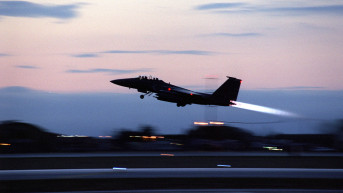
The bombing began the next day, March 24 at 7:00 p.m., targeting objectives in Novi Sad. This military campaign, known as Operation Allied Force, was NATO's second combat operation in the Balkans in just four years. NATO's plan was to use bombing to force the President of Serbia, Slobodan Milosevic, to accept NATO's demands. NATO leaders agreed to a two-day air strike, believing Milosevic would comply as he had done in Bosnia four years earlier. When Milosevic refused, the air campaign gradually escalated into an operation that lasted continuously for the next 78 days.[1]
British writer and Nobel laureate, Harold Pinter, was among the first to give his assessment of the bombing. He publicly called NATO aggression a "bandit action," and shortly thereafter stated: "I am ashamed to be British. Blair, Cook, and Robertson engaged in cruel killings." He raised even more ire among the British when he stated on television, "the sole aim of this action is to establish American dominance in Europe and turn Kosovo into an American colony."
Revolted by what was happening in the skies of Yugoslavia at the time, Pinter, not caring much for diplomatic language, defined U.S. foreign policy with the sentence: "Kiss my ass, or I'll hit you in the head. Milosevic refused to kiss the American ass, and Clinton hit the Serbian people on the head, with disastrous consequences for Kosovo." Responding to frequent criticisms, during the NATO aggression on FR Yugoslavia, Pinter wrote in The Guardian in London: "NATO aggression is ill-conceived, wrong, and catastrophic. It is also totally illegal and probably marks the last nail in the coffin of the United Nations."
Pinter was not shy about expressing his political views publicly, turning his appearance at a congress of analytical psychologists into a kind of tirade. At that gathering, Harold Pinter said: "I maintain that bombing Serbian civilians is not accidental, but deliberate terrorizing of an innocent people. Large amounts of explosives dropped on Serbia have caused enormous damage to its irreplaceable cultural heritage. This is psychotic vandalism."
Another Nobel laureate, Peter Handke, wrote an essay titled "The March Attack," in which he said it's as if this wasn't our planet... "Those who bombed and who killed thousands of people - they don't belong to Europe, nor to planet Earth," said Handke, adding that because of all this, he feels "a kind of revulsion toward the human species." Due to his disagreement with Pope John Paul II's stance, Handke left the Catholic Church.
"Now, for the first time, I would like to live to be 90 years old. To live and to document everything that is happening to the Serbs. Serbs are the new Jews undergoing a new Holocaust, and I would like they, like the Jews, and me with them document every word, every proclamation issued by the media of the new Nazism," Handke said as he left Belgrade after a brief visit to Belgrade in early April 1999. He toured Belgrade with a few friends and visited people demonstrating in the city center. "Just like Hitler, NATO is in love with its own death," he added.
"Everyone expected the bombing to begin, but when it actually happened, it was like fiction, like it wasn't real...But it became real! I remember everything. I was on the street, the wind was blowing, and there was silence all around," Handke described his memory of March 24, 1999.
Noam Chomsky said that the bombing should help NATO, if not save it. "Military actions, relying on force, always give advantage to the United States and Britain because they are militarily dominant, so wherever there is a confrontation moving into the field of force, it strengthens the U.S. dominance. That's quite obvious. In this tension between NATO and the European Union, the United States, by relying on force, strengthens NATO, and that is absolutely bad. We should trust Clinton, Schroeder, and Blair when they talk about the need to preserve what they call 'NATO credibility.' But when they talk about NATO credibility, they are not talking about the credibility of Italy, Denmark... They are talking about the credibility of the United States, meaning the credibility of U.S. power. That credibility means that other people should be appropriately frightened," Chomsky said.[2]
With this bombing, NATO effectively severed a part of Serbia's territory, which it declared an independent state several years later. "Until you understand that Serbia and Russia are not the same? That is unfortunately a painful fact and danger. We annexed Kosovo. We and the international community. It was taken from Serbia. Who did that if not us? Have we recognized Kosovo? It's not annexation, but seizure. What is that called? Extraction. It's not about the neck, but the throat. This is not about questioning Kosovo, but the whole concept," said Croatian President Zoran Milanovic a year ago.
[1] Kosovo: "The Limits of Air Power II" Col Anthony L. Hinen, USAF War Can Be Won With Airpower Alone!
[2] Dragan Bisenic, The Interview with Noam Chomsky, Dominant Group Interests, NIN, 2522, April 28 1999.
Tommorow - 78 days of bombing, 415,000 projectiles, and 1,100 aircraft


0 comments