
FEUILLETON Rambouillet - ultimatum for the bombing (11): Racak – crime and punishment
Writing for Kosovo Online: Dragan Bisenic
David Halberstam in his book "War in Time of Peace" describes that shortly after the president was freed from personal accusation due to the "Lewinsky affair", Madeleine Albright found herself alone in her efforts to push for action against Milosevic on January 15, 1999, at the National Security Council meeting. She highlighted what was then widely known. The agreement Holbrooke managed to reach in October was falling apart, and she strongly advocated for the use of force, but neither the uniformed chiefs nor Bill Cohen wanted to be dragged into the Balkans. Sandy Berger again reflected the doubts of the White House. Clinton, still besieged in Washington, was hardly eager for a new military adventure. The meeting frustrated Albright greatly. "We are just mice turning the wheel," she said on her return to her office.
That was a fateful day. If she couldn't set the machinery in motion, Albright was sure events would do it sooner or later, as Halberstam notes. She didn't have to wait long. Last time, in Bosnia, it was Srebrenica that prompted the West to take action. This time, in Kosovo, it was the village of Racak. The events there happened almost simultaneously with the "we are just mice" meeting in Washington. What happened in Racak changed everything, and its political significance was evident. Kosovo, like Bosnia, could no longer be ignored.
Racak was yet another of those small places that symbolize something larger than themselves. In late autumn 1998, the KLA entered Racak and used it as a base for attacks on the Serbs. After a small KLA unit apparently attacked local Serbs, killing four policemen, significantly larger armed Serbs entered the village.
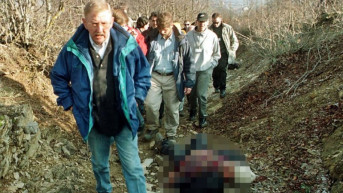
Soon reports emerged of a major massacre in Racak. The head of the Verification Mission, American diplomat William Walker, immediately took a convoy to the village. There he discovered, as he stated, the bodies of 44 dead.
The massacre in Racak became a decisive event for the US administration and allied Western governments to launch military action against the Serbs, as it was a clear sign that the worst from Bosnia would be repeated. Walker, seen by the State Department as a "freelancer" with obvious sympathies for the Kosovars, didn't even seek instructions from Washington. He immediately called an emotional press conference and described the events in Racak as a crime against humanity. Albright also understood the significance of what had happened. If there were people in the administration who thought Walker had gone too far, she wasn't one of them. She picked up the phone and called him, "Bill, you're doing a great job. You were right about Racak".
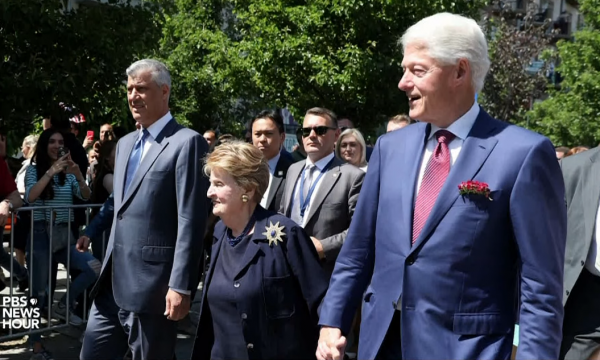
In her memoirs, Albright describes the morning of Saturday, January 16, 1999, when she heard the news about Racak. She says that some people wake up to the sound of roosters crowing, the alarm bells ringing, or the clinking of coffee cups. "As a Washingtonian, I wake up to the radio with all the news. Since it was Saturday - January 16, 1999 - I turned on the radio a bit later than usual, but still long before dawn. As I lay there in the winter darkness, I heard the announcer reporting on a massacre 5,000 miles away. It didn't take long for the details to come. 'There are many bodies up there,' Ambassador Bill Walker told journalists, 'men who have been shot in various ways, but mostly at close range'".
I spent most of that Saturday alone at home, talking on the phone with half the world. I called NATO foreign ministers to propose that the Alliance review and update plans for launching military strikes. And I called my top advisors, seeking a strategy that would combine force and diplomacy to stop Milosevic without surrendering Kosovo to the KLA guerrillas.
After the "massacre in Racak", Americans, "based on the still-valid ACTORD (Activation Order), wanted to start bombing the Federal Republic of Yugoslavia immediately. They expected the participation of other NATO countries, including Germany. No other political goal, apart from punishing, could be discerned". (Ridger Folmer, "War in Yugoslavia" - background of a green decision")
However, as Folmer writes, the Americans were willing to "delay the start of direct air strikes in favor of negotiation processes only if, first, the negotiation package contained a firm core that could not be negotiated and which, moreover, confirmed to other Western partners that the ACTORD remained in force and could be applied immediately if the negotiation process failed. We had to make this concession in order to even start negotiations in Rambouillet".
Events leading up to Rambouillet were marked by NATO's harmonization with the Contact Group. The United Nations played a supportive role solely through the Secretary-General and at best had only indirect influence, but no real weight. Diplomacy witnessed a vision of something akin to a Dayton II agreement, for which France wanted to make available the Rambouillet castle. The United States viewed this European theater with a certain skepticism.
Meanwhile, exploratory talks indicated that the Kosovo Albanians would be willing to participate in a closed conference if territorial issues were not mentioned and if the negotiation process aimed to truly conclude only an internal agreement. The FRY was willing to engage in direct negotiations with the Kosovo Albanians based on the outlined eleven points, although there were thoughts against a conference involving "KLA terrorists". Nevertheless, both sides were, in principle, willing to respond to the call from Rambouillet. Written sources do not indicate any need for a specific military threat or even the threat of war by NATO to bring them to the negotiating table.
Political directors of the foreign ministries of the countries represented in the Contact Group gathered in London on January 22, 1999, to prepare for the conference. On January 26, the US Secretary of State met her Russian counterpart in Moscow. With a balanced statement, the FRY was called upon to accept the measures of the UN Security Council and to fulfill the agreement with the OSCE. However, the KLA was also called upon to adhere to its commitments, as its provocations could significantly contribute to the emerging tensions. Ministers insisted that the parties involved work more intensively on a political solution. The focal points in this regard - substantive autonomy for Kosovo and the preservation of the territorial integrity of the FRY - were reiterated.
However, Albright seemed dissatisfied with such a solution. She truly hoped that Ivanov could at least be persuaded to tacitly tolerate NATO leadership in the implementation of a certain agreement. However, the Russian Foreign Minister could not agree to that. Expressing her dissatisfaction, Albright then refused to attend the Contact Group meeting in London. After intensive discussions with Europeans, US diplomacy, supported also by the British, succeeded in pushing through a "dual strategy" that combined diplomacy and a credible threat of force. NATO partners in the Contact Group fulfilled another request from the US Secretary of State - to transfer authorization for the start of air strikes to the NATO Secretary-General - to ensure Albright's attendance in London. By initially refusing to participate in that meeting, the US Minister tactically managed to bring some European partners from the Alliance to her course, who were still somewhat hesitant.
The Secretary-General of the United Nations had a somewhat unusual appearance in the NATO Council on January 28, 1999. He linked the efforts of NATO, the Contact Group, and the UN, even appearing to encourage NATO to use force. For the president of an organization pushed aside by NATO, it was indeed a notable appearance.
On January 29, the foreign ministers of the Contact Group concluded that the parties should be issued an "invitation". Negotiations were to be conducted based on the principles of the Contact Group, which were non-negotiable. These principles were formulated the next day and astonishingly resembled the eleven known principles from October 13, 1998! The parties were supposed to enter into negotiations within one week, and their duration was limited to a maximum of 14 days. The President of the UN Security Council stood behind the Contact Group's demands with a statement of his own.
Although there was no genuine need seen, the NATO Council intensified military pressure on the parties by, albeit with a clause reserving rights, but quite clearly, issuing a threat of war. The NATO Secretary-General conveyed the latest threat to the Belgrade leadership and Rugova and requested them to comply with the demands of the international community. The Yugoslav Foreign Minister protested to the President of the UN Security Council and futilely demanded an emergency session. Finally, on February 6, both sides appeared in Paris.
To be continued tomorrow: NATO usurping United Nations' rights

0 comments