
FEUILLETON 25 years of NATO bombing of Serbia (16): Monica Lewinsky on Kosovo and the downing of F 117 in Berlin
Written for Kosovo Online by Dragan Bisenic
The recent series "Impeachment" by the American television Fox has brought back memories of the "Lewinsky affair" that shook America and the world 25 years ago and which immediately preceded NATO's aggression on our country. It happened that in the first days of the bombing of the FR Yugoslavia, I found myself in Berlin with - Monica Lewinsky.
The television series Impeachment, which began airing on the "Fox" channel from October 7th, not only became one of the most-watched but also revived public memories of the scandal that surpassed all previous political love affairs in power and changed the entire global cultural matrix of attitudes towards intimacy.
Bill Clinton's two hours of public hearing in February 1999, broadcasted by almost all the world's largest television networks, where the American president spoke about all aspects of his relationship with White House intern Monica Lewinsky, included numerous explicit and pornographic details. Mass culture theorists claim that this hearing, in symbiosis with then-popular Latin American love dramas, permanently discarded romantic vocabulary, replacing it with explicit sexual and pornographic language that dominates social networks today.
This scandal coincided with the Kosovo crisis and the subsequent bombing of the FR Yugoslavia, leading many to find a connection, explaining that the "Lewinsky scandal" was decisive for Clinton to start bombing the FR Yugoslavia, so he wouldn't be remembered in history as the only president who had to explain to the whole world what sex is and isn't. This was also depicted in the movie "Wag the Dog," albeit filmed in 1997, two years earlier.
March 27th in Berlin
During those March days of 1999, I was preparing to attend the Leipzig Book Fair as usual. "As soon as you leave Belgrade, there will be war," said Nina, my college colleague, when she saw me at Slavija Square the night before my trip. It didn't help when I explained to her that I go to the Leipzig Book Fair every year anyway, and it always takes place in the last week of March. That year, many who had learned that if a chance for war appears in the Balkans, it won't be missed, were packing their bags before the NATO ultimatum - if the Rambouillet Agreement is not accepted, there will be bombings.
But I headed to the 1999 Book Fair, which started just three days before the bombings began, with the firm belief that the bombings would not happen, that this ultimatum would end with some sort of agreement between Holbrooke and Milosevic, just as it had happened in October the previous year. At that time, a "activation order" for NATO was already prepared, but it was agreed to find the OSCE Verification Mission in Kosovo. But there was an even more bizarre reason for my trip to Germany.
The world's most famous intern, Monica Lewinsky, was presenting her book in Berlin on March 27th. I had arranged with the publisher "Ulstein" to be in the group of journalists who would be allowed to have their books signed by the star. No interviews were considered. The publisher envisioned the highest possible level of commercialization for this event. "Mercedes" had to pay to transport Miss Lewinsky from the "Adlon" hotel to the "KaDeWe" department store, for which both the hotel where Monica stayed and the department store where the promotion was to be held had to pay, as well as RTL for an exclusive interview with her.
World television networks, which had collectively looked into the pants of the president of the most powerful country in the world following the affair that had occupied the global public for months, made the threat of bombing a small country seem like comic revenge for public humiliation. No one I asked later found a confirming connection between the "Lewinsky affair" and the bombing of Yugoslavia, but it seemed absolutely impossible to me. Both events were processed in the same head, the same brain, and it's impossible they didn't, at least mentally, intertwine.
In any case, on March 21st, I was in Cologne. I had previously arranged a meeting with then-State Secretary in the German Ministry of Foreign Affairs, Wolfgang Ischinger, for the afternoon of March 23rd. Ischinger had been a participant in the Dayton negotiations and was directly involved in the Yugoslav crisis. We had met two weeks earlier when German Foreign Minister Joschka Fischer and the Commissioner for European Affairs, Hans van den Broek, were in Belgrade.
In the German media at that time, there was a real frenzy for Yugoslav journalists who would talk about the increasingly dramatic announcements about what would happen with Yugoslavia. I also received such a call - for March 24th. I was to be in the studio of "Bayerischer Rundfunk" at 7 pm, together with the well-known German journalist Christoph Bertram and historian Marie-Janine Calic.
The Day Before
While sitting in Wolfgang Ischinger's office the day before the bombing began, he told me that it was not a war against "Yugoslavia and the Serbian people, but about stopping a huge humanitarian catastrophe." He listed the huge numbers of refugees, so that Kosovo, according to him, was left without a fifth of its inhabitants (about 400,000 refugees) and wondered why the Serbian government accepts NATO as an enemy. "Why doesn't it say that the Rambouillet Agreement has great advantages," he said. When asked whether the German army would agree to act independently, isolated from NATO or against NATO's will, he replied that the Bundeswehr without NATO is unimaginable because NATO is Germany's best partner.
Of course, what interested me most was whether there would be bombings or not. "There will be bombings 99 percent. Holbrooke has already left Belgrade. If Petric and Majorski (the EU envoy and the Russian envoy) do that today, then it is almost certainly going to happen." He hadn't even finished the sentence when the phone rang. From the conversation, I concluded that German Chancellor Gerhard Schröder was calling for an urgent meeting. Ischinger turned to me and said that Petric and Majorski had left Belgrade and that he had to go to the meeting. "Contact me in the coming days," he said as he said goodbye.
Outside, a typical German drizzle was falling. I went to see Dragoslav, who worked at the United Nations in Bonn. I tell him what Ischinger told me and wonder why a solution is only sought by putting pressure on one side. Anyone who considers themselves moderately intelligent would assume that in conflicts, solutions are sought on both sides, not by increasing pressure on one against the other. This only produces conflict. "It's not about that here. It's about punishment. Public opinion will accept the bombing of Yugoslavia because it believes that the Serbs finally need to be punished," Dragoslav explained.
All this seemed so unbelievable to me. Something will surely be found at the last minute.
The next day, March 24th in the morning, I picked up my accreditation for the European Union Summit being held in Berlin at the same time as Miss Lewinsky's book presentation. Moreover, European state leaders Chirac, Schröder, and Blair would be only a hundred meters away from Monica's celebration.
German newspapers had semi-dramatic headlines informing about the breakdown of negotiations in Belgrade, but still did not state the inevitability of war. Talking to friends from Belgrade, I conclude they are not too worried, which, along with delicately analyzing the headlines in the newspapers, gives rise to the conclusion that something will be figured out at the last minute to avoid war.
That day, the European Union once again called for a political solution to the conflict, which seemed like a sufficient basis for some solution to suddenly be found. I don't know if behind such self-confidence was also the belief that I know and share the stubbornness of my people - for those who decide to go to war with us, it won't end well. So, we won't lose this war, then it's hard to believe that the other side, which won't win, will even start the war.
Christoph Bertram and Marie Calic, while we talk before the show that evening, do not share my optimism. The host will be even more surprised when he asks me the first question at the beginning of the show. Reading the news that planes had taken off from Aviano towards Yugoslavia, he asks me: "What will be the reaction of the Yugoslavs to the bombing?" "NATO planes have already flown over Yugoslavia," I respond. "I don't see how a potential war will end to believe that the bombing will actually happen. Look, the European Union has called for a solution to be found at the last minute, so I believe it will be found."
Before he could interrupt me, I saw the pitying look of the host. He probably wondered, "Who brought this fool into the studio?"
"Well, we'll talk about that later," he said instead.
About fifteen minutes later, news came into the studio that the first bombs had fallen on Yugoslavia. The host asked me: "And now," as if gloating over his guest's ignorance.
"And now there will be a war, the end of which I don't know and the purpose of which I don't understand," I said. When the question was posed to Bertram, who is certainly the best German foreign policy journalist, he also did not know the purpose of this war.
When the conversation ended, I didn't feel stupid. It's better to be uninformed than informed and powerless to prevent something like war. Somehow it seems right to believe that what shouldn't happen, won't happen. Maybe it's naive, but it preserves self-confidence. I spent the whole night in the hotel in front of the television, then proceeded to Berlin the next day.
"War!", "Bombs in Europe" - screamed the headlines of German newspapers.
That Woman
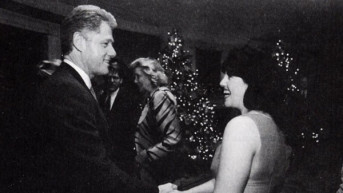
How all this was the opposite of the tender newspaper articles about Monica Lewinsky. "Sovereign, open, beautiful," journalists described her, "in a new Armani suit and with a new hairstyle." All this was decorated with her photographs with Bill Clinton. "The girl who 'terrorized' the poor American president," the media sarcastically described her.
Bill Clinton and Monica Lewinsky
In any case, she caused great trouble for the American president, from which he barely escaped. One, actually the most important part of the saga that was a formal reason for initiating the impeachment procedure, is that the American president lied. And the American president must not lie. Clinton, in fact, lied that he had spoken with Monica Lewinsky while visiting Bosnia and Herzegovina on December 22, 1997, before Christmas.
Clinton then visited Sarajevo with a large entourage and his wife, arriving by a U.S. Air Force plane from the NATO base in Aviano. He then went to Tuzla, where a large contingent of 8,500 American soldiers was stationed. It was in Tuzla that Clinton spoke with Monica, but he denied this during the hearing, and this dishonesty served to formalize the impeachment charges against the president.
The American president is now bombing Yugoslavia - will we also cause him trouble, and how will he get out of it? Perhaps I wanted to meet Monica Lewinsky to join in "terrorizing" the American president? Maybe I don't believe enough in our victory, so I want to meet someone who humiliated the American president? Logically, the medieval rule applies: the enemy of my enemy is my friend. Or are there the lowest tendencies towards bizarreness?
Thousands, mostly women, had already occupied Berlin's prestigious department store "KaDeWe" (Kaufhaus des Westens). Television cameras and journalists were given a small space opposite the table where Monica Lewinsky would sit with her authorized biography writer Andrew Morton. Morton also wrote the biography of another famous victim of unfortunate love - Princess Diana.
As I pushed through the crowd to get to a copy of the book, I stopped to talk to the visitors. "Clinton betrayed this girl. Many men and women do that, but he showed no desire to protect her," said one woman. "He is a scoundrel. See what he's doing to you, and what he did to this beautiful girl," another told me. They interrupted each other. "Their opponents used both of them...", "It's all Israeli espionage...", "Those crooks across the street," said a third, pointing to the building where the EU Council meeting was held, "treat us like Clinton treated her. They don't pay attention to ordinary people"...
Most believed Monica Lewinsky's words that she decided to speak publicly only after Clinton said in a public hearing, "I have nothing to do with that woman." "That woman" - those were the words that offended her. Now she was just "that woman." I took three copies of the book in which all this was recorded because I figured that while signing them, I could ask her something. No one would be able to stop me.
I headed to the room where a few journalists were to have their books signed. The security was almost as extensive as for the statesmen across the street. When I approached the table, I introduced myself and asked her if she approves of "the last adventure of the American president." She almost laughed heartily but only replied, "I don't comment on it." Then I asked her to at least gesture what she thinks about it. She nodded her head as a sign of approval of my previous question. So, she condemns. I asked her about her opinion on the bombing, but the answer was the same with the same warm smile. Then I invited her to come to Belgrade, under better circumstances, as my colleagues from a newspaper I was writing for at that time had instructed me. To stick together, us, Clinton's victims. "Maybe," she said as colleagues and security began to show disapproval. Our brief exchange of words ended, and I held the books signed by her.
When she approached to sign books for the gathered crowd, a semi-riot ensued with shrieks and screams, so the signing had to be temporarily halted. When order was restored, the signing continued. Outside, Kurds protested demanding their rights, but also against NATO and the bombing of Yugoslavia.
The European Union Summit had already begun. The press center was filled with thousands of journalists from all over Europe. When they saw "Yugoslavia" on my badge, they rushed from all sides: "Will Milosevic capitulate?" "What is the Serbian army doing in Kosovo?" "How long will the war last?"...
The press center was excellently equipped. Each place had a computer and phone whose use was free. Food and drink were also free. I spoke at length with friends in America. It won't be much of a loss for the European Union. Phone calls there are cheap anyway, especially from Germany to America. I gave dozens of statements about the war. Then the Euronews team came with news that the "invisible" F 117 plane had been shot down and wanted my comment on that. I quickly informed myself about what really happened, because for everyone in the room, it seemed like a severe blow to the credibility of the entire NATO venture. The F 117 "stealth" was a symbol of American air power. It was assumed that NATO could not lose its leading capabilities so quickly and easily. Later, I read about how it all happened. Here is how the air defense system, which even General Short respected, functioned.
"Dani commanded: 'Destroy target! Launch method t/t!' The Guidance Officer, Senad Muminovic, pressed the button to launch the missile. A muffled explosion. The starting motor of the first missile roared. The missile guidance station swayed. The first missile launched and after 5 seconds, the second. The guidance officer reports: 'First launched – first engaged (tracking operators by plane F1 and F2 begin to guide the missile towards the target), second launched – second not engaged (no possibility of guiding the missile). Distance 13 kilometers.' Operators by F1 and F2 steadily track. I get up from the shooting operator's assistant seat and watch the last kilometers of the missile's flight on the tracking operator's screen. At the point of the missile's and target's encounter, a light flash is seen on the display indicators. The target is destroyed. Time of destruction 20:42. We found the plane at an altitude of 6 km. A counter-missile maneuver followed, and it was shot down at about 8-10 km altitude. The other guidance officer parameters were not read, it was a matter of seconds. The whole process lasted about 23 seconds," described Lieutenant Colonel Aničic.
At some point, I read on the internet the brutal idea of Zbigniew Brzezinski that the bombing should include civilian targets as well as ground intervention, attacking Yugoslavia from all sides. I called Brzezinski, but I couldn't reach him. I got Morton Abramowitz instead. He listened to me and suggested that I write my view for "The New York Times." I immediately called David Sanger, a member of the editorial board of "The New York Times," with whom I had been in contact for the last few years. David agreed without much question to send him the text.
EU leaders deliberated non-stop. They decided on the expansion of the Union. The bombing of Yugoslavia was hardly mentioned. Somewhere around midnight in the press center, I saw Julian Brightwaite. He had recently been the press attaché at the British embassy in Belgrade, and now he was the head of Tony Blair's information team. His father, Sir Roderick, was the British ambassador to Moscow during the key years of Gorbachev and "perestroika." He had given me an extensive interview about that time earlier. I talked with Julian for almost an entire hour. Julian explained that the bombing would escalate until Milosevic finally signs what is demanded of him.
We will meet again in the morning under unusual circumstances. When the Summit ended in the early hours, the heads of government went to the large hall where they held press conferences. Exiting the press center, I bumped into a group of people. When I looked to the right, right next to me was British Foreign Secretary Robin Cook, and next to him, Tony Blair. A tall guy from the security went to my left and didn't even attempt to stop me from walking in that company. I saw Julian walking behind Blair. I greeted him, just so the security guy wouldn't change his mind. Then I introduced myself to Cook and asked him what the purpose of the bombing was. "To stop the humanitarian catastrophe in Kosovo," Cook said.
"When will the bombing be ended?" I asked further.
"Mr. Milosevic knows our phone numbers. Whenever he accepts our demands, the bombing will be stopped immediately," Cook replied.
I asked the British Prime Minister about the letter in which Milosevic called him a scoundrel.
"I haven't read that letter," Blair replied.
All the while, we walked together, so I was surprised that no one reacted to the intruder. Probably everyone was fed up with meetings and lack of sleep.
Returning to War
The next day, German newspapers excitedly reported the successful destruction of bridges and buildings. Most of those surveyed supported the bombing. Among the artists, one said, "We'll see what it means when we see bombers over Berlin. All of this will come crashing down on us." The next day, when the "invisible F117" was shot down, the euphoria completely disappeared.
Celebration in Buđanovci after the downing of the "invisible" F117 aircraft (March 28, 1999)
It was time to pack for Belgrade. The bus from Budapest was half-empty. The driver couldn't believe those who were returning.
The border was in the twilight. A customs officer entered and asked us to come out and show our luggage. Monica's books were on top of my small travel bag. The customs officer took them, looked at them, and saw the signature.
"Did you see her?" I responded affirmatively. "She's the reason Clinton is bombing us. If it weren't for her, he wouldn't have bombed us. Come with me." Almost running, with the book in hand, he went into a room where his sleepy colleagues were. "Look what the man has. He saw Monica," he almost shouted. The others slowly gathered around, looking at, flipping through the book. "Whore," one muttered.
The next day, I saw that Monica Lewinsky had already entered folk legends. "None of this would have happened if Monica had clenched her teeth," was one of the slogans at a concert in Republic Square. The people identified with Monica, unlike the customs officers. Although maybe they shouldn't. Is she an accomplice or a victim? Monica had been to Bosnia several times while she was an assistant to Kenneth Bacon, the Pentagon spokesman. She might have even been able to say something in our language because there are those who claim she knew some of our words. The folk sense seemed to be on the right track. Not only could the American president have lost his job because he lied about his phone conversations with Monica while he was in Tuzla, but Monica also spent two years analyzing and monitoring the situation in the Balkans while working at the Pentagon, as John Dolan writes in "Book Review." But, the strangely intertwined game of culprits and victims was not over yet.
A year later, anecdotes from my encounter with Monica Lewinsky on the first day of the bombing of the FR Yugoslavia, I told at a reception in Paris to Robert Badinter, a French lawyer, former Minister of Justice, and President of the French Constitutional Council. Based on the conclusions of the commission he led, the breakup of Yugoslavia was legalized, and Slovenia and Croatia were given a legal basis for international recognition. I asked him what he, as a lawyer but also a proven charmer, thinks about Clinton's behavior. "Horrible. He is not a gentleman at all. A gentleman must not sweat and blush for two hours denying what the lady admits," Badinter replied.
Badinter is accused of "killing" Yugoslavia. On the very day we met, he was proud that a man he had defended as a young lawyer had been released from prison. The case was lost because it involved the murder of a child. Already a major opponent of the death penalty, Badinter managed to save his defendant from the penalty that the public had already assigned to him. In the meantime, he completed high school and college in prison, and eventually earned a Ph.D. in history. He became the most exemplary prisoner in France. "If a man is free in his mind, he is free everywhere," Badinter concluded.
Similar words were repeated a few years later by another famous prisoner, Slobodan Milosevic. "Although I am in prison, I am free. Freer than you. I am free with both a small 'f' and a big 'F'," Milosevic said in court. I don't know if he would have ever said that if he knew he shared the same thought with Badinter.
0 comments