
FEUILLETON 25 Years of NATO Bombing of Serbia (27): Milosevic's "Sword of Surrender" Between "the rock and the hard place"
Writes for Kosovo Online: Dragan Bisenic
Vuk Draskovic's statements were interpreted as an attack on the unity in defense which could quickly become harmful, so it was necessary to remove it from public discourse. Momir Bulatovic arranged this with Milosevic. The crisis was allegedly ended by the idea of Vuk Draskovic's wife, Dana Draskovic, who stated that three ministers had resigned and that this was sufficient for SPO, and that the government could do whatever it wants with them. Thus, ministers from SPO no longer attended government sessions, but were only officially dismissed in August 1999.
NATO's air strike strategy was compared by SKY News analyst Francis Tusa to the systematic actions of British aviation in World War II.
"It is very systematic. It resembles actions from WWII, tonight Dresden, tomorrow Berlin. I do not mean to say the strategy is being copied, but there is a systematic destruction at night of everything that might have remained from previous attacks or was only damaged," Tusa observed.
During this time, Madeleine Albright had already deeply engaged in planning a ground operation, but insisted that it not be discussed at the just-concluded NATO Summit, to prevent it from becoming a stumbling block and a cause for division at an event that was meant to demonstrate NATO unity. As she already knew from her "Quint" phone calls, the British favored a ground option, Germany and Italy were against it, and the French would only support it in the unlikely event that it was approved by the Security Council.
"We did not want to spend the Summit arguing about ground troops," Albright admitted. What enabled the removal of the discussion was the personal relationship between Clinton and Blair. Before the summit, Blair came to the White House for a late-night meeting. Whatever they discussed, the NATO summit was spared division. Blair did not seek a firm commitment to a ground operation. Both leaders emphasized unity in all their public statements. With the support of the US, NATO began to plan for the possibility that air strikes would not be sufficient.
On the same day, on the other side of the ocean, preparations were beginning for the final moments of this global drama. Russian envoy Viktor Chernomyrdin first visited Bonn on April 29. He stated that former Yugoslavia was a "zone of direct German interests," as it would bear the brunt of reconstructing the Yugoslav economy. Chancellor Schröder, in Chernomyrdin's view, belonged to politicians who were most committed to resolving the Kosovo issue. The main message of the first meeting was that a military solution was a dead-end, in return, Schröder assessed the military operation as "an extreme measure," but referred to the obligations of allies in NATO. Throughout, he was interested in how Milosevic was behaving and whether he was ready for concessions. There was also talk of integration processes, so Schröder spoke at a press conference about the convergence of positions between Russia and the West.
Germany had, during this time, prepared its own plans for building Southeast Europe, so Joschka Fischer suggested to Chernomyrdin that he familiarize himself with the newly prepared proposal of the Stability Pact for Southeast Europe and support it. There were many participants in it, and a place for Yugoslavia was foreseen, but only after resolving the Kosovo crisis. Chernomyrdin noted in the document controversial proposals, which he could not agree with without additional explanations, so he told Fischer that the draft needed to be given meaning and that the Russian side would study it carefully.
Chernomyrdin also spoke by phone with Gore while in Bonn. The American Vice President wanted Russian help in concrete and important proposals that would serve a political solution to the Kosovo crisis. These included the withdrawal of military and police forces from Kosovo, the issue of the nature of the international presence, the formation of a temporary international administration, and the conditions for ending NATO military operations. When Chernomyrdin mentioned to Gore the appropriateness of conducting a peace operation under the UN flag, he reacted negatively, as leading figures in the American administration opposed the UN having a command and control function during the peace operation.
Chernomyrdin then proceeded to Rome. The new Italian Prime Minister, Massimo D'Alema in Parliament made an incredible statement – that NATO intervened because the Serbs had killed 300,000 people in Kosovo. He noted that Italy was inclined towards a peaceful solution, but as a member of the "great eight," it had to adhere to adopted positions.
Chernomyrdin also met with the previous Prime Minister, Romano Prodi, who had just been elected President of the European Commission, with whom he discussed the reconstruction of the economy and economy of Yugoslavia.
Chernomyrdin returned to Belgrade on Friday, April 30. There, he also faced the "support" he had during his stays and negotiations. Perhaps, to make Chernomyrdin's positions convincing, NATO strongly bombed primarily Belgrade this time as well, and Chernomyrdin referred to it as "NATO bacchanalia."
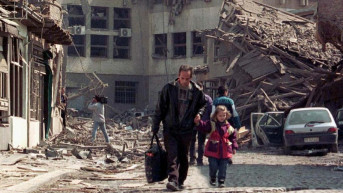
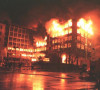
Belgrade had one of the most dramatic nights since the beginning of the bombing the previous evening. The city center was hit several times during the last bombing. Early in the morning, after 05:00 AM, Belgrade felt a strange earthquake of medium intensity, causing most residents to leave their apartments. NATO had hit several buildings the previous evening, including the General Staff and the Ministry of Defense in the city center. The Ministry of Internal Affairs of Serbia, which was also out of function, was hit a second time. The General Staff buildings were bombed twice, and in the second attack, nine people from the rescue team were injured. Bombs were dropped on the residential part of Belgrade, but there were no civilian casualties.
Near Belgrade, on Avala Mountain, the famous TV tower, which had been a symbol of this mountain and Belgrade for decades, was destroyed. As a result, TV Belgrade ceased broadcasting its program.
The Belgrade authorities announced that when two bridges on the Sava were demolished two days ago, there were several casualties, and television broadcast that image. Across the country, reports of civilian casualties among Albanians in Kosovo are being reported. Two days ago, it was announced that five Albanian children had been killed by a cluster bomb.
These were not good signals before the then-diplomatic activities in Belgrade. Observers explained that NATO and the US, with their latest bombings, did not support the peace efforts of many European diplomats, especially Russian special envoy Viktor Chernomyrdin, who was visiting that day. Before Chernomyrdin's first visit to Belgrade, NATO destroyed the residence of Yugoslav President Slobodan Milosevic, and on the night after that visit, NATO destroyed the building of Serbian television. Another type of explanation was that the US wanted to show distance from the visit of the American delegation that had come to Belgrade.
On Thursday, April 29, late in the evening, a large American delegation of peace and religious activists led by former politician and former Democratic presidential candidate Jesse Jackson arrived in Belgrade. Coming with a group of Catholics, Jews, Muslims, and Orthodox Christians, Jackson said their goal was linked to the fate of three captured American soldiers. In Belgrade, it was expected that Jackson could have a broader scope of activities, despite the White House publicly disavowing any connection with this mission. Jackson is President Clinton's personal confessor, and this fact led many to believe he could bring some diplomatic and political messages to Belgrade. Jackson indirectly confirmed the broader framework of his mission by describing it as a "path to peace." "American officials told me this is a dangerous path. But the path to peace is always dangerous," Jackson said.
Jackson and his delegation had several meetings - with Serbian Orthodox Patriarch Pavle, with the Foreign Minister of Yugoslavia Živadin Jovanovic, and with Yugoslav President Slobodan Milosevic. A visit to the American soldiers was also allowed, Jackson said.
The Serbian Orthodox Church announced that Patriarch Pavle would meet with the 34-member delegation, many of whom were American congressmen.
The most problematic issue for all peace negotiators was the international presence in Kosovo. Yugoslavia had so far accepted a UN international mission. President Milosevic held a meeting with top Yugoslav officials the previous day. They spoke "about the political process for solving the problems of Kosovo and Metohija," as announced in the official statement. Participants in the meeting very positively assessed the talks with Ibrahim Rugova and reiterated their readiness to directly lead the talks. Socialist Party spokesperson Ivica Dacic again said that Yugoslavia was ready to accept an unarmed international UN mission, without the participation of NATO countries and countries that participated in the aggression against Yugoslavia. The coalition partner of the Socialist Party, the Serbian Radical Party, repeated the same approach.
All this was preparation for the arrival of Russian envoy Viktor Chernomyrdin. The talks this time were conducted "one-on-one," Chernomyrdin noted. He emphasized that this time, "perhaps due to fatigue or real effort or under the impression of massive bombings," Milosevic "could not contain his emotions." From the beginning, he attacked NATO and the US for openly sabotaging the negotiation process. Under such conditions, it is not possible to talk about the withdrawal of Yugoslav military and police forces from Kosovo. He also announced that Yugoslavia had filed a lawsuit against 10 NATO member countries participating in the bombing of Yugoslavia at the International Court in The Hague. Although hopes are not high, let it deliver its verdict.
Under such conditions, it was very difficult to talk about the necessity of continuing the peace process, continuing negotiations, and seeking a solution. Milosevic did not want to hear about NATO's presence, which was precisely the condition the Americans demanded as a basis for ending the bombings. Milosevic argued that if both sides seek to resolve the conflict, one side cannot be the arbiter, giving epithets to NATO "that are not for listing."
Milosevic was an exceptionally tough negotiator, Chernomyrdin asserts. They talked for hours, and when he finally agreed that UN forces could come to Kosovo, a problem arose - he did not want NATO soldiers among the troops. The atmosphere of the talks, Chernomyrdin compared with the atmosphere of those days in Yugoslavia: "Outside, the wailing of sirens announcing air raids could be heard, reminding us that war was ongoing, that noisy spring at the end of the 20th century. The atmosphere of our negotiations was no less exciting and unpredictable." As an experienced negotiator, but also knowing Milosevic's psychology, which he had particularly studied before the talks, Chernomyrdin said: "Either we agree on concrete steps and try to stop the bombing, or we part ways and rely only on the Lord God!"
That worked. Milosevic realized he had gone too far, and he took a step back. After ten hours of talks, they signed a document determining NATO's role in resolving the conflict, containing concrete proposals for ending the bombings, procedures for withdrawing military and police formations, and the international presence in the province.
Chernomyrdin does not fail to say that it was difficult to convince Western leaders that he was not representing Milosevic's interests, nor a postman conveying messages from one warring side to another. His mission, he emphasizes several times, was to protect Russian interests in the Balkans.
The document states that Milosevic and Chernomyrdin agreed on the following:
Immediate cessation of all military operations, as well as violence and repression Ending the bombing is carried out simultaneously with the beginning of the withdrawal of military and police forces of the FR from Kosovo. NATO guarantees that it will not conduct a ground operation and the entry of KLA members into Kosovo. The dynamics of the withdrawal will be agreed upon during negotiations. Safe return of all refugees and displaced persons - citizens of the FRY, regardless of nationality and religion. Enabling unhindered access to international humanitarian organizations to fulfill their functions and cooperation with Yugoslav authorities and organizations. Resuming negotiations between Belgrade and political leaders of Kosovo Albanians on a political agreement that guarantees Kosovo wide autonomy with full respect for the equality of citizens and national communities, sovereignty, and territorial integrity of Serbia and Yugoslavia. International cooperation in rebuilding the economy of Yugoslavia including the region of Kosovo as a whole. International presence, at the same time, negotiations will begin between the FRY and the UN (Secretary-General Kofi Annan) on the international presence in Kosovo under the leadership of the UN in agreement with the FRY with an appropriate role for Russia which would ensure the return of refugees from Kosovo. Chernomyrdin gives no further details of these ten-hour talks. When he reported on the meeting to Russian President Boris Yeltsin, he was asked to fly directly to Washington and now agree with the American side. Directly from his residence "Russia," Yeltsin called Clinton and informed him about the talks in Belgrade, asking the American president to meet with Chernomyrdin. Clinton accepted.
The NATO war was an occasion for many intellectuals and writers to express their views on it. The vast majority were negative.
Austrian writer Peter Handke again spent this week in Serbia, and before May 1, he traveled back to Paris. After his two stories about Serbia, Handke reacted very sharply against the war. "Mars Attacks," wrote Handke, comparing the fate of the Serbian people with a modern holocaust. Handke, as a Catholic, decided to leave the Catholic Church because the church reacted to the war after 12 days.
"Thank you NATO! Thank you great little writers, from Gabriel García Márquez to Günter Grass, from Kenzaburō Ōe to Subcomandante Marcos for what they did not write. Thank you to the Pope and the Vatican for its white, whitewashed silence. A big step for humanity! However, for those on our planet Earth who have not yet turned into Martians and other green butchers, their homeland is, starting March 24, 1999, Serbia, Montenegro, the Republika Srpska, Yugoslavia. 'Mars Attacks' and from the Martian attacks, the whole globe is called Yugoslavia. 'Mars Attacks' and during the Martian attacks Helsinki, Madrid, Algiers, Dar es Salaam ('house of peace'), Jerusalem, Jericho, Baghdad, and even London, Paris, Berlin, and Washington will be part of Yugoslavia," Handke wrote.
Much of his prophecy indeed came true. Washington and New York were attacked in 2001, Baghdad soon after, Madrid and Paris were targets of terrorist attacks, and wars and conflicts became broader and stronger in the Middle East than ever before. Thus, bombed Yugoslavia and bombed Belgrade became the fate of many more cities and states than anyone could have expected then, and unfortunately, there will likely be even more.
Handke is constantly attacked by many European newspapers. He responded by stating that journalism now is the "Fourth Reich". At the beginning of June, his play about the war in Bosnia will be shown at the Burgtheater in Vienna. This piece should also be played in Belgrade on the same days. Protesting against NATO's action, the general director of the Burgtheater in Vienna and the director of Handke's drama, Klaus Paymann, left the theater.
He came to Serbia again at the beginning of this week and visited Kragujevac and Sabac with the intention of visiting other destroyed Serbian cities. During his visit to Kragujevac, he said: "This is the greatest crime after World War II, the greatest crime since the beginning of crimes, like the crime against the Jews in World War II, but in a different way. It is a crime against labor, against tools, against man and his future. The crime against tools with which man began to be a man, the crime is against man," said Handke, visiting the bombed and destroyed 'Red Flag' Car Factory. "This place, Kragujevac is the end of art," Handke said.
Kragujevac is the most symbolic place in Serbian memory, as is Kraljevo. In Kragujevac, German Nazis killed 6,000 innocent people, and in Kraljevo 4,000 in October 1941. Every year here, symbolic events are held to commemorate these events.
Handke announced that he wants to visit an old Serbian monastery in Kosovo – Decani, where he was last three years ago, and travel to Kosovo despite warnings that it is dangerous.
Unlike Handke, another well-known writer in the German language, Günter Grass, has a different fate. The newspaper "Novosti" organizes a large campaign to return Grass's books published in Serbian.
Immediately after the start of the bombing, Grass supported NATO's action. In his speech at the Leipzig Book Fair, Grass said it should have been done earlier and that he "was never a pacifist." "Novosti" announced that next Monday the first transport of books will start by train for Germany.
All books are collected in one bookstore in the center of Belgrade. Books arrive from all over Serbia, from public libraries, schools, and publishing companies. Translator Nikola B. Cvetkovic, who also translated Grass's books, said that returning the books is the best way to respond to a writer who is on the immoral side.
"For us, he was once a great name in German literature," said the director of the Library in Kragujevac, Branislav Stojadinovic. His statement is a call for the destruction of civilization and culture. It is direct support for the killing of children."
The director of the Library in Subotica, a city with a large Hungarian population, Edit Plankos stated, "We do not make an Index Librorum Prohibitorum, but we support this action."
Although Grass suggested a few days ago to "stop the bombing for 48 hours," the organizers did not change their intention. "We were loyal to Mr. Grass's books during the school period. We read his books, but he had no right to judge our people, because he was not with us," said the director of the Culture House in Leskovac, Bosa Panic-Tasic.
Mexican writer Carlos Fuentes condemned NATO attacks on Yugoslavia. "NATO's unilateral action establishes a very dangerous precedent," Fuentes wrote in an article published in the independent newspaper "Reforma." "Is the drama of the Kurds in the Turkish state smaller? Of course not. But Turkey is a NATO member and as such is freed from 'original sin'... 'Humanitarian reasons' abound also in sub-Saharan Africa, but their sin is that they are far away – and that they are African," concluded Fuentes.
On those days around May Day, which were very warm and sunny, NATO planes dropped numerous leaflets with various messages to citizens. One of them had this content written in Cyrillic: "Slobodan Milosevic has been gambling with the future of the Serbian people for years. His policy has lost Krajina, Eastern Slavonia, Baranja, and Sarajevo. He is now gambling with his pogrom in Kosovo. He is betting with the Serbian cradle, with the Serbian place in the world, and with the lives of his people. Is all this his, personal, and he dares to gamble it away?"
Among the notable statements was also the statement of Mexican actress Leticia Calderon, who played the leading role of Cassandra in the series "Esmeralda," which was also broadcast during the bombing and which gained enormous popularity in Serbia. According to those who organized the filming of her statement, it was recorded several times, as the actress accidentally hit and knocked down the microphone in front of her several times.
"Friends from Yugoslavia, from Serbia, and from Kosovo, I know through what difficult moments you are going through, the sufferings, pressures, fears that you and your families are experiencing, and I want you to know that on the other side of the world in me and all my colleagues from 'Televisa' there is an unconditional feeling of solidarity with you. We support you and pray for you! I am aware of the sympathies that 'Esmeralda' has with you and for that, I am grateful. I hope that this story of love represents for you at least a small door of light, a window of relief, a ray of hope in these difficult times. On behalf of EKA and Televisa, on behalf of all who work in this series, on behalf of all Mexicans, a people who are proponents of peace and respect, I send you a feeling of sentimentality and eternal sympathy towards you."
Chernomyrdin spoke with Clinton from 4 – 6 PM on May 3, and that meeting was not officially recorded. Before that, Chernomyrdin and Gore met with their delegations.
Strobe Talbott recalls that American Vice President Al Gore and Chernomyrdin spoke on the phone for more than an hour on April 26. They agreed that it was better to meet in Washington seven days later, on May 3, rather than renew the work of their commission. Gore's campaign for the presidential elections, as a Democratic candidate, had a thorny start. He faced a challenge from former New Jersey Senator Bill Bradley and had a problem positioning himself relative to the Republicans. Polls indicated that he was far behind the two frontrunners, George Bush Jr. and Elizabeth Dole.
"When I visited Chernomyrdin in the Gazprom office on Tuesday, April 27, his first words were: 'It pains me to see that our previous achievements – which we can be very proud of – are turning to dust and ashes,'" recorded Talbott.
During the just-completed visit to Belgrade, Milosevic was explained that Russia was ready to act as a "...mediator, but not as a lawyer or defender."
"Our intention is to achieve a peaceful solution, not to – carry out Milosevic's crazy commands," Chernomyrdin said, according to Talbott's accounts.
NATO needed to "provide Milosevic with a way out." At this moment – "you are cornering him." If the bombing continues, the Russian envoy said, Milosevic will endure and NATO will have no choice but to carry out a ground invasion of Serbia. Ground warfare would give the Serbs "an excuse for bloodshed, which is their specialty." It would be "a general disaster if you enter into ground warfare there and I think it would be a disaster literally for everyone!"
"He looked at me significantly to make sure I understood what he was talking about. Of course, I understood, especially after Yeltsin's comments which exuded a threat in the conversation with Clinton, two days earlier" .
In early May, Chernomyrdin traveled to Washington to meet with Gore. They briefly saw each other during the afternoon of May 3, and then continued the conversation, which lasted more than three hours, at the Vice President's residence on Massachusetts Avenue. In the context of the relationship and cooperation of these two politicians over the past six years, this meeting seemed unusually stiff, like treading water and unproductive.
Towards the end of the conversation, Chernomyrdin suggested finding "someone neutral" with whom he could work in tandem, someone, as he described it, "who could receive Milosevic's sword of surrender," says Talbott.
The trick was to find a statesman who was not connected with NATO, but who supported the conditions that the Alliance had offered Milosevic. The best candidate for this was the President of Finland, Martti Ahtisaari. He was the head of a country that was not a member of the Atlantic Alliance, and which was about to take over the rotating chairmanship of the European Union in June.
Sandy Berger liked the plan and called it: Hammer and Anvil. Chernomyrdin would strike with all his might at Milosevic, and Ahtisaari would provide support so that the "beaten" Milosevic would accept NATO's conditions.
Madeleine Albright provides more details and reveals that the role of mediator for the Finnish President Martti Ahtisaari was her idea. Chernomyrdin arrived in Washington on May 3. Chernomyrdin brought with him a letter from Yeltsin proposing a ceasefire, during which Kofi Annan and Chernomyrdin would travel to Belgrade to negotiate a settlement. This agreement would then be implemented by the UN. President Clinton responded that we will not allow the UN to negotiate on behalf of NATO.

0 comments