
FEUILLETON 25 years of NATO Bombing of Serbia (37): British End-of-War Strategy
Written for Kosovo Online by: Dragan Bisenic
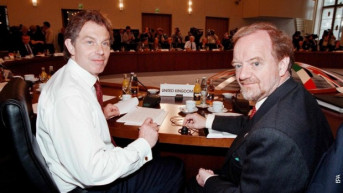
Ahead of the final negotiations and their preparations in late May, British Prime Minister Tony Blair consistently convinced Clinton of the necessity of a ground operation. Blair saw not only the need for the operation itself but also for his "leadership" in it. He wrote about it, stating that his action "interestingly speaks to leadership" because these are "decisions that define, separate, and those characteristics of high command".
"It goes like this. You have a strategic goal. Let's say you've embarked on it. You encounter an obstacle. The cost of its removal seems high. Anyone who doesn't sit in the leader's chair can discuss it. The cost is very high, says one; the goal is very important, says another; the pros and cons are enormous, says a third. The leader must decide whether the goal is worth the cost. Moreover, he or she must make an uncertain estimate of what the exact cost or price of not achieving the goal might be. Both must be judged and measured against inaccurate science. Those not in the seat can point out the cost, but they don't have to say what prevails. Their responsibility may be acute, but it is not final. That responsibility lies with the leader.
In this context, indecision is also a decision. Inaction is also action. Both omission and execution have consequences. So, yes, a ground war in the Balkans. Are you crazy? But if the alternative is Milosevic's victory, then what is the cost of peace in the wider region? What is the price of NATO's credibility? What is the cost of deterring a dictator?" Blair wrote, setting up a Manichaean dichotomy as the basis of his dilemma.
He concluded that "no matter how high the price, my decision was that the cost of allowing Milosevic to triumph was so high that it cannot be accepted. So, if the only way to avoid that cost was a ground operation, we had to do it," Blair stated, noting that it was still a "minority view".
According to what Chernomyrdin testifies, Blair's thinking was compatible with Milosevic's, and that was precisely something Russia desperately wanted to prevent. Milosevic, as Chernomyrdin notes, once said that NATO should be allowed to "begin", "let them just come to our country". Chernomyrdin retorted that they would first be leveled to the ground, and only when they realized that they had been shelled to the ground, then they would come. "They will come quietly and calmly," Chernomyrdin said.
"Viktor Stepanovich, we would rather die than allow that... We've been here for 400 years..."
Blair's right-hand man in promoting his goals was Alistair Campbell, or the "Prince of Darkness" as he was called on the Thames, who writes in his diary how NATO is preparing to "turn off the lights" in Belgrade, which still refuses to capitulate − alliance bombers will target key electrical installations across Serbia. "Prince of Darkness," as he was colloquially dubbed on the Island, is Alister Campbell, at that time Tony Blair's propaganda chief, and his diary is a thick book titled "Power and Responsibility." Excerpts from that diary were later included in his second, much more extensive book, "The Blair Years," which also provides an overview of British propaganda and military actions during the NATO attack on Yugoslavia.
Campbell, whom Blair appointed to be the chief media controller of the NATO attacks, recommended that the military operation must be based on simple concepts, like any supportive media campaign; that they shouldn't have to deal with the media all the time and must allow professional media advisors to take over so they could focus on the military; that the morale and efficiency of the operation could be enhanced by a sense of strong and coordinated media messaging spread worldwide. On the train ride back, he prepared a detailed plan for media behavior during the bombing, and Blair discussed it with Clinton, who said he thought NATO should stay until it finished. Campbell confirmed Blair's dark mood by noting that NATO didn't feel victorious at all. They felt their hands were tied behind their backs, and Campbell found them somewhat desperate and demoralized. He felt Clark would be in bad shape if this lasted too long. "Tony said we'd have to take over this show," Campbell revealed.
British Chief of the General Staff, General Charles Guthrie, considered Wesley Clark not "the right general," while according to his deputy, Briton Rupert Smith, he was suspicious, though he deemed him "an appropriate commander." During a visit to NATO on April 20, Blair saw a nervous Clark, while Milosevic remained very strong despite the destruction of part of his capacity. Clark spoke of Milosevic in a "very personal way," so Blair got the impression that he took this mission too much as "personal," and less as a task of military leadership.
In his diary, Campbell also reveals how the bombing of RTS came about, revealing that he was even personally involved in it, although later Tony Blair pointed out that it was not his "primary responsibility." Clark, after Blair left, called Campbell for a meeting. "I thought it would be about a meeting or his profile, I had sent him a message earlier. Instead, he took me to a raised platform and opened the book lying on it. It contained satellite images of targets. He specifically showed me various images of RTS in Belgrade (TV) and the headquarters of the Socialist Party, which was used as a radio broadcasting center run by Milosevic's daughter. He said the French would allow him to target one, but not the other. Next to the RTS picture was 'the risk of collateral damage is very high.' It was next to a church and other buildings. The party headquarters were more open. He wanted to hit both because his media machine was a legitimate target, but the French were very unsure. He intended to hit the TV station. I said we had been discussing this for weeks. But he said there was another problem. This was where some of the Western journalists did their shows. Ken Bacon [spokesman for the US Department of Defense] said there were no safe places in Belgrade, which was the closest thing we had to a warning, but he asked how big of a problem it was. Suddenly it occurred to me that they were asking me if the significance of the target was enough for me to live with the consequences of anger and probably death among Western media. 'Can I do that?' he asked. Not as 'do I have permission?' but 'is this feasible?' He said, 'I need your answer within an hour if that's okay.' Then Solana called. Clark said, 'Alister and I are discussing whether to bomb it. The French are tough, but I'm for it.' I said after the call ended that it was not difficult to prove that it was a military target, and yes, unless we were afraid there was a human shield, there was no difference between a journalist working and any other civilian who might be injured. He said if he could bomb a TV today, electricity tomorrow, we'd really start to make progress. I ran into Rupert Smith, told him about the conversation, and he said that was typical of him. 'He should do it. His decision, no one else's. Right call.' I talked to Tony Blair about it. He said maybe he was just trying to flatter me by making me think I was really involved in an important way. Also, I noticed he couldn't resist telling Solana I was there and involved in the discussion. Blair said I should tell him I'm here to be helpful, but that wasn't the responsibility I expected at this time. Fortunately, in our media monitoring report, I recorded a line from John Simpson (BBC's editor for global affairs) who said he was 'invited' to the TV station but didn't go, suggesting the media understood it could be a target," Campbell described.
These lines are an unusually cold acknowledgment by one of the most important people directing global public opinion during NATO's confrontation with Serbia, precisely about his role in bombing a TV station and the subsequent killing of 13 journalists and television collaborators, although Campbell was inseparable from the journalism profession. Campbell didn't flinch when he approved the bombing and destruction of the television, approving Wesley Clark's idea. This passage sheds a very clear light on the responsibility for this action on Wesley Clark, who, despite French opposition, decided to bomb the RTS building. Blair better judged this situation, commenting that the discussion about the destruction of RTS was not something Campbell's "primary responsibility" was about. It is worth considering the behavior of the renowned BBC journalist, John Simpson, and perhaps other journalists, who were pre-informed about the bombing of RTS and remained silent about it, opening a debate about the role of journalists in military actions and where the boundary lies that turns a reporter into an active accomplice? Clark pays no attention to this event, except noting at one point that he "has not yet received permission to target TV and power plants."
In shaping Blair's stance, former Prime Minister Margaret Thatcher played a special role. Thatcher was a radical opponent of the leadership of Serbia and Slobodan Milosevic since the late 1980s, while she was serving as British Prime Minister. She told Blair that she couldn't understand why Clinton wasn't more decisive and why he didn't take stronger actions.
Margaret Thatcher was an early advocate of the use of force against Serbia and Milosevic. For example, at a lecture at the Faculty of Economics of the University of Zagreb on September 16, 1998, she said, "There is no longer terror and oppression in Croatia, not even in Bosnia and Herzegovina, but in Kosovo, where ethnic cleansing has taken hold."
However, Thatcher did not unconditionally justify and support the position of the British government and Tony Blair, because she was a great and sincere opponent of the doctrine of "humanitarian intervention" as it was portrayed from the beginning, "the Kosovo campaign." "There was, of course, at one level, a somewhat hypocritical reason: by focusing on humanitarianism instead of the use of force, uncomfortable questions about the need for direct UN authorization (which could not actually be obtained due to opposition from China and Russia) were avoided," Thatcher emphasized, stating that "coercive humanitarian intervention, which represented a hitherto unknown doctrine of uncertain reach and questionable legality, had now begun to emerge as the basis for a revived, albeit undeclared, new world order."
Thatcher, even when the book was published in 2002, suggested that the status of Kosovo be decided by a "fair referendum," and that Serbs in Kosovo be guaranteed their rights by the Constitution and that "Serbian sanctuaries be respected."
On May 2, there was no mood for a toast in Downing Street. Tony Blair was dissatisfied with the results of the bombing of Serbia, so he ordered Alastair Campbell to urgently orchestrate the media in Britain and Coalition countries; to present the bombing of power plants, substations, and power lines in Serbia to the public as a strike against "legitimate military targets." Blair, for his part, picks up the phone to "boost the spirit" of Bill Clinton in Washington for the second time in two days. The previous day, on May 2, he suggested to the US president to immediately establish a joint British-American "Nerve Center" in London, from where all the propaganda of "punishing Serbia" would be commanded. Since the previous day, there has been no response from Clinton, so from Campbell's diary, we learn that Blair is "extremely frustrated": "T.B. (Tony Blair) is disappointed with the Americans, he feels that the entire American machinery is not acting at the speed we (the British) are demanding."
In the cabinet, George Robertson and the others came to make a presentation about ground troops. Charles Guthrie stuck a map above the fireplace and went through three routes - Albania, Macedonia, Montenegro? - and explained why all three were difficult. He said there were two options for invasion - limited, meaning three months and at least around 80,000 soldiers; or unlimited, which would mean 200,000 soldiers, and there was still no idea where they would come from. Blair nodded silently, occasionally sighing loudly, and clearly taken aback by the scale of what was supposed to be a sure thing - and even then, he wouldn't be that sure. He said we had to continue with preparations and hope in the meantime that the air operation had improved efficiency and intensity. Campbell notes that the "Serbs claimed that NATO bombs hit a convoy of refugees, killing many," so he called Jamie Shea (NATO spokesperson) and said that while the facts are being established, the "history of lies told by the Serbs about the victims" must be prepared. At first, it was not clear whether the claims were true or not, and it proved difficult to extract information from the military. Blair came on Clinton's phone call. Both of them are now quite panicked. Clinton said that efforts should be made to persuade Chirac to support attacks on Phase 3 targets and to assist Solana and Clark.
Clinton said he would rely on Chirac and say that we will all pay the price for it if we end up unable to make decisions that the military believes are necessary, and the suffering lasts longer than it should.
Tony Blair fears that Clinton in Washington has not yet made a decision; that he is overcalculating the possible reaction of the Russians. At that moment, however, Blair, Campbell records, wants to "convince Clinton and NATO allies of the need for a ground invasion as early as the first phase of the air campaign," in case the bombing does not lead to Serbia's capitulation and Milosevic's fall. He is particularly afraid that in some circles at NATO headquarters, but above all in Bill Clinton's mind, ideas about some kind of "peace deal" with Milosevic are swirling.
"We are too slow, not energetic enough," Blair laments to Campbell, who adds that his boss had already made a decision; that there could be no negotiations with Milosevic, regardless of what others, the allies, think... "And I cannot understand in any way how Clinton, as a subtle politician, cannot think along the same lines as we do."
On May 3, Tony Blair was not at all impressed by the previous results of the bombing of Serbia, so he decides to personally pressure NATO allies to be "more aggressive and faster."
Blair on May 4th confides in Campbell that he is definitely convinced that (Blair) personally needs to take over the operation because he "feels" that at that moment and with the current mood among the allies, he is "the only person capable of convincing the Europeans and persuading them to provide enough boots for a ground invasion."
Blair is determined to personally secure about 100,000 soldiers. That would then be a good argument to pressure Clinton to enter with 50,000 Americans. That number would be sufficient, as suggested to Blair by his people in the Ministry of Defense, to successfully "deal with the Serbs." Blair's wife, Cherie Booth, according to Campbell, at that moment draws her husband's attention to carefully calculate the matter because, as she claims, "the Americans are ready to provide up to forty percent of military involvement."
Already on May 6, Blair confides in Campbell that he has "thundered - flashed" decided to gather a sufficient number of soldiers for the campaign against the Serbs, but that he trusts only his Britons and Americans for the rest of the personnel, although, as for the Americans, Clinton is still "wobbly." His propaganda machine will take care of the rest of the staff. To begin with, Blair, therefore, guarantees 40,000 Britons; The Germans will "perhaps" enter with around 8,000, and the rest will be filled by smaller countries, NATO members. Blair is sure that he will complete the remaining work with his personal lobbying.
At that moment of the bombing operation, Blair's adviser on Serbian issues (later Paddy Ashdown's adviser in BiH) Julian Braithwaite, who sits in the NATO Operational Center in Belgium, confides in Campbell that the day before he had a long and "interesting" conversation with Blair about Serbia and the Serbs: "I understood why we must, at all costs, separate Milosevic from the people, and I definitely got the impression that Blair doesn't like, he hates the Serbs at all."
On the same day, the head of the Foreign Office, Robin Cook, also complained, after a meeting of the G8 ministers, that the Americans "are still wobbling and are of no use"; that "they remain silent and sit on their hands whenever we try to encourage them to take more decisive action."
And Tony Blair complains to Campbell on May 6 how Clinton has just, in response to the question of whether Milosevic should (politically) survive, replied that he would have no problem with it, so Blair immediately calls Clinton and - despite such a statement - gets the impression that the American president has, however, "moved" from his previous, wavering position, and that now, after British pressure, he would accept a ground attack on Serbia. After this phone call, Tony Blair confides in Campbell that he felt that Clinton had indeed "softened" and that he had "put him (Clinton) back on the position where we (in London) wanted him to be from the beginning."
Since he thinks he has done the job with Clinton, Blair does not hesitate - he flies to Paris to see Prime Minister Jospin and is pleased to meet a like-minded person at Matignon. Campbell follows Blair on that trip and writes after the meeting: "Jospin turned out to be very tough on Milosevic and thinks (like us) that there is no situation in which France would agree to him to remain in power in Belgrade."
Jospin also believes that "Martti Ahtisaari should talk to Milosevic, but it should be a conversation that leads exclusively to the fulfillment of all the Coalition's demands. However, Blair comes out of the meeting with the impression that Paris is still "indefinite" about the ground invasion of Serbia.
At that moment, at the end of the aggression against Serbia, Tony Blair once again calls Clinton to agree on further "treatment" of Serbia, now that they are reaping the "sweet fruits of victory." Clinton believes that the allies should already develop a short-term plan that would lead to some kind of pact of stability in the Balkans, but above all, "we should hoodwink Milosevic and allow the Serbian people to formulate their vision of the Balkans themselves, while we already work on it."
At that moment, Tony Blair believes, Campbell records, that the West should generously "channel money to Serbia's neighbors," but that "Serbia should not get a cent"... The Serbs should know that "Milosevic totally messed up."
0 comments