
FEUILLETON 25 Years of NATO Bombing of Serbia (33): Bombing and Destruction of the Chinese Embassy
Written for Kosovo Online by Dragan Bisenic
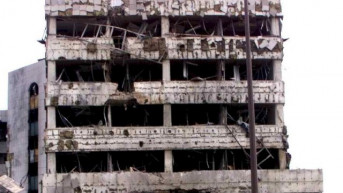
President Clinton assessed that on May 7th, there was the most significant political setback in the conflict when NATO bombed the Chinese embassy in Belgrade, killing three Chinese nationals. "I soon learned that the bombs had hit a targeted site, which was incorrectly identified as the Serbian Government building used for military purposes based on old CIA maps. This was the kind of mistake we had worked hard to avoid. The military primarily used aerial photographs for targeting," Clinton stated.
On the night between May 7th and 8th, the most massive attack on Belgrade since the beginning of NATO's attack on Yugoslavia was carried out. The Chinese embassy building in Belgrade, Hotel Yugoslavia in New Belgrade, the building of the Federal Ministry of Internal Affairs, the General Staff and the municipal MUP Savski venac near the Railway Station were hit and destroyed. Areas of Rakovica and Avala were targeted, and several substations in Belgrade were knocked out of operation using special graphite bombs. During the night, NATO bombed the Oil Refinery in Pancevo, Novi Sad, Paracin, and Sombor. It was later revealed that American bombers had flown directly from a base in the USA and dropped five guided missiles on the Chinese embassy building. Three journalists were killed and several Chinese officials were injured.
Since then, President Clinton personally took control of selecting targets for bombing. "I began meeting several times a week with Bill Cohen, Hugh Shelton, and Sandy Berger to review high-profile targets in an attempt to maximize damage to Milosevic's aggression while minimizing civilian casualties. I was shocked and deeply troubled by the mistake and immediately called Jiang Zemin to apologize. He refused to accept the call, so I apologized publicly and repeatedly," Clinton described.
Madeleine Albright noted that the fact the embassy was hit multiple times led Beijing to accuse the US of a deliberate attack. "In this case, NATO's exalted military reputation worked against us, as it was hard for the Chinese to believe that we could make such a mistake," Albright explained.
She decided in the middle of the night to visit the Chinese ambassador accompanied by Thomas Pickering and Joseph Ralston, whom she asked to wear a general's uniform for that visit to Washington, and to personally apologize to him on camera.
On the morning of May 8th, an extraordinary session of the United Nations Security Council was held at China's request.
The Chinese representative read a statement from the Chinese government stating that the attack constituted a violation of China's sovereignty and the basic principles of international relations. Additionally, China strongly condemned this "barbaric act" and vehemently protested, demanding that NATO, led by the United States, take responsibility and retained the right to take further measures. Further in this statement, the attack on the embassy was called a war crime.
The US representative said that the facts had not yet been confirmed, but that NATO was investigating the matter. He also stated that NATO did not target civilians or embassies and that he deeply regretted if NATO was responsible for the incident, but that only one man was responsible for the crisis, Slobodan Milosevic.
The Dutch representative emphasized that he did not accept the comparison of "accidental victims" with systematic killings, rapes, and burnings of homes for which Belgrade was responsible. The Cuban representative stated that it would not take 20 years to understand that this war was a mistake.
In any case, massive protests were held in front of the American embassy in Beijing, and embassy staff were not allowed to leave. In these circumstances, CNN invited Henry Kissinger, not just as an expert on China, but as a man who enjoyed great trust from the Chinese leadership, to comment on the consequences of NATO's bombardment and destruction of the Chinese embassy in Belgrade.
Commenting on the bombardment and destruction of the Chinese embassy in Belgrade by NATO, Kissinger on May 11, 1999, assessed that "Chinese behavior was disproportionately provoked" and that it was "very dangerous to provoke the United States by keeping our ambassador confined in the embassy," especially an ambassador who was so dedicated to improving Sino-American relations."
He started from the premise that the Chinese "rationally conduct foreign policy—showing the level of frustration that has now found a point of expression." Regarding the administration's policy towards China, he said it was "essentially the correct policy—a attempt to establish a relationship of cooperation with China," but noted that the domestic debate about China had been very heated.
The administration did what it always does, tries "to steal" as much of the criticism from opponents and turn it in its favor by saying—by never justifying the agreement or really justifying the relationship based on its values, but by pretending—engagement will make them whatever the critics want them to be.
Kissinger pointed out that the war in Kosovo seemed extremely threatening to China. He started from the basis that the original American stance toward China in 1971 was the Brezhnev Doctrine, in which the Soviet Union affirmed the right to influence the domestic evolution of other countries based on its opinion of what should be right and proper for them. "Thus, they see our justification for what we do in Kosovo as affirming NATO's right to interfere in the affairs of other countries even when those countries do not physically threaten NATO. This is a principle they find very unacceptable. If I look at the president's apology, for example, he apologized as much as possible. But he also said, 'You must understand why we act this way in Kosovo.' Thus, they must sign off on accepting that apology for our explanation for Kosovo which they completely reject," Kissinger pointed out the paradoxical contradiction in the Clinton administration's stance towards China. He noted that the relationship between America and China had been worsening from four years ago to the conflict in the Taiwan Strait.
He said he did not want to "teach" the Chinese, but he did not think that "the way to deal with us—to kick us." At the time, he warned the Clinton administration to understand that it could not treat this problem "as if it were some primary campaign in New Hampshire where we can, you know, on the one hand, say the right things as far as they are concerned, and then satisfy any domestic opposition and then say, 'Understand why we really do this.'"
Kissinger suggested resolving the dispute by having Washington send "some respected person, like Colin Powell to the embassy, and not send anyone to China now—to bring the maps and whatever else we used and to say, 'This is why we did it. We are sorry for this. This is our explanation. Honestly, I would strongly imply that this is all the explanation you will ever get on this topic, because that's all we can do," Kissinger said.
At that point, the host, Charlie Rose, interrupted and asked if he accepted the explanation that NATO had bad maps and that's why NATO bombs fell on the embassy?
Kissinger responded that he believed in the explanation. He then noted that he was told some "senior Europeans do not believe in this explanation." He dismissed the possibility of being the one to convey an apology to the Chinese, as he was not qualified to explain it. "I would leave it to someone who is technically competent in bombing," he pointed out, indicating that they should not be explaining the Kosovo issue to them, as it is a separate matter and they do not have to agree to the bombing and the overall problem it relates to.
He concluded that the administration was better at public relations than at the essence of this issue, where it had failed significantly. He compared it to the president spending 9 days in China, but only two hours with Chinese leaders. Kissinger was irritated by the headlines in American newspapers that fueled the conflict. "Where will we be in five years when every Asian state can maneuver between us and China if this turns into a real confrontation?" Kissinger wondered.
Over the next three days, protests escalated across China. They were particularly intense around the American embassy in Beijing, where U.S. Ambassador Sasser found himself under siege. The Chinese said they believed the attack was intentional and refused to accept Clinton's apologies. When Clinton finally spoke with President Jiang on May 14, he apologized again and said he was sure he did not "consciously attack his embassy." Jiang responded that he knew Clinton would not do that, but said he believed there were people in the Pentagon or the CIA who did not favor Clinton's approach to China and might have intentionally set the maps to cause discord between the two countries. "It was hard for Jiang to believe that such a technologically advanced nation as ours could make such a mistake," Clinton stated.
Russia sent Chernomyrdin to Beijing and threatened to break off negotiations, leading to a new crisis within NATO. During this time, German Foreign Minister Joschka Fischer withstood a party rebellion and kept Germany aligned with other countries in the operation.
An investigation later determined that Colonel William Bennett of the U.S. Army was responsible for the mistake in identifying and defining targets. Bennett was an expert on the deployment of the American anti-missile system Patriot abroad and had also worked for the CIA in identifying and verifying targets in Serbia for NATO bombing in the spring of 1999. Bennett was killed under mysterious circumstances at the end of April 2009 in rural Loudoun County near Washington. Although it is not impossible that it was a random murder, or even a crime without motive, a shadow of doubt will likely remain over his death, as well as over the circumstances that led to the bombing of the Chinese embassy in Serbia.
Military personnel and subsequent investigations began from the premise that in the weeks before the bombing of the Chinese embassy in Belgrade, NATO was under enormous pressure to escalate its war against Yugoslavia. The supreme commander of the alliance had demanded 2,000 targets in Serbia—a number some aides considered arbitrary and too large for a country the size of Ohio.
As the Kosovo War began with too few targets and an unrealistic hope for a swift victory, NATO was forced to search for new objectives. A NATO official mentioned the intense pressure that even staff like cooks and drivers with high-security clearances were called into the NATO targeting office in Mons, Belgium, to help with paperwork for potential missions.
In this pressured environment, the CIA presented its first proposal for a target in the war. It was chosen by the Division for Counter-Proliferation, which lacked specific experience both in the Balkans and in selecting bombing targets. The target was accepted without further military verification, a fact that later fueled doubts about the American claims of an accidental mistake.
The target was, in fact, the Chinese embassy. It was described in a classified document approved by President Clinton as a warehouse supposedly serving as a procurement center for the Yugoslav Army. The document included a satellite photo, casualty estimation, and location description.
Only the casualty estimation proved accurate. The significance of the target for the war was misrepresented, and a high-ranking intelligence official noted that any imagery expert should have clearly seen that the depicted building did not resemble a warehouse or any other Serbian government building.
Prompted partly by articles in two European newspapers suggesting that the bombing was intentional, The New York Times interviewed more than 30 officials in Washington and Europe. While the investigation yielded no evidence that the embassy bombing was deliberate, it did provide a detailed account of a broader set of mistakes than the United States or NATO had admitted, pointing to a wider circle of blame beyond the government's explanation of a simple miscalculation by a few CIA individuals. Retrospectively, it was noted that the bombing, if unintended, could have been avoided at several points along the way.
Eleven months later, CIA Director George J. Tenet dismissed a mid-level officer who had marked the location that turned out to be the embassy. He also reprimanded six other employees, stating that agency officials "at all levels of responsibility" contributed to the bombing. Tenet later wrote his memoirs, but they contained no mention of the war against Serbia or the bombing and destruction of the Chinese embassy.
China dismissed these actions by the CIA chief as "inadequate." American officials attempted to explain how such a bizarre chain of errors could occur in intelligence and military organizations that pride themselves on technological strength.
"This was a mistake compounded by other mistakes," said Undersecretary Thomas R. Pickering, who had the task of explaining the attack to the Chinese the previous year. Even some NATO and American officials admit they cannot explain how and why so many errors occurred.
Chinese officials were particularly suspicious since the attack hit the defense attaché's office and the embassy's intelligence cell. However, what neither they nor American officials disclosed is that the bombs, according to Pentagon officials, were actually targeted across the entire building. At least one, possibly two bombs did not explode, officials said.
If the attack had gone as planned, the embassy would have been demolished, and the death and destruction much worse.
Even some of those who accept the American assurances that the bombing was accidental say the guilt is indisputable.
"It was a systemic problem," said Representative Porter J. Goss, a Florida Republican who was then chairman of the House Permanent Select Committee on Intelligence. "It wasn't just a problem at the CIA. The fact is that someone in the Pentagon at least should have stood up and said it's not just the agency's fault. Firing one person and absolving all other agencies—including the White House—does not do justice."
The original NATO plan was to bomb Yugoslavia for two nights, with daily pauses to allow President Slobodan Milosevic to agree to NATO's demands to withdraw Serbian forces from Kosovo. "Show them a bit of force—boom! boom!—and they will fall. That was definitely the prevailing opinion," said a NATO officer in Belgium.
American officials said they were always prepared for a longer war, but when the bombing began on March 24, NATO had only 219 targets across all of Serbia, focused on anti-aircraft defense and military communications. Fifty-one of those targets were hit on the first night; by the third night, NATO had nearly exhausted half of the initial targets. "We woke up and saw that Milosevic wasn't going to come out on the lawn with a white flag," said a NATO officer.
This realization sparked a scramble to find more targets. While diplomats struggled with whether to start bombing politically sensitive targets, including those in Belgrade, NATO military commanders, who had spent four decades planning a war against the Soviet Union, found themselves utterly unprepared for the task of selecting targets for this kind of air campaign, officials said.
The alliance had only two targeting centers, one at the Joint Analysis Center in the UK and the European headquarters of the Air Forces in Germany, both managed by Americans.
Only the UK also contributed fully developed targeting proposals, and there were only a couple of dozen, according to NATO officials.
As the war continued, offices "produced" 10 to 12 new targets daily, while allied pilots struck at twice that rate.
In early April, the commander of the alliance's air force, Lieutenant General Michael C. Short, continued to highlight the problem during morning video conferences of NATO commanders. "I'm running out of targets," he said one morning.
NATO Supreme Commander in Europe, General Wesley K. Clark, asked why he didn't have 4,000 targets on his desk, a NATO officer said. By mid-April, General Clark had halved his request, and the intelligence director of the Air Forces for Europe, Brigadier General Neil T. Robinson, who was responsible for this, agreed. Every morning, General Robinson briefed commanders on progress toward the goal. A month into the operation, they still had only 400 fixed targets, not counting tanks and other weapons pilots were trying to hit in Kosovo.
Target selection is usually a painstaking process involving a pile of intelligence reports checked and rechecked against satellite photos. By mid-April, NATO had reached out to any military command with targeting expertise.
At that point, General Clark began to expand the scope of targets to include electrical networks and commercial facilities such as tobacco warehouses and the "Red Flag" car factory. "You've destroyed almost all military targets of significance," said an assistant to General Clark. "What do you do now? You start looking for other targets."
Despite this, by the end of the war, NATO had produced only 1,021 fixed targets. About 650 of those were bombed.
Among them was one that had arrived by fax from the CIA. The CIA had provided information on numerous targets throughout the war, but it had not previously been asked to propose its own, said Pickering and other officials. Its history of selecting targets was somewhat questionable. During the Persian Gulf War, it had sent bombers to a supposed intelligence bunker that turned out to be an air raid shelter filled with women and children.
The agency has its own targeting cell, but the Division for Counter-Proliferation, a small office focused on non-proliferation of missiles and nuclear, chemical, and biological weapons, proposed this target.
Officers there reportedly saw the war as an opportunity to destroy the headquarters of the Federal Directorate for Supply and Procurement (Jugoimport SDPR), which had long been a concern because of its suspected involvement in smuggling missile parts to places like Libya and Iraq, said intelligence officials.
The directorate is part of Jugoimport, a purported private corporation, but one that, like much of the industry in Yugoslavia, is closely linked to the ruling elite around Mr. Milosevic. Several officials admitted it had only a superficial relation to the war's objectives; the targeting document showed that experts had assessed only civilian casualties inside, not military casualties.
"This had nothing to do with the war in the Balkans," said an official. "They thought: 'While we're bombing anyway, here's a target that should be of great benefit to the nation and what we're doing.'"
Even so, when agency officials discussed the proposed target at at least three meetings, more time was spent discussing whether they could legally justify the attack under international rules of warfare than on the actual location.
The officers of the department lacked specific expertise in targeting or the Balkans, officials said. No one involved was identified, but officials said the officer who received the most blame, Colonel William Bennett, whom CIA chief Tenet had fired, was a retired military officer who had been hired to work in the department.
He was told to locate the headquarters of the directorate and begin work, according to someone familiar with his task. On April 9, he called the National Imagery and Mapping Agency in the suburbs of Washington, asking for a map of Belgrade. Using it and two tourist maps, the officer attempted to pinpoint the headquarters, equipped only with its address.
A senior defense official said the address—Boulevard of the Arts 2 in New Belgrade—came from a letter intercepted by intelligence officials, though the address was readily available, including on the directorate's website.
The NIMA map, made in 1997, shows major buildings and geographical features. It does not list street addresses but identifies major landmarks. It was designed, said a senior intelligence official, for ground operations, such as evacuating personnel from the U.S. embassy.
Knowing that address and the address of other buildings on the same street, the officer used a technique called "resection and intersection" to locate what he thought was the headquarters. The method involves finding addresses in parallel streets and drawing lines to the target street assuming the numbering schemes are uniform. It is used to generally locate landmarks in the city for such things as search and rescue missions. "To target based on that is incomprehensible," said one official.
After selecting what he thought was the directorate, the officer called NIMA on April 12 or 13 and requested satellite images of the location, which he received on April 14. At that point, a NIMA analyst assigned the building a number -- 0251VA0017 -- from the military's "bombing encyclopedia," a worldwide compendium of potential targets and other landmarks.
Satellite images did not cause concern. When Mr. Pickering, the undersecretary, informed the Chinese of the bombing last summer, he said there were no seals or flags to identify it as a diplomatic facility. An incredulous Chinese official asked why American satellites did not see that it was an embassy. "Didn't you see the green tiles on the roof?" the official asked, according to an American who was there.
In fact, a senior intelligence official said, the satellite images contain clues that should at least have raised questions — not necessarily about the embassy, but whether it was the headquarters of the Yugoslav weapons agency.
"It doesn't look like an office building," the official said. ''It looks like a hotel. It's too nice a place. Given the space around it, I didn't see the outer fence that I would expect from a government facility.'' He made what one official called a "superficially perfect" proposal by downloading a targeting form from the military's secure intranet and filling it out -- complete with a "bombing encyclopedia" number, as well as the figure's eight-digit longitude and latitude.
Impressively packaged, the proposal raised no questions. CIA Assistant Director of Intelligence for Military Support, Brig. Gen. Roderick J. Isler eventually approved it, and it reached European Command and the Joint Chiefs of Staff looking like a more advanced proposal than it was, officials said. "This target had an aura of authority because it came from the CIA," said John Jay Hamre, who served as deputy defense secretary.
Hamre said the Joint Chiefs never conducted a detailed audit of the target. The reasons are not clear. Instead, the Joint Chiefs received two proposals for the same target, one from the CIA and the other from European Command, which failed to notice that it had originally come from the agency, and approved it. "They got a fake confirmation," one intelligence official said.
Agency officials said their officials never intended for the Pentagon to view the target as a full proposal, but simply as a nomination. Instead, as one NATO officer put it, "he went through like a cog on a conveyor belt."
By April 28, 10 days before the bombing, planners in Europe had assigned a serial number to the target, like every other in the war. It was number 493, and the essential information about the target was reduced to a single document to be presented to President Clinton and other NATO leaders.
This document identified the target as "Belgrade Warehouse 1", but under the heading "link" it named "Federal Supply and Procurement Directorate Headquarters". The goal was to "destroy warehouses and contents," which it further stated would undermine the ability of Serbian forces to receive new supplies.
She also classified the possibility of collateral damage as "high level 3," which the official said refers to the likelihood that bombs would send pieces of glass flying long distances. This indicates that analysts could differentiate the marble and glass structure of the embassy. The directorate's headquarters was made of white stone.
Three red triangles in the image show the points where the bombs were supposed to hit. The document also estimated that the casualties would range from three to seven civilians, likely those working inside, while the assessment of unintended civilian casualties, which includes those that could occur at that moment, ranged from 25 to 50.
Three people were killed and at least 20 injured in the bombing.
Mr. Tenet stated that the CIA had proposed only one target during the war. In fact, the agency had proposed two or three more, but after the embassy bombing, Pentagon officials refused to strike them.
As with most attacks during the war, particularly strikes in Belgrade, planning and execution were carried out by Americans. In attacks involving stealth aircraft B-2 and F-117, many details about the strikes were classified as "U.S. only," mainly due to fears of revealing secrets about those aircraft.
After the war, some allies questioned this practice. A report from the French Ministry of Defense about the war complained about military operations "conducted by the United States outside the strict frameworks and procedures of NATO."
A senior NATO diplomat stated that the United States had attacked 75 to 80 targets in this manner. The Chinese embassy was one of them.
Control of information limited the number of allied officers who could have noticed the targeting error.
General Jean-Pierre Kelche, who as the Chief of the Defense Staff was the highest-ranking French military officer, said that despite the restrictions on military operations, all concrete targets were reviewed by political and military leaders of the main allies, including French Prime Minister Jacques Chirac and British Prime Minister Tony Blair.
He stated that unilateral American operations were a political problem, but not an operational one. However, he added that the militaries of each country are responsible for reviewing the targets that their forces were supposed to hit.
Immediately after the bombing, London's "The Observer," in collaboration with Politiken, a Danish newspaper, published articles suggesting that the bombing was intentional. Their stories claim that the attack's aim was to silence transmitters in the embassy that were being used to relay communications for the Yugoslav armed forces.
The New York Times dismissed these claims. Officials rejected the idea that the Chinese embassy was being used for relaying and said that during the war, they did not suspect it was doing so. General Kelche said that photos taken after the strike showed a regular antenna on the roof, not microwave dishes that would be used in military communications.
0 comments