
FEUILLETON: 25 Years Since NATO's Bombing of Serbia (34): The Secret Axis of Blair and Clark and the Lost Battle of the "Apaches"
Writing for Kosovo Online: Dragan Bisenic
The situation remained chaotic, with peace efforts yielding no results, only multiplying the number of peace mediators. UN Secretary-General Kofi Annan appointed two of his own—Slovak diplomat Eduard Kukan and former Swedish Prime Minister and UN High Representative in Bosnia and Herzegovina, Carl Bildt. As a result of agreements in Washington, Finnish President Martti Ahtisaari stepped in on behalf of the European Union. Military commanders were frantically searching for new targets, with Wesley Clark becoming increasingly impatient for a ground operation. The war could not stop. David Halberstam noted that "among all serious partners, the British were the most aggressive, and the French the least." France was most concerned with setting boundaries on bombing targets, "caring not so much about what would happen to Milosevic but about their long-term connections with the Serbian people if Belgrade were bombed." Some of these tensions reflected traditionally friendly ties with Belgrade, part of it reflected a French instinctive resistance to what they considered excessive compliance with American will on the continent. But a central part of it also represented something new in the post-Cold War order: opposition from former allies—led, of course, by France—to American actions now that America remained the only superpower—"the most natural resentment toward a wealthy and powerful state by those who felt that America did not take their desires seriously enough nor consulted sufficiently with them," Halberstam assessed.
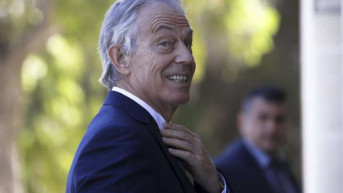
However, the most publicly highlighted figure was British Prime Minister Tony Blair. Unlike John Major, who "kept his foot on the brake" during the years in Bosnia, Blair helped NATO take a completely belligerent and aggressive course towards Serbia. Blair was young and eloquent, firmly believing this was the right moral path and eager to be as sustainable as possible. He and Clinton had an unusually strong relationship due to similar backgrounds, politicians who started somewhat on the left, changed over time, and eventually shifted to the center. Both advanced thanks to the ability to effectively use modern media. If nothing else, Blair was the first generation of international politicians who honed their craft studying Clinton and the skillful way he used modern media, choosing issues he wanted to be associated with and, of course, those he wanted to avoid.
The moment Blair's war adrenaline surged was in early April when, disturbed by the lack of any success, Blair went to Brussels to find out what was wrong. He spent several days there, most of it with Clark, where he soon became Clark’s "convert" and a faithful follower of the concept of greater use of force, especially ground forces. Clark helped in Blair's conversion as most senior British officers working with Clark shared his essential viewpoint: if it's going to be done, then it better be done "thoroughly." British military doctrine did not yield to the onslaught of hyper-modernization by aviators and other technicians. An deep imperial reflex lived on in Britain: no victory without infantry. When Blair returned to London, he became a "fundamentalist" of using ground forces, and the White House was not entirely happy about his transformation and the emergence of a leading figure in the Alliance who was running ahead of the President. While thrilled to have Blair at the forefront speaking about the war, the White House was not happy that he and his people were so openly talking about ground forces that could cause cracks in the Alliance and make the Prime Minister look more convincing than the President. In private talks with reporters, spokespeople described Blair as "strutting". It was clear that he was just making statements, and that the real ground forces should be sent by America. Simply, Blair was scoring points on someone else's "trouble".
There was also the question of whether Clark was even on the team. Things quickly began to unravel. The White House started to doubt the British-Clark axis, feeling that the British, when they wanted something done, worked through Clark, and Clark, when he wanted something done, worked through the British. In a way, both sides used external channels when it suited them, informing each other of any potential blockages in the American system. This led to quite a rude awakening in the White House where none of the senior executives had ever had a problem with a previous war, how the balance of power had changed since the war began and how a commander could be much more powerful than they had assumed. Bombing Bosnia and quickly bombing Iraq in "Desert Storm" were passing exercises. The White House was occasionally absolutely irritated by Clark, but could not do much about it.
After visiting Brussels, Blair also recommended to Clinton to be more aggressive in retaining NATO machinery in decision-making; limitations on Clark and Short were unacceptable. This immediately had effects and dramatically reduced the number of politicians who could veto targets on the list, although Clark and Short still considered the French a problem. However, by mid-April, frustrations reached a peak. It seemed that the war was not going well. Target lists were still not considered appropriate. "NATO," Berger said much later, "was like a new plane that had never taken off before and had trouble reaching altitude as it was taking off". In Brussels and Mons, pressures increased to expand the bombing lists and to accompany it with ground forces.
The pressure on Clark was almost unbearable, his aides thought. Everyone in NATO and everyone in Washington, both civilians and the military, knew what he needed to do and after their calls came a call from someone else often from the same country, and often at the same or higher position who would tell him not to do it. Those around him, even senior officers who did not agree with his policy or did not always personally like him, thought that Clark was showing himself in the best light.
His demands for expanding the target list were received with increasing success, but he was sure that ground troops would bring Milosevic to his knees, if not their actual use, then at least the threat of them. He did not think Milosevic would take the NATO mission seriously until he saw the ground forces coming. Clark was, after all, a soldier, and the military believed that ground troops win wars; air forces, though very valuable, were never the decisive weapon. But, this belief brought Clark into direct conflict with Cohen and the Joint Chiefs of Staff who were determined to draw the line regarding ground forces.
Regarding this issue, there were ongoing sparring battles. Clark would take a step aimed at least partially at approaching the option of ground forces, perhaps just to get troops in that area, but people from the Pentagon would smell it and try to block it. At one point, he requested what the military calls a "ready brigade," which would be on standby and stationed in that area. In that case, it would be on a ship near the coast of Greece, waiting for the call, "a more obvious knife aimed at Milosevic's heart," with 47,000 elite troops ready to enter battle within 24 hours, indicating that they were moving towards more, not fewer forces as the war progressed. The request reached the Pentagon, and a rejection came back. "How could they refuse you," asked one of Clark's assistants? "They said it was too expensive," he replied. "Too expensive," said the assistant, "how can it be too expensive to have a brigade just sitting there?" "They said the whole operation was too expensive and that they have big budget issues," said Clark. What he and his assistants knew wasn't the truth. The truth was that the Pentagon did not want ground troops anywhere near; he was too quick on the "trigger," too motivated, too ready to act on his own, to be trusted with a brigade. Both sides, it was obvious, were directed at each other and played a heavy game with high stakes. At one point, a member of Clark's team was preparing a report for Washington about what would be needed in Kosovo if the allies won, which included a completely new police system. The obvious solution was to use foreign troops to fill the vacuum. In Brussels, it was ordered to delete that part of the report before it was sent.
Then began one of the greatest internal battles in the Pentagon in recent decades. Not even Vietnam had so divided the officer corps as did the question of using "Apache" helicopters in battles. "Serbia had defeated the 'Apaches' in advance," claimed David Halberstam. "Nothing that happened in the Balkans caused as much tension as the fight over AH-64 Apache helicopters, the fastest, most modern helicopters in the army, specially designed, if believed, for situations just like this. The 'Apaches' were the best and most modern weapon of this type in the army, designed to avoid infantry snipers on the ground, even those armed with simple man-portable air-defense systems. They possessed the latest available technology, inventions that not only would keep their engines cool but also the entire exhaust system, thus protecting them from all heat-guided missiles. They could also fly at night without showing any light. Expectations of what the 'Apaches' could do in Kosovo were extremely high, especially among those inclined to aviation and who wanted to make a faster, more mobile, more flexible army in response. When it was announced that they would be sent to a base in Albania, Kenneth Bacon, a senior Pentagon spokesman, pointed out that they could change the course of the war and give the United States the ability to get closer to Milosevic's armed units in Kosovo."
They were supposed to be the best military weapon for air support to ground forces, especially against the slightly outdated enemy weapons and their accompanying infantry units. They were faster and more agile with far greater scanning capacity of the battlefield than armored vehicles on the ground, faster but more precise than jet fighters. "Instead, as Dana Priest wrote in the Washington Post in a sharp criticism of what happened, 'the lauded helicopters became symbols of everything that's wrong with the military entering the 21st century: its inability to adapt quickly; its resistance to change, its obsession with casualties, its identity crisis after the Cold War."
If the 'Apaches' were a mistake, it was an expensive mistake. Between 15 and 18 billion dollars were spent, not only to make them an exceptional instrument of attack but also to limit their vulnerability to infantry fire—the Achilles' heel of combat helicopters. Each 'Apache' cost $14.5 million. The end product was considered exceptional: it was fast, could fly just above the treetops at high speed, and even had curved rotor blades to reduce noise. However, they were helicopters, always vulnerable to ground fire, if enemy soldiers were calm and did not panic. Surprise, stealth, and limited time in the operational zone were obviously critical to their use.
Ironically, Hugh Shelton, a soldier and Chairman of the Joint Chiefs of Staff, was the first to suggest using 'Apaches' in Kosovo, even before the bombing began. He casually mentioned this idea to Clark, who immediately grasped it, seeing their potential to fill a significant vacuum in his repertoire. At the very least, he believed, they could significantly increase the pressure on Milosevic. But the internal debate about the 'Apaches' was never really about the use of helicopters in war; it was always about ground troops. The Pentagon suspected that Clark wanted the 'Apaches' as a "Trojan horse" for ground forces, and of course, they refused. A large number of impartial observers, as well as a number of Clark's allies, believed that the suspicions of senior officers were absolutely correct.
In traditional battle plans, made for Pentagon strategies, 'Apaches' were to be used as a supplement to infantry. But the first condition of engagement in Kosovo was that there were no ground troops, which meant no infantry spotters on the ground for helicopters. Since there were no ground troops, Clark wanted to use drones and satellite photos to observe Serbian forces. Based on the intelligence data collected in this way, the 'Apaches' would then attack Serbian units, but his superiors in Washington were skeptical.
Given the speed of the aircraft and the diversity of the terrain, Dennis Reimer, Chief of Staff of the Army, said it would be like observing Serbian ground forces through a straw. For the command in Washington, there was little military support for the 'Apaches,' in their opinion, the request for their use reminded them of the worst kind of unjustified risk. What would happen if an 'Apache' was shot down? Wouldn't a ground rescue team then have to be sent to the territory held by the Serbs? And if the Serbs surrounded that area with their troops and waited for the rescue team, wouldn't you have to send an even larger force to protect your people? For the command, it was a repetition of both Vietnam and Somalia. The wound in the Pentagon's heart from the downing of an F-117 had not yet healed. What would happen if another appeared? Then the Pentagon would simply die of shame and rage, the generals argued. Starting with something small and relatively innocent, from which something bigger and unpredictable then arises – there was no better path to disaster. Whether civilians who had so far given a fairly limited mandate were ready to open up for greater engagement, they doubted. If they wanted a platform similar to the 'Apaches,' some senior officers thought, the A10 Warthog plane that was the star and surprise of 'Desert Storm' would have been perfect and less vulnerable.
In Washington, Clark was practically without support in the ground army. Shelton was at best ambivalent, and Reimer was against their deployment. Their discussions went back and forth, Clark increasingly demanded the 'Apaches,' Shelton demonstrated the Pentagon's (White House's) refusal. "Wes," Clark quoted Shelton's words, "you need to know that it's hard for me with command. The Chief of Staff (Reimer), simply does not want to send them."
For Reimer and others, the 'Apaches' were the first step towards ground warfare. Finally, Shelton came up with a compromise solution: send the 'Apaches' to Albania, but do not use them until a higher level of consensus is reached about their use and until everyone is aware of the potential number of casualties. When consensus was reached, Shelton would make a recommendation to the president. This at least matched part of the decision in the White House, which hardly portrayed itself as eager to engage deeper and was still extremely nervous about casualties.
The decision to move forward, without really moving forward, was adopted on April 3. Everyone expected the 'Apaches' to arrive in Albania in ten days. This forecast, like many others about their usefulness, turned out to be quite optimistic. The infantry dragged their feet and slowly delivered the 'Apaches.' Obviously, someone at the very top sent a signal saying there was no need to hurry. Deadline after deadline was missed. Excuses piled up. There was always some reason not to proceed. Nor had anyone in the army, one senior officer observed, ever been punished for a huge delay in transferring vital weapons to the combat zone.
Of course, no base was ready for the 'Apaches.' Potential sites were studied, and in the end, the military chose a base near Tirana, close to the Montenegrin border where they had a view of several divisions of Serbian troops, as well as one of the largest Serbian airports in Podgorica. But the base itself looked like a disaster zone, a sea of mud, and the infantry had to repair and rebuild it for their helicopters. They had to bring in a huge amount of stone. Special landing platforms were made, and tanks and other armored vehicles were transferred to protect the base. 5,000 soldiers were also sent in case the Serbian army became confident enough to attack the base itself. Building the base and transferring all the equipment at a cost of about $480 million required 550 flights of giant cargo planes. It was the end of April when the helicopters arrived. Clark had requested 48, the army sent 24.
There was still no word on whether the 'Apaches' could fly. Then one crashed during a routine flight due to a mechanical failure, an event that contributed to making those who were hesitant even more suspicious. In Washington, Cohen, Shelton, and Ralston still did not want to use them and only said so much in the White House. Given Clinton's aversion to potential casualties, as Dana Priest pointed out, that wasn't hard to sell. There was a long debate about the estimates of projected losses. Clark and General Don Hendricks, commander of the "Hawk" helicopter strike unit, were impatient to use the 'Apaches,' and thought the risks were relatively small. Senior officers in the Pentagon wanted to know how large the personnel losses might be. Initially, Clark and Hendricks said it was hard to give estimates because this was a new type of mission. They were pressed further, and during a phone call with the Pentagon in mid-April, Hendricks said it would be about five per hundred combat flights, or maybe a little more. The question remained unanswered as to which figures both sides were betting on. Hendricks remembered using the figure five, while one senior officer heard six out of fifty, a figure that was mentioned at least once in the White House. In the White House, civilians later said they began to hear figures that even went up to 50 percent. People seemed to hear the figure they wanted to hear.
Certainly, helicopters are among the most vulnerable aircraft, and the terrain was mountainous and the foliage dense, meaning it would be difficult and dangerous to fly, especially when the opponent has countless small hand-held rocket launchers. But American commanders in the field still wanted to use them; this was their mission and a real opportunity to test a potentially wondrous piece of military equipment. Clark spent three weeks from the arrival of the 'Apaches' working with his commanders to ensure they had an acceptable tactical plan to use the helicopters with a certain degree of safety and that they would be a valuable instrument in combat. The nervousness in Washington irritated him and his commanders.
Like other combat pilots around the world, 'Apache' pilots and their commanders were aggressive, confident, and sure that they could adjust their strategy to the needs of the situation, impatient to justify all that training. The very nature of their profession imposed risk, and they were all well-prepared to accept it. That was what they had signed up for and wanted to continue with. According to their tactical plan, planes would precede them with sudden fire, then the 'Apaches' would come in, flying at 90 miles per hour, machine guns would sound, and they would stay briefly, just five minutes in the combat zone. Jet fighters above their heads would provide additional support.
But doubts in Washington were never dispelled. For Clark's superiors, the risks were constant. A Serbian soldier with one hand-held rocket launcher could simply be lucky and turn what was an apparent victory into a defeat, which CNN and other networks would barely wait for. Besides, it was an obvious place in the constant battle with Clark to draw the line and get White House support. The generals in Washington did not, Clark would later say with considerable bitterness, understand that the 'Apaches' could fly at night, and that hand-held SAM-7s did not have night sights, nor did his superiors understand, Clark said, that 'Apaches' have infrared suppressors that could prevent SAM-7. The infantry, he later thought, had spent 20 years and all those billions creating a superior instrument, and then were afraid to use it.
In the end, the 'Apaches' returned to their base in Germany. It took 30 trains, 20 ships, and 81 C17 cargo flights to return everyone and everything to their original bases. The fear of their vulnerability remained so great despite the enormous cost of bringing them to Albania, that the "Hawk" helicopter unit was not engaged in combat missions, not a single shot was fired, and not a single Kosovo Albanian was protected. When it was all over, the Secretary of the Army, Louis Caldera, noted with some melancholy that we seem to be a nation more prepared to endure losses in training than in actual battle.

0 comments