
FEUILLETON: 25 Years Since NATO Bombing of Serbia (39): Decisive Meeting with Milosevic on June 3rd
Writing for Kosovo Online: Dragan Bisenic
In the letter, which formally accepts the broad principles of the peace agreement set by the Group of 7 industrialized countries and Russia on May 6, arrived after Finnish President Martti Ahtisaari was preparing to travel to Belgrade on Wednesday for the first meeting of a Western leader and Milosevic since the start of NATO bombings.
The planned visit and Ahtisaari's decision to speak with a man who was indicted for war crimes last week suggested that diplomacy had progressed enough to require a direct exchange, however unpleasant such a meeting might be.
The newspaper noted that "Western officials stated that Mr. Ahtisaari's visit reflects the belief of Western governments that Mr. Milosevic is beginning to yield under the pressure of NATO bombings and that time is running out for a diplomatic solution that would prevent a possible ground invasion of Kosovo."
Although U.S. President Clinton was against the use of ground forces, military planners believed that preparations needed to be made within the next few weeks to make the threat of an invasion credible. It was announced that Clinton would meet with the Joint Chiefs of Staff in two days to discuss options for the use of ground troops in case NATO decides to carry out an invasion of Kosovo. It was unusual that the meeting was requested without the presence of the American NATO commander, General Wesley K. Clark, who argued that a ground invasion was necessary.
James P. Rubin, the State Department spokesperson, said that Ahtisaari would bring a detailed plan of the agreement. Rubin stated, "The plan shows how we believe that the broad principles now agreed upon by Yugoslavia will function at an operational level."
In a letter received by Germany today, Mr. Milosevic committed Yugoslavia to the vague terms set out on May 6, including the withdrawal from Kosovo of "military, police, and paramilitary forces" and the acceptance of the deployment of "an effective international civil and security presence."
However, the Yugoslav letter did not commit to the withdrawal of all Serbian forces from the province, which is a central Allied demand that, out of respect for Russia, was not mentioned in the May 6 statement.
The letter also indicated nothing other than the acceptance of the "presence of the United Nations, the mandate, and other elements to be decided by the United Nations Security Council Resolution"—a venture that seems far from Washington's demands for a force in Kosovo that would have NATO at its core.
Milosevic also quickly accepted the "presence of the United Nations" in Croatia and Bosnia during the difficult moments of the wars there, a presence he later used to consolidate the Serbian position by playing on the ambiguities of the United Nations mandate and the weaknesses of the deployed forces.
"The central unresolved issue remains what leaves Kosovo and what enters," said Michael Steiner, a diplomatic adviser to German Chancellor Gerhard Schröder. "We need all Serbian troops, except perhaps a symbolic presence, and a convincing military deployment that only NATO can provide."
Western officials said that Ahtisaari would explain this to Mr. Milosevic and make it clear that he must accept NATO's conditions, not the May 6 statement.
So far, discussions with Mr. Milosevic have been led by Russian Viktor Chernomyrdin, and NATO is concerned that the Yugoslav leader may have received a diluted version of the alliance's demands, officials said. Therefore, Mr. Ahtisaari's presence is considered critical at this stage.
NATO's conditions include the withdrawal of all Serbian forces, acceptance by Belgrade of international forces in Kosovo with NATO at the core, and the return of nearly a million ethnic Albanians who were expelled from their homes.
"We will not agree to less," said Secretary of State Madeleine Albright at a press conference. She added, "It is important that there is an explanation from Mr. Milosevic about what he thinks."
She said this after a meeting with Italian Foreign Minister Lamberto Dini, who said that Mr. Milosevic must accept the conditions set on May 6, as well as NATO's demands, and must begin withdrawing forces from Kosovo. "If this is not accepted and cannot be verified, then I think it will be impossible for the alliance to agree on a suspension of bombing," Mr. Dini said.
This statement, from a country that was among the most eager to end the bombing, suggests that the Clinton administration has convinced its allies that only what would constitute a clear acknowledgment of defeat by Mr. Milosevic would be enough to stop the bombing and pave the way to a settlement.
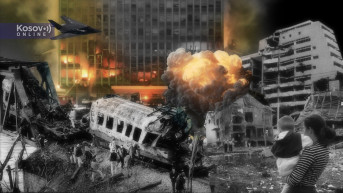
NATO military actions were intensifying, now targeting energy plants. They used so-called "graphite bombs" which fell like cobwebs on installations and were difficult to remove, leading to frequent power outages.
The fighting at Pastrik continued, and the Yugoslav army successfully repelled attempts by mixed Albanian-NATO forces to capture the summit, which Wesley Clark acknowledged.
Former German Chancellor Gerhard Schröder, in his memoirs, attributes the credit for Russia joining the American and NATO side to German diplomacy. The NATO attack on Yugoslavia, which marked Schröder's tenure as Chancellor, curiously, does not have a separate chapter but is discussed solely from a German domestic political perspective.
Schröder considered it "a great achievement of the German Foreign Minister to suddenly convince the hesitant Russians that it was in their own interest to withdraw support from Belgrade." Schröder writes in his memoirs how his foreign policy advisor Michael Steiner (formerly the deputy special envoy of the United Nations in Bosnia, Swede Carl Bildt) convinced him that the "war" (NATO aggression), which was in a "hot phase," could end (only) if "Russia was brought into the boat." Moscow, writes Schröder, had long given the impression that, out of some kind of pan-Slavic emotions, it stood by Belgrade, which Milosevic used as a trump card.
In this context, Schröder praises Fischer's diplomatic efforts to distance Yeltsin from Milosevic. Schröder assumes that the turning point was also helped by the fact that the Americans and the British were having an open discussion about sending ground forces to Kosovo.
In early June at Petersberg near Bonn, Chernomyrdin, Ahtisaari, and Talbott met where the final proposal for Milosevic was adopted. "To facilitate this meeting, Joschka Fischer employed every imaginable diplomatic maneuver," Schröder notes.
Russian General Ivashov sees things differently and describes "to understand how the process of 'surrender' of our positions unfolded, next to the G8 decision, the negotiation period from June 1 to 3 is also very important." Those were dramatic days. Then, in Bonn, the three negotiators met together with the German host, Schröder, and Fischer. Ahtisaari stated that the G8 meeting held in Cologne on June 7 and 8 was the ultimate deadline for NATO to resolve the crisis. If the negotiations failed, then plans for ground troops would be enacted. Chernomyrdin writes vividly about the tension and fatigue. It was the "last effort," as the Finnish president called it. The negotiations began under the shadow of controversy in the American media that Chernomyrdin had with President Clinton. First, on May 16, Clinton published an op-ed in the "New York Times" insinuating that America and Russia agreed on everything regarding the bombing of FR Yugoslavia. Chernomyrdin in his memoirs notes that it was impossible not to respond to this article, so he published his own response in the "Washington Post," where he listed all the differences and disagreements between the USA and Russia.
The basic question was whether Chernomyrdin and Ahtisaari would go to Belgrade with one or two papers? Chernomyrdin insisted that everything should be decided by the UN Security Council. He argued that he knew Milosevic best, "who was ready to oppose a group of states and NATO, but was not ready against the whole world. At one point, early in the morning, the Americans suggested adding the words 'among others' to the list of conditions, indicating that the list of conditions would further expand. Chernomyrdin closed his briefcase and left. However, the next day, on June 2, an agreement with 10 points was reached, which enabled Chernomyrdin and Ahtisaari to head to Belgrade the next day.
NATO members got what they wanted. In Bonn, Chernomyrdin was surprised to learn that "NATO strategists had already planned the deployment of their military contingents in such a way that there was no place for the Russians except to remain among their combat formations." Such a start to the negotiations discouraged V.S. Chernomyrdin - "like a blow to the head." General Leonid Ivashov, who was in Bonn, recalls that Chernomyrdin did not resist on most positions. The Russian military managed to agree with the American on many issues, including securing a special sector for the Russian military in Kosovo, however, Chernomyrdin canceled the agreements and solemnly declared that the Russian delegation agreed with the document presented by the Americans, i.e., with all the conditions offered by Talbot. According to Ivashov, Chernomyrdin traveled from Moscow to Bonn on June 1, 1999, for talks with Strobe Talbott and Martti Ahtisaari with a draft peace agreement that the Russians had aligned with American generals Casey and Fogelsong. On the first day of detailing the document, he represented "Moscow guidelines," but after midnight he sent most of his delegation "to sleep" and remained alone with the American diplomat. When he came from Bonn to Belgrade the same morning and sat down with Milosevic, he sided with "the flag of Ahtisaari and NATO," forgetting the agreements in Moscow.
By adopting the American document, the entire previous approval process was annulled. There was still left to convince Belgrade," Ivashov noted. Russian historians, like Yelena Guskova, have perceived Chernomyrdin's entire activity as a gradual "surrender" of Russian positions and acceptance of American and NATO stances.
The Russian military delegation that participated in the negotiations hoped to return to Russia from Germany and report to Yeltsin that all Russian demands remained unmet. But Chernomyrdin decided to fly directly to Belgrade. The last meeting with Milosevic was dramatic, as Milosevic realized that he was forced to sign the ultimatum. Talbot cites the following description by Chernomyrdin, which Ahtisaari gave upon returning from Belgrade:
"Our friend Viktor was absolutely incredible. He did everything he promised, without sabotage or complaints. The Serbs were clearly hoping that he would offer them a way out; but he did not."
Martti Ahtisaari and Viktor Chernomyrdin arrived together in Belgrade on June 3 with a proposal of 10 points, formulated in Bonn. The meeting started at 5:55 PM. When Ahtisaari handed Milosevic the paper in English, he skimmed it and said:
"We must either accept this or continue to fight." After a few moments of silence, one of the Yugoslav politicians asked Ahtisaari to comment on a point in the document. Ahtisaari replied:
"I am not authorized to comment on the text of the document."
Milosevic said:
"I must study this document with the government today, and tomorrow it will be considered at a session of the parliament."
He proposed that the negotiators stay in Belgrade and wait for the decision of the government and the Assembly. Milosevic and his associates talked with Chernomyrdin for a long time about further steps to stop the bombing. Chernomyrdin almost disdainfully described President Milosevic's behavior:
"And again Milosevic did not say a word about his safety. At the end of the conversation, I suggested that he formulate an assessment or comment on the proposed document: what he agrees with, what needs to be corrected. Since the final text needs to be adopted by the United Nations, there is a possibility to make amendments. It doesn't matter whether these amendments will be accepted, it is important that the whole world knows what does not suit the Yugoslav side," Chernomyrdin noted.
This attitude was also accepted by Leonid Mlechin, who, as it seems, quite faithfully conveyed the official positions, i.e., Chernomyrdin's views in his book.
But not everything was as it seems, as testified by General Leonid Ivashov, given that Russian generals had traveled to Belgrade from Bonn, together with Chernomyrdin.
"Viktor Chernomyrdin forced Slobodan Milosevic to sign that shameful paper. He set an ultimatum – take it or leave it, either war or peace. When I found out what they had offered Milosevic, I called Bora Milosevic in Moscow from Bonn and my friends in Belgrade and told them that this proposal should not be accepted and that Milosevic should seek serious amendments. After that, I attended negotiations in Belgrade where he sought that. Then Chernomyrdin turned red, puffed up like a bull, and said: 'No corrections – just yes or no. What do you want,' he yelled at Milosevic. 'If you accept the paper that has been offered to you without any changes, then peace ensues, Kosovo remains in FR Yugoslavia, and if you do not accept – war. You want war!' - he yelled," Ivashov testifies.
However, there is another version of this event which was presented by General Ivashov. Referring to Chernomyrdin's claims that Milosevic was given a chance to intervene, which he did not use, and that it is believed here that Ahtisaari was the one who threatened him into signing, Ivashov repeated:
- Ahtisaari was silent the entire time. And especially did not bang his fist on the table. After his departure, Milosevic gathered the Russian team and the closest Yugoslav leadership and again said that he could not accept it and that something had to be changed. Again, Chernomyrdin jumped: "No corrections!" And then he started explaining: "Why are you opposing? The war stops, Kosovo returns to Yugoslavia, peace comes"...
Serbian President Milan Milutinovic then said: "I want to ask General Ivashov if he agrees with what Chernomyrdin said, whether Kosovo will indeed return to the composition of Yugoslavia and when?" I answered:
"If you sign this act of unconditional capitulation, Kosovo will never be yours again."
At the second meeting, on June 4, 1999, attended by Martti Ahtisaari, Viktor Chernomyrdin, and Slobodan Milosevic, which started at 9 AM, I also attended as the Chief of Staff of the Supreme Command. I remember, the Finn pulled a document crumpled into a "ball" from the inner pocket of his coat, calling it "paper" and said that it was up to us to adopt it or reject it without discussion. To emphasize his words, he hit the table hard, saying that Belgrade would be flattened if we refused that, supposedly, Russia-agreed plan. We were not allowed to say anything, but our eyes "spoke." They were filled with tears. General Ivashov cried like rain," Ojdanic testified.
Milosevic said he accepted the proposal as a peace plan.
He adds that the decision to sign the plan was made because it guaranteed the sovereignty and territorial integrity of the country. The Assembly voted and everyone was for it, except the radicals. "Unfortunately, we were deceived again," the general states.
The Serbian Assembly was to start sessions on June 3 at 10 AM, and the next meeting was scheduled for 1 PM. When they reached Milosevic, he said: "The Federal Government and the Assembly have accepted the proposal you brought." The decision of the Assembly was signed by Dragan Tomic. He said that the agreement guarantees the unity of Yugoslavia and the beginning of a peace process that is significant not only for Yugoslavia but for the entire region and Europe. Ahtisaari replied that it was "the first step towards peace." Milosevic lit a cigarette, and General Rimpi, who was in the delegation, counted that Milosevic had smoked 11 pieces during the previous day's discussions. The meeting ended at 1:25 PM, without any ceremonies. Ahtisaari notes that some Yugoslav generals could not hide their disappointment and distress. Chernomyrdin first called President Yeltsin to report the news, and then Strobe Talbott. He went to Moscow to report to Yeltsin, and Ahtisaari was received in Bonn as a victor.
The shock on the Serbian side that prevailed after Ahtisaari and Chernomyrdin presented "new solutions." Milosevic asked for the Yugoslav Assembly to express its opinion, and at a joint press conference, Ahtisaari arrogantly said that it was agreed that all those found to have committed crimes against Albanians in the war, including the highest military and political officials, would be prosecuted.
- Of course, I knew that when he spoke about punishing the highest military and state officials, Ahtisaari, practically, was threatening me with The Hague. I didn't care then, I had bigger worries - Ojdanic remembered. During the third encounter, Milosevic claimed that NATO would use the negotiations to completely divide Yugoslavia - Kosovo would be given to Albania, Vojvodina to Hungary, and Montenegro would be made into a puppet republic. He also outlined his scenario of what would happen in Kosovo: "NATO will solidify under the UN flag in Kosovo, will form a temporary administration, and then an Albanian one. During that time, the Serbs, who will be imposed unbearable conditions, will completely leave the province. They will be pushed out (I must note that, as time has shown, he was right). Kosovo will become a purely Albanian territory with its own leadership, parliament, political system. And that's why one should not agree to the deployment of NATO forces in Kosovo, no matter under whose flag they appear," Chernomyrdin recorded.
And that's all. Chernomyrdin claims that "there were no deceptions, about which some Russian generals spoke." In the book, Chernomyrdin settles scores with generals "for whom someone else's head is worth a quarter of a kopeck, and their own neck a whole," who were ready to drag the Russian people into war. "It's easy to be principled when you're not suffering, and you're not bearing responsibility," and further:
"Why don't these strategists and tacticians use their gift for resolving the conflict that is right before them, so that the blood of Russian children and peaceful residents does not needlessly flow, in Chechnya."
Russian President Boris Yeltsin concluded that Chernomyrdin "did everything he could" and "stopped the war." He judged that in all this, "Milosevic behaved absolutely unprincipledly," because "in relations with Russia, his main trump card was the explosion of dissatisfaction among citizens with my foreign policy, the schism in society, what pushed us into military and political confrontation with the West." Yeltsin accepted that "during Milosevic's time, the Albanians were subjected to cruel repression and had to flee the province."
German Foreign Minister Joschka Fischer was a particularly important figure during the bombing. He was at the head of the "Green" party, which originated from the anti-war movement and protests against the installation of American "Pershings" on German soil. It was considered that he was a very sensitive link in the entire operation because withholding support from the "Greens" for this operation would have led to the fall of the German government, and thus to Germany's inability to participate in the bombing of Yugoslavia and Serbia. However, Fischer supported the NATO attack on Serbia and Yugoslavia more than was expected of him. Fischer proved to be a bellicose leader who gave, as Oskar Lafonten assessed, "astonishing statements," those about Auschwitz, emphasizing that bombs were needed to stop "Serbian SS troops." Fierce opponent of NATO aggression Oskar Lafonten, who was practically, since he was the leader of the Social Democratic Party (SPD) at the time, brought Schröder to the chancellor's throne after Helmut Kohl's 16-year reign, wrote in the book "Heart Beats Left" how he could not believe that just the government of sworn pacifists – a coalition of social democrats and greens – would, for the first time in half a century, drag Germany into war.
Lafonten demonstratively left Berlin, and all positions – party leader, "super minister" (finance), and Bundestag deputy – twelve days before the bombing began. During the aggression, he wondered, he says, whether it was smart what he had done. And whether, as party leader, he could have, if not prevented the war, then at least German participation in it. With the remark that he might have succeeded in that if he had been chancellor, which he could have been by "right of pulling," as the first person of the winning party... Lafonten was bitter that the ruling coalition, which he "enthroned," just a few months later violated what was written in the coalition agreement: that it would strictly respect, when it comes to potential military engagement, "international law and the German constitution." He wanted precisely a coalition with the Greens, a pacifist party, convinced that the government would thus more easily be able to pursue a policy of peace. He was surprised by the fact that this party so quickly "spent its pacifism."
He warned (Fischer) that Auschwitz is created by those who would, allegedly, prevent it. NATO does it now: then there were gas chambers and a bullet in the back of the head, today they do it, Lafonten noted, computer killers from five thousand meters high...
Top of Form


comments