
FEUILLETON 25 Years of NATO bombing of Serbia (4): Clinton also approved Bush's warning
Writing for Kosovo Online: Dragan Bisenic
On the other hand, there was also an expression of concern that the US was doing too little to stop the disintegration of Yugoslavia. In correspondence I had with Bill Montgomery on this matter, he pointed out a section of a report from the embassy in Belgrade, which he forwarded to Secretary of State Eagleburger.
"From time to time, I would add a small comment in the upper right corner of the first page, as I did here. If you look at my comment and Eagleburger's response, you will see that we had different views on our policy towards the Balkans. I wanted the US to be much more involved in confronting the terrible violence that erupted in Bosnia and Croatia. The US policy, directed or greatly influenced by President Bush's stance against interference there, was somewhat strangely (for that time) more concerned about Kosovo than Croatia/Bosnia," Montgomery stated.
What Lawrence Eagleburger later revealed allows the "Christmas warning" to be viewed differently and makes it clear why Clinton and his administration relied so heavily on it.
This so-called "Christmas warning" was reiterated by the Clinton administration within a month of taking office in January 1993. From then until the military intervention, the Christmas warning was discussed in the US Congress, where senators and congressmen raised the question at every hearing of whether the Christmas warning was still in effect.
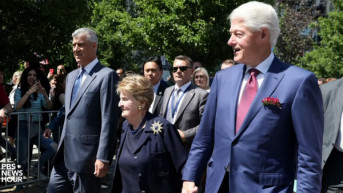
Namely, Eagleburger, in an interview for The Washington Post, just a few weeks after the Clinton administration took office, revealed that this letter was not just Bush's.
"Eagleburger said that Bush's letter, carefully vetted by Clinton before being sent, had been prompted by intelligence reports that Serbs might initiate a reign of terror in Kosovo during the transition period in the United States. 'If something were to really happen, we were prepared to do what we said - I promise you that,' Eagleburger said, adding that this would include US air strikes on Serbia.
Eagleburger pointed out that 'the war has not yet spread to Kosovo, although many officials predict it will and that it will trigger a wider conflict involving Macedonia, Albania, Bulgaria, and probably Greece and Turkey.'
Discussions within the Bush administration on how to respond to the disintegration of Yugoslavia date back to immediately after the CIA report of October 1990. Dozens of interagency meetings were held regarding Yugoslavia, and senior officials were briefed on daily events.
The main question from late 1990 to mid-1991 was how to prevent the breakup of the increasingly unstable Yugoslav federation. “The opinion in the administration was that the danger of a split in Yugoslavia was enormous,“ a senior official said, adding that Bush's policy of opposing the breakup of multinational states had been influenced by his determination not to complicate the efforts of then... Soviet President Mikhail Gorbachev to keep the Soviet Union intact.
The US stance intensified when Baker traveled to Belgrade on June 21, 1991, warning Yugoslav leaders of the 'dangers of dissolution' and announcing that the US would not recognize secessionist republics. In retrospect, said a former US intelligence official, the Yugoslav military had interpreted Baker's stance as a 'green light' for the use of force against seceding states.
Less than a week after Baker's departure, Slovenia and Croatia declared independence anyway. When the Slovenian militia took over its border crossings, a ten-day war broke out with the Yugoslav Army. Two months later, much more serious fighting began between Croatia and Serbia.
These events caught the world between the end of the Cold War and the beginning of serious international efforts to address civil wars. The European Community of 12 nations, disturbed by the fighting in Central Europe, sought to mediate between the Yugoslav parties, but the ceasefire quickly collapsed. European Community policymakers became victims of internal divisions, based on conflicting historical ties and interests. At this stage, NATO considered Yugoslavia a problem beyond its jurisdiction. The Conference on Security and Cooperation in Europe (CSCE) lacked a clear consensus on what to do. The United Nations was initially only peripherally involved.
After Baker's visit to Belgrade, Bush and Baker decided that the United States would not deeply intervene, but would let the Europeans take the lead. The two Texans at the top of the US Government "thought it was a swamp" that Americans should avoid at all costs, according to close observers of their policy. Accordingly, the administration took on a prominent role only episodically, when it seemed that the reactions of the US public to the televised horrors from the Balkans demanded a response from the US.
Looking back, the early period of US passivity may have been the last point at which the disaster in the Balkans could have been stopped, according to several top officials in the Bush administration. "Perhaps, right at the outset, if some forces had been inserted along the Croatian-Serbian border, it's possible the fighting could have been stopped before it started," National Security Advisor Brent Scowcroft, who served as the US military attaché in Belgrade from 1959 to 1961, said. "Once it started, it was hard to see how you could have stopped it without massive force," Scowcroft said in an interview with The Washington Post editors and reporters on January 19.
A senior State Department official at the time, speaking many years later, told me that "it would have been foolish not to brief the Clinton administration on the content of the letter, since the current administration will be gone in less than a month. We would look completely foolish if the new administration were not willing to endorse this step."
"The constant issue or complaint was that we were too focused on Kosovo, which was then quiet, and not on Croatia and Bosnia, which were huge problems. The response was always very cold-blooded and cynical: while the fighting is terrible in Croatia and Bosnia, it's confined to those two countries. But if violence erupted in Kosovo, it could spread to neighboring countries like Macedonia, Albania, Bulgaria, and Montenegro. They all had some connection to Kosovo. So, even though we didn't bomb Serbia until 1999, we were very engaged many years before that," he told me.
At a meeting on Wednesday, May 6, 1998, the Subcommittee on European Affairs of the Senate Foreign Relations Committee convened, chaired by Senators Biden and Smith. Present at the hearing was then-US Envoy for Kosovo, Ambassador Robert Gelbard, from whom Senator Smith expected clarification on whether the US administration still adhered to the warning on the use of force promised by US President George Bush in December 1992.
Smith began by stating, "Given the potential for this conflict to spread to the rest of the Balkans and beyond, including our NATO allies Greece and Turkey, I believe it is crucial for the administration to clearly articulate its policy on this issue," and reminded that "in December 1992, then-President Bush sent an unequivocal warning in a letter to President Milosevic that the United States was prepared to militarily intervene if Serbia attacked ethnic Albanians in Kosovo. President Clinton reiterated this so-called Christmas warning after taking office in 1993. It would be in the interest of further public debate on this issue if, Ambassador Gelbard, you publicly explain what this warning entails and whether it will continue to be US policy," the chairman, Senator Smith requested.
"In the event of a conflict in Kosovo caused by Serbia's actions, the United States will be prepared to use military force against the Serbs in Kosovo and in Serbia proper," President George Bush quoted Senator Smith in a letter to Slobodan Milosevic, then-President of Serbia, on December 25, 1992. Gelbard stated that the escalation of the conflict "threatens regional stability," where Albania - "which has just returned from the brink of anarchy, and FYROM (Former Yugoslav Republic of Macedonia) are particularly vulnerable."
Tomorrow: Gelbard's sensitive secrets
comments