
FEUILLETON Americans, Serbs, and Albanians in the Balkan Wars and World War I (12)
Writing for Kosovo Kosovo Online: Dragan Bisenic
“Fan Noli's conversion in the service of the Comintern"
This idealized document, full of inaccuracies, distorted and incomplete facts, and superficial conclusions, has become the "alpha and omega" of all Albanian claims and arguments, not only at this peace conference but has been adopted and interpreted up to the present day. The document was republished by the diligent researcher of Albanian history, originally from Kosovo, Bejtullah Destani, in the book "Albania & Kosovo: Political and Ethnic Boundaries, 1867-1946. Documents and Maps".
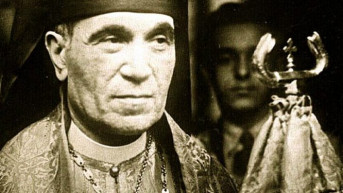
Fan Noli, whose real name was Theofan Stilian Noli (in the picture), was a bishop and the founder of the Albanian Orthodox Church and later, from 1924, the Prime Minister of Albania. Undoubtedly of Greek origin, as he behaved in the first phase of his life, Mavromatis was a unique and gifted character who became the most prominent versatile convert playing some of the key roles in modern Albanian history.
Although he had a completely secular profession, after breaking ties with the Greek Orthodox Church, he was ordained as an Orthodox priest by the Russian archbishop in America, Platon Rozhdestvensky. Fan Noli was a determined follower of the ideology of annexing Kosovo and Metohija to Albania.
Formation of KONARE
After the conflict with Ahmet Zogu, during which Zogu had to seek refuge in Belgrade at first, Fan Noli, following Zogu's return, was sentenced to death and had to flee the country when he became a part of the projects and national policies of the Comintern in the Balkans.
In Vienna, Noli founded the "National Committee" (Albanian: Komiteti Nacional Revolucionar), also known as KONARE. The committee published a magazine titled "National Freedom" (in Albanian: Liria Kombetare). Some early Albanian communists, such as Halim Xhelo or Riza Cerova, began their publishing activities here. The committee aimed to overthrow Zogu and prevent any role he might have in the country's political life.
Despite efforts, the committee's access and influence in Albania were limited. With the intervention of Kosta Boshnjaku, an old communist and a member of KONARE, the organization would receive unconditional financial support from the Comintern. Additionally, Noli and Boshnjaku facilitated exiled members of the Committee for the National Defense of Kosovo, which Zogu had outlawed, to receive the same financial support from Moscow through the leading organization for spreading the world proletarian revolution.
Through KONARE, and also directly, the Kosovo Committee participated in the Balkan Federation, the Comintern's agency for spreading communism among nationally dissatisfied peoples of the Balkans, continuing the early contacts of Bajram Curri (since 1921) with the Soviets. When the policy of defending Yugoslavia became the official position of the communists in the 1930s, this line of support faded but did not disappear.
Within the framework of the Comintern, the committee collaborated with other nationalist movements that arose in Yugoslavia as a result of the Comintern's activities in the Balkans. Mainly through Zija Dibra, its leaders would establish contacts and meetings with Stjepan Radic, the leader of the Croatian Peasant Party, Bulgarian VMRO revolutionaries Todor Aleksandrov and Petar Chaulev, and Montenegrin Marko Raspopovic, who had settled in Shkodra.
Committee for the National Defense of Kosovo (in Albanian "Komiteti Mbrojtja Kombetare e Kosoves" - abbreviated as KMKK) was an Albanian organization founded in Shkodra on May 1, 1918. It was mainly composed of Albanians originating from Kosovo, led by Hoxha Kadri from Pristina. It existed in a looser form since May 1915. The committee's main goals were to fight against the borders of the Principality of Albania, established based on the London Agreement (1913), the "liberation" of Kosovo, and the unification of all lands inhabited by Albanians.
The committee provided organizational and financial support to kachaks in Kosovo and Skopje. During the Paris Peace Conference on May 6, 1919, the Committee called for a general uprising in Kosovo and other Albanian regions in Yugoslavia. This led to a large-scale rebellion in Drenica involving around 10,000 people under the command of Azem Galica. The uprising was suppressed by the Yugoslav Army.
The confrontation continued during 1920, 1921, and 1923, with a revival in 1924. One of the results was the creation of a "neutral zone" around Junik, which served as a base for threatening the border and providing ammunition and other logistical support for kachaks.
The Committee was one of the five pillars of Noli's movement (together with the army, liberal beys, progressives, and Shkodran – Catholic leaders from Shkodra), although they were not invited to be a part of the new government led by Fan Noli.
When he died in 1964, the obituary in Tirana was personally written by the Albanian leader Enver Hoxha, who emphasized that "the party appreciates Fan Noli's personality, his merits" and suggested that his body be transferred to Albania.
Great Albanian demands, rejected by the USA
However, Noli defined the key ideas of the Albanian national program for the Paris Peace Conference, which are still heard today with minor variations. These are the following theses: Albanians are divided, they are direct descendants of Illyrians, Macedonians, and Epirotes, speaking the language of the Aryans. They fought against the Romans, Goths, Veneti, Slavs, and Turks. All Albanian neighbors were liberated from their protectors, and territories such as Plav, Gusinje, Podgorica, Nis, and Vranje were taken from the Albanians. Albania was an obstacle to Germany because it prevented its "advance to the south".
"The borders of the Albanian state must be corrected to include all territories that are exclusively or predominantly Albanian, which were carved out by Prussian tactics in the past, such as the Adriatic port of Dulcinjo (Ulcinj), the Hoti plain, Gruda, Plav, Gusinje, the province of Kosovo with the cities and districts of Peja, Prizren, Djakovica, Mitrovica, Pristina, Skopje, Debar, Struga, and Ohrid, as well as the province of Cameria, or Southern Epirus, as the Greeks call it, which extends from the Corfu Channel to Preveza. To challenge the Albanian character of these districts means to evade solid facts confirmed by any impartial observer. The Serbs have sincerely given up on that job and claim the right to the Albanian province of Kosovo based on vague historical foundations and memories of the short-lived empire of Emperor Dusan. The Albanians responded that they were there for centuries before the appearance of the Serbs on the Danube and that today they are the real owners of the land", Noli concluded briefly, without delving into or mentioning such "details" as obvious monuments of Serbian statehood or Ottoman population statistics, given that the Ottoman Empire was very organized and precise administrative machinery.
Noli did not mention the well-known "Migration Period", which he obviously knows about since he suggests: "Moreover, the Serbs have no reason and no right to expand to the south now when they can legitimately expand to the north and secure their outlets to the sea through countries inhabited by related races".
This argumentation was not convincing to anyone, least of all the American delegation.
"This area undeniably was an inseparable part of the great Serbian empire in the 13th century", Edward Bonsall said, Assistant to the head of the American delegation, Colonel House.
Tomorrow the continuation of the feuilleton "Americans, Serbs, and Albanians in the Balkan Wars and World War I"
0 comments