
FEUILLETON: Dissolution of Yugoslavia, NATO aggression, and the seizure of Kosovo (1): Fatal German cards
Writing for Kosovo Online: Miroslav Stojanovic
The Wilson Digital Center from Washington has launched, by disclosing secret documents (several hundred) from the office of former German Chancellor Helmut Kohl, into the media and political orbit, an old topic - about the role (and responsibility) of Germany in the dissolution of Yugoslavia - with new, unknown details and the well-known (undisputed) essence: Official Bonn (at the time still the capital of again reunified Germany) engaged in 1991, especially in the second half of the year, with emphasized destructive energy in transforming (original) Yugoslav drama into the tragedy of a great country.
This fact cannot be relativized even by subsequent "rewriting of history." The first strong, and fatal, card that unified Germany, with its growing strength and ambitions, threw on the European table, was indeed an introduction to the Yugoslav (bloody) drama.
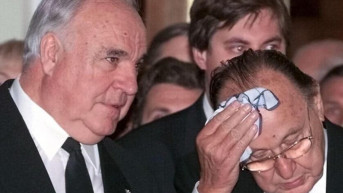
Chancellor Helmut Kohl and Foreign Minister Hans-Dietrich Genscher in 1991, almost ultimately, informed the leaders of the European (then twelve-member) family that Germany would recognize the secession of Slovenia and Croatia. And thereby, effectively, start the breakup of Yugoslavia. Despite the fact that precisely the European Community (later Union) feverishly tried to solve the Yugoslav problem through political (diplomatic) means (a series of Hague meetings) and on its own initiative.
The second strong German card, the one concerning the fate of Kosovo and Metohija, will be discussed more in the following installments of this feuilleton. Rambouillet was, in fact, originally a German idea and initiative (its implementation was taken over by the Americans) with also fatal consequences: the programmed collapse of Rambouillet (about which there has been exhaustive writing in this place) represented the "prelude" to the so-called "war for Kosovo". Actually, the NATO aggression, with the third warlike, and devastating, German campaign against Serbia and Serbs in one century!
Official Bonn embarked on this venture of destruction with almost incomprehensible persistence. Alone against all: against European partners, against the United States, against the (aging) British Lord Peter Carrington (who chaired the futile conference on Yugoslavia), against the Secretary-General of the United Nations Perez de Cuellar, and even against the viewpoints of their own diplomats who were serving in Belgrade at that time or in previous years.
European partners were forced to submit to German dictation. There was evidently a fear that if a unified Germany was not followed, it might "go its own way." And act on its own. And whenever that happened, it usually ended in disaster.
For example, French President Francois Mitterrand warned Chancellor Kohl of the possible, and disastrous, consequences of hasty recognition of Slovenia and Croatia. However, he wanted to keep Germany in the "team" at all costs, where, thanks to internal rules, its capriciousness and unpredictability could be somewhat restrained.
There was also a fear (though not overly realistic) that newly unified Germany, with its increased power and confidence, could (even) turn its back on the European Community. And thus, in a dramatic way, could jeopardize the idea of a united Europe, which at the time, at the (historical) Maastricht Summit (I reported from this gathering for "Politika"), was being realized with the creation of a monetary union, receiving new impetus and acceleration.
Regarding Germany's fatal role in the breakup of Yugoslavia, almost all the major players on the (then) world political scene have spoken out. Some of them belatedly, when they were no longer in important positions.

For example, Gerhard Schroder, in a conversation with journalists from "Zeit," admitted that the NATO aggression had been a "flagrant violation of international law." And yet, he, then in the most important political position in the country, the chancellorship, agreed that Germany would participate in that aggression.
Former (West) German Ambassador to Belgrade, Horst Grabert, a close friend of Willy Brandt, was convinced that Kohl's and Genscher's recognition of secessionism in Slovenia and Croatia came at the persistent insistence of the leadership of the Christian Social Union in Bavaria (CSU), its right wing, which was closely connected with the extreme (Ustasha) Croatian emigration.
In addition to rewarding the Croats as "war allies" (this "alliance" was often emphasized by Franz Josef Strauss, the powerful head of the Bavarian government and party), it was necessary to punish Serbia. It had always been seen in German plans and aspirations as an obstacle.
Even Friedrich Naumann, one of the creators of the idea of a "Greater Germany," which was supposed to encompass the entire Central European space and be bordered by economically dependent states, "obedient followers" (which did indeed happen after the collapse of the "Eastern (socialist) empire": Germany's influence became predominant from the Baltic to the Adriatic Sea), and it predicted that only Serbia would remain outside that circle. As a "fortress that is a nuisance." And one that "must be erased."
To be continued tomorrow: The spark that ignited the Balkans


0 comments