
FEUILLETON: Dissolution of Yugoslavia, NATO aggression, and the seizure of Kosovo (7): Schroder's invention Ahtisaari
Writing for Kosovo Online: Miroslav Stojanovic
As the bombing lasted longer without the expected effect - a quick and unconditional surrender of Belgrade - nervousness grew among Western leaders and NATO strategists.
Two completely opposite ideas and initiatives were put into circulation: the engagement of ground troops and invasion, since bombers with their deadly projectiles failed to "bring the Serbs to their knees" (which was publicly insisted upon by Klaus Kinkel, the foreign minister in Chancellor Kohl's government) and - a peace plan.
On the first option, invasion, with a large number of NATO soldiers, Americans, and British insisted on, with their (then) leaders, Bill Clinton and Tony Blair.
Germans, on the other hand, attribute the "authorship" of the peace plan and negotiations with Belgrade to themselves. It was obviously a coerced idea and a political salvation for the red-green ruling coalition.
The First of May was approaching, with traditional and massive protest marches. This time, according to announcements, they threatened to turn into strong anti-war demonstrations. And harsh criticism of the government's war policy.
The West was already facing challenges, on how to get out of the crisis it created (when Belgrade obviously showed no intention of withdrawing) without "Milosevic feeling like a winner."
The exit strategy, in the German interpretation, was found in - creating a peace plan. Germans used the fact that, at that moment, they chaired the European Union and the Group of 7. For the "peace initiative," it was necessary to obtain, first, the consent of the countries participating in the bombing of the Federal Republic of Yugoslavia. Nineteen of them.
A particular concern, however, was how to "get the Russians on board" and obtain the support of the Chinese. Suddenly, it was realized that the "decisive role of Russia" was crucial in achieving the plan. Official Moscow "withdrew offended" after the NATO bombing of Serbia without prior consultations with the Security Council.
German politicians believed that the Americans, who made all the decisions, did so "to spare Russia from even greater loss of prestige." There could be no talk of Russian support for NATO intervention.
Moscow, allegedly, feared a "parallel with (the then troubled) Chechnya" in this interpretation. China feared a parallel with Tibet. National interests of "veto" powers were at stake.
The key conclusion followed: even if the planned bombing of Serbia had arrived as a topic at a Security Council meeting, and both powers, Russia and China, had voted against it, "NATO would have intervened. The Russians were treated as "equally irrelevant as the United Nations..."
Schroder praises his foreign ministry in his memoirs for persuading "hesitant and wavering Russians." Official Moscow was supposed to "understand" that it was in the "Russian interest to withhold support for Belgrade."
The former chancellor believes that in this "persuasion of the Russians," a strong argument was the fact that there were extensive discussions in the United States and Great Britain about sending ground troops to Kosovo. Such an operation, with the long-term stationing of NATO troops in the region, would not be in "Moscow's geostrategic interest."
If the Russians showed a willingness to "give in," quite unexpectedly, the "problem of China" emerged: Beijing angrily reacted to the bombing of the Chinese Embassy in Belgrade.
Schroder realized that this act could not simply and without consequences be qualified as the infamous "collateral damage." He decided on an urgent, lightning visit to Beijing (ten hours flight there, a few hours in Beijing, ten hours flight back) to, on behalf of the Western alliance, "openly and publicly" apologize for the bombing of the embassy. This provided the Chinese with an opportunity to "save face" without their (expected) more radical response.
The apology, he believes, worked. It had a significant echo in the Chinese media. Beijing remained neutral in the "Balkan conflict." The path for "Ahtisaari's mission was clear."
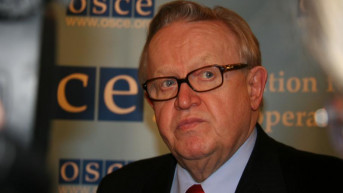
But why Ahtisaari now? Gerhard Schroder says that former Finnish President Martti Ahtisaari, as the immediate "executor" of the German peace initiative (which had meanwhile grown into a United Nations plan), was his invention.
In May 1999, he flew to Helsinki for a brief visit. And he persuaded Ahtisaari for a mediation, negotiating mission with President Slobodan Milosevic. The political experience of the Finnish president played a crucial role in this. And especially, the (then) neutrality of Finland.
The conditions that needed to be "set for Milosevic" were, of course, dictated by the Americans. Under their direction, and on German soil, at Petersberg Hill near Bonn (at the official state residence, a hotel), a tripartite meeting was held with American Strobe Talbott, Russian Viktor Chernomyrdin, and Martti Ahtisaari.
At this meeting, three (ultimatum) points were finalized to be presented to Belgrade: 1. the withdrawal of paramilitary forces and Serbian regular troops from Kosovo definitively, 2. Belgrade's agreement to place the province of Kosovo under the protectorate of the United Nations, 3. Belgrade's readiness to agree to international military presence (occupation) in Kosovo under NATO command...
The fateful meeting near Bonn, before Ahtisaari and Chernomyrdin went to Belgrade, was, among other things, problematic because Chernomyrdin came out to Milosevic with different demands from those he had left Moscow with.
Members of the Russian delegation, especially its military part, with General Ivashov, were surprised and appalled by this fact. In his political (presidential) ambitions, Chernomyrdin apparently valued the support of the Americans more than the orders of (his) official Moscow.
Satisfied with the job done in Belgrade, Martti Ahtisaari sent a euphoric short message to German Chancellor Gerhard Schroder in Cologne, where the summit of European Union leaders was being held in early June 1999: The war is over...
The elaborated (famous) Ahtisaari plan was never implemented. However, his (fatal) mission in Belgrade did its ominous work: Kosovo was seized...
THE END

comments