
FEUILLETON Rambouillet - ultimatum for the bombing (3): NATO generals and readiness exercises
Writing for Kosovo Online: Dragan Bisenic
The invitation to attend the NATO military exercise named "Determined Falcon", which was scheduled to take place on Monday, June 15, 1998, arrived just one day before the trip, which began on Sunday. A large group of Belgrade journalists, including almost all those who covered the Kosovo issue, first traveled to Budapest, from where we were transported by a US military "Hercules" to the Aviano Air Base. When we arrived, we settled into military beds or simply mattresses on the floor, like many other journalists invited from all NATO member states. Special attention was paid to journalists from Serbia, Kosovo, and Albania.
The "Determined Falcon" exercise for journalists started with military discipline at the crack of dawn, at four o'clock. For many, it was too early to start witnessing the capabilities of NATO aviation, which was "scheduled" by the NATO Council. Considering the Kosovo issue, the NATO Council tasked the military part of the Alliance with developing possible options that could be applied. "This is the first of those scenarios," said NATO's European commander, General Wesley Clark, in an interview exclusively organized for Belgrade journalists, adding that "the violence in Kosovo must stop".
Short said the military exercise demonstrated NATO's air power and showed that it was ready to act immediately if necessary. He said "Determined Falcon" achieved all its objectives. "The goal of the action was to support peace and stability in the region. It also shows the concern of all member countries for the escalation of violence in Kosovo. At the same time, this demonstrates NATO's support for the territorial integrity of Yugoslavia," Short said.
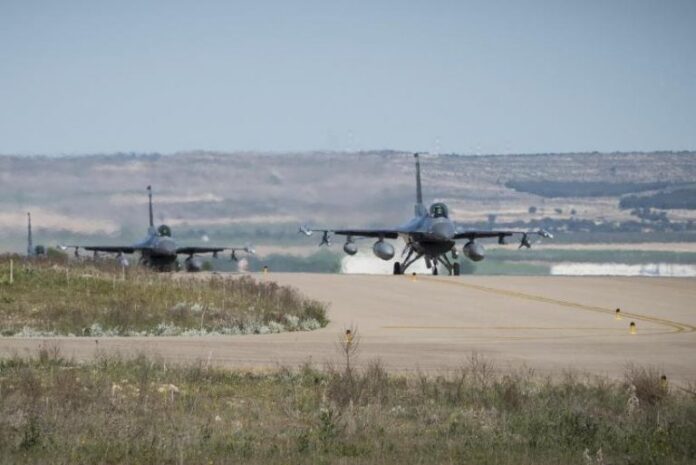
The operation began early in the morning at 5:30 with the first press conference. The planes took off from air bases in five countries – Germany, Great Britain, Greece, France, and most of them from Italy. We witnessed the takeoff of F-16 and F-18 fighter jets up close, as did correspondents accredited in Brussels.
The exercise involved 85 aircraft, with 68 participating in combat action and 17 providing support. Prior to the start, in his first encounter with journalists, General Short stated that he did not expect any incidents with the Yugoslav Army, "which we know has good radar systems", nor did he expect NATO to violate Yugoslavia's airspace.
General Short confirmed at the end that the planes flew 25 kilometers from the Yugoslav border. The planes flew from northern Italy, across the Adriatic, then over northern Albania and Macedonia, before splitting into two groups, flying over Tirana and Skopje, and returning. The operation was monitored by an AWACS aircraft with the Chief of Staff of the NATO Southern Wing aboard.
When asked by representatives of the Kosovo Albanian media what the next steps would be "if Milosevic does not stop the violence", General Short said he could not predict that, as it pertained to political decisions. A BBC correspondent asked what message was being sent to the authorities in Serbia, and the general responded that NATO Secretary-General Javier Solana had already stated that through this exercise, NATO was demonstrating its ability to act quickly and efficiently.
In a conversation with Belgrade journalists, NATO Supreme Allied Commander Europe, General Wesley Clark, when asked if this exercise was a form of political and military pressure on the authorities in Belgrade and what his stance was on the territorial integrity of Yugoslavia, General Clark said that all leaders of NATO member countries claimed to respect the territorial integrity of Yugoslavia. The message of the exercise was that NATO was concerned about peace and stability in the region. This exercise was an opportunity to demonstrate NATO's ability to act if necessary and that the problem in Kosovo should be resolved peacefully through dialogue.
To my question, "Has NATO taken similar action to protect the territorial integrity of Yugoslavia?" Clark responded, "I couldn't predict what NATO would do. A bunch of political decisions would be adopted by sovereign NATO member countries. The NATO military command would act as decided. At this moment, we believe that cessation of violence in Kosovo is a prerequisite for progress and negotiations".
The next question was what would happen if the violence did not stop? "I cannot make predictions about what would happen because it depends on NATO member countries again. The NATO Ministerial Council had a meeting in Brussels proposing to conduct a study of possible options. This exercise is the first option and the first decision made by NATO," Clark said.
Regarding the question "Is NATO planning ground military exercises because of Kosovo?" Clark said that such an exercise was planned in the Republic of North Macedonia and Albania as a part of the Partnership for Peace to support peacekeeping operations and humanitarian issues and would take place later in the summer.
In front of the gymnasium where we were accommodated with one part of the 200 journalists who were following this exercise, a small picnic was organized, serving an Italian menu with pizza, cheeses, and wines. Lieutenant Jubenks, who was taking care of us, explained that all hotels were occupied under the influx of thousands of new guests and there was no place for those who arrived last.
By Monday, we were all next to the hangars from which the planes were supposed to take off. Everything seemed harmless, as harmless as it could be. General Michael Short, who would later become famous for his statements about leveling the entire Belgrade, persistently rejected any association with provocation or aggression. He did the same when asked about political objectives or threats that could indicate NATO. "This exercise demonstrates NATO's readiness to act quickly and immediately if necessary. It also expresses the concern of NATO member countries about the situation in Kosovo," General Short said.
People who identified themselves as journalists from the Kosovo Information Center in Brussels repeatedly asked General Short whether NATO would act in Kosovo, either in combat actions or to protect the "no-fly zone", but he diplomatically avoided answering. He only said that the "territorial integrity of the FR Yugoslavia is very important for NATO" and that Kosovo "should have an appropriate status".
The general was much more talkative about topics related to the future of NATO, so he reiterated several times that this was the first NATO exercise according to the model being created for the organization in the 21st century. This NATO would operate outside its traditional zones defined by the "Cold War".
-
For the first time, NATO is operating outside its traditional zones, over Albania and Macedonia. Therefore, this exercise is held within the Partnership for Peace program. Aircraft from Portugal, traditionally oriented towards the Atlantic, are here together with aircraft from Denmark, which are directed towards Northern Europe. Even more importantly, after a long time, Turkish and Greek aircraft are flying together, proudly described General Short in describing the efforts in building the new NATO.
Russian journalists, watching the aircraft take off, told observers that it was all "a show staged according to the rules of Hollywood spectacles", and that journalists had come to report on it. Russia was not invited to attend this exercise even as an observer, nor were other non-member countries invited. General Short dismissed claims that Russia had not been informed about this exercise.
The pilots who flew over Albania and the Republic of North Macedonia shared their impressions upon landing. They were pleased with the sights they saw on the ground. Major Denis Prokopovic had already been on various missions in Bosnia and Herzegovina. "The weather was perfect. The cities are beautiful. I flew mostly over Macedonia and looking at the places in the north, it seemed pleasant to live there," the Major said.
Spanish Major Luis Villar has over 3,000 flying hours, including 500 on the F-18 "Hornet". "There was nothing special about this flight. It was a routine peacekeeping flight over Albania and Macedonia. The flight lasted four and a half hours," Major Villar said. Since 1994, he has flown in over 100 missions over the former Yugoslavia, totaling 260 hours. His unit has the symbol of a bull, but that does not mean it has anything to do with a corridor or the "Chicago Bulls". It is the emblem of the "Face to Face" unit, reminiscent of the title of a TV talk show or quiz. When asked if he participated in actions over Bosnia and Herzegovina in 1995, he did not want to talk about it but confirmed that he had participated in combat actions. "Those are entirely different actions", the major said.
An official from the Kosovo Information Center in Brussels was interested to know if the major could do "what he did over Bosnia" in Kosovo. The Spaniard was reserved, saying that "Kosovo doesn't mean much to him". Colleague Miroslav Lazanski asked the major what he thought of the Yugoslav anti-aircraft defense. "Too dangerous", the major said, which to some extent proved to be quite accurate. When asked how he would assess Yugoslav pilots as opponents, Villar diplomatically replied, "Every opponent is dangerous".
Portuguese Major Mario Barreto had never flown over Bosnia and Herzegovina. "My base is the Portuguese military base Montijo, and I fly about 20 hours per month. The weather during this exercise was excellent. We flew about 20 kilometers from the Yugoslav border. I saw villages, towns, and airports. I don't have the impression that it's all very densely populated. It all somewhat resembled the northern part of my country. It corresponded to what we heard while preparing for the flight," Major Barreto said.
Concluding the conversation with journalists, General Short said that no exercise had ever functioned as well as this one and recommended talking to the pilots.
To be continued tomorrow: First executive order for the bombing

comments