
FEUILLETON Rambouillet - ultimatum for the bombing (4): First executive order for the bombing
Writing for Kosovo Online: Dragan Bisenic
While the generals responded very diplomatically, NATO Secretary-General Javier Solana warned the President of the Federal Republic of Yugoslavia, Slobodan Milosevic, on the same day that he was facing "the last chance" to avoid "international military intervention" to "stop the violence" in Kosovo. Solana said that these maneuvers showed the readiness of the international community to act. "We are probably facing the last chance that President Milosevic has to fulfill the recommendations of the international community in order to find a peaceful solution to the conflict and avoid international military intervention," the NATO Secretary-General said. Solana specified that NATO was seeking approval from the UN Security Council for any military intervention in Yugoslavia.
Solana made this statement, but Slobodan Milosevic had already traveled to Moscow the next day for a meeting with Russian President Boris Yeltsin. The topic was Kosovo, and Moscow, on the eve of the meeting, stated that "the situation regarding Kosovo is causing maximum concern". "At this decisive moment, we must act precisely so as not to provoke further tensions," the official Russian representative Vladimir Rakhmanin said.
Russian media, citing "well-informed sources", reported that the meeting would discuss the G8's call from June 12 for Belgrade to "halt all activities of security forces, to agree to international monitoring, the return of refugees, access for humanitarian organizations, and to make progress in negotiations with Kosovo Albanians".
Just a week after this exercise, on June 21, the KLA called for war. The KLA headquarters called on all "healthy Albanian political forces to serve the homeland and the liberation war". The KLA headquarters, which called itself the "Main Staff", urged the Albanians to be "ready to finally confront the enemy".
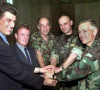
On Thursday, June 25, Holbrooke held a press conference where he talked about the meeting and photographing with KLA members in the village of Junik the previous day. "The village of Junik, where we arrived after several confusions, was guarded by uniformed men and some without uniforms. We engaged in conversation with them because we came to see the facts, not to negotiate. A man who introduced himself as a morale officer gave us his view of the situation. It was a very interesting discussion, and I informed the Secretary of State about it. On the way, we also talked to the Serbs at checkpoints because we wanted to hear as many facts as possible," Holbrooke explained. Holbrooke compared the situation in the western part of Kosovo to the "Wild West", emphasizing that the "lion's share" of responsibility for the escalation lies with "Serbian security forces". Despite this explanation, Belgrade was convinced that by this move, the US was definitively siding with the KLA.
Meanwhile, NATO military planners were considering three options for intervention against Yugoslavia at the time. The first was a blockade of the country with about 23,000 soldiers to prevent the conflict from spilling over into neighboring countries, primarily Macedonia and Albania. The second option was a ground intervention, which would mean an attack on a sovereign country, in addition to being very expensive and militarily risky given the terrain configuration and the available forces of the Yugoslav Army in Kosovo and Metohija. Therefore, at that time, the preference for air strikes prevailed, introducing a no-fly zone or a ban on the action of armored units to be destroyed from the air. The absence of NATO military intervention during the summer of 1998 was interpreted by US sources as the incompatibility of the political goals of the United States and the Kosovo Liberation Army.
In the meantime, the KLA, in an attempt to seize the first major town in Kosovo and Metohija, the city of Orahovac, suffered a heavy defeat in a frontal clash with Serbian Police forces, which continued their offensive until mid-September when they surrounded the remnants of the KLA on Mount Cicavica. The defeats of the KLA during the summer of 1998 caused significant political turmoil in Albania, where Sali Berisha's Democratic Party unsuccessfully attempted to seize power, further worsening the KLA's position. Reflecting on the developments in Kosovo and Metohija, "The Washington Post" wrote in August that the conflicts between Serbian police and the KLA "demonstrated Serbia's military strength", giving it a strategic and psychological advantage and defeating those Albanians who aspire to Kosovo and Metohija's independence. Asked why Kosovo and Metohija's independence was not acceptable to the United States, this editorial responded that it would mean the collapse of the Dayton Agreement and the return of war to Bosnia and Herzegovina because the Albanians, with their demands, would ignite an intolerable war fire in the southern Balkans and because it would prompt other Balkan and European countries to align with their former clients and provoke chaos in the region. "There is logic in not wanting to assist a group whose values and goals we do not support," one US official concluded, according to this newspaper.
In early October, Richard Holbrooke and General Wesley Clark found themselves back in Belgrade on a mission to force the Yugoslav President to accept an international presence in Kosovo and Metohija. Holbrooke came to Belgrade to internationalize the Kosovo crisis by introducing OSCE and NATO missions, which faced strong resistance from the Yugoslav side, which still insisted that the events in Kosovo and Metohija were internal matters of Serbia and Yugoslavia. Holbrooke and Clark arrived with the threat that General Clark would be given "execution orders" to bomb Serbia, although it was unclear to anyone what the basis for such action would be and why Serbia should be bombed because the KLA was fighting against Serbian Police and the Albanians?
The talks were concluded several days later with an agreement to send 2,000 OSCE observers to Kosovo and Metohija under the unusual name "verifiers", while NATO was authorized to monitor military activities in Kosovo and Metohija from the air. Heading this mission was the US Ambassador William Walker, whose appointment from the very beginning raised suspicion from the authorities in Belgrade due to his previous activities in Latin America. Milosevic and Holbrooke agreed on 11 political principles for resolving the conflict and the OSCE mission in Kosovo and Metohija, while generals Wesley Clark, on behalf of NATO, and Momcilo Perisic, on behalf of the FR Yugoslavia, signed an agreement on the NATO Verification Mission.
The eleven principles entailed: 1) a peaceful and political solution for Kosovo and Metohija to be achieved through dialogue; 2) cessation of violence and terrorism; 3) respect for the sovereignty, territorial integrity, and internationally recognized borders of the FR Yugoslavia; 4) full respect for the equality of all national communities; 5) the future of Kosovo and Metohija lies in peace, equality, and integration towards economic progress; 6) the solution for Kosovo and Metohija must be in accordance with the legal frameworks of Serbia and the FR Yugoslavia, international standards, and the Helsinki Final Act; 7) the right to self-government for the citizens of Kosovo and Metohija, while elections would be held in the province nine months later under the supervision of the OSCE; 8) additional human, political, cultural, and other rights for members of national communities; 9) the formation of a municipal police force; 10) amnesty for all individuals involved in conflicts except in cases of crimes against humanity and international law; and, 11) a review of previously issued judgments against members of national communities.
The NATO mission agreement stipulated that NATO reconnaissance aircraft would be granted the right to fly over the territory of Kosovo and Metohija, and for this purpose: 1) A security zone would be established along the borders of Kosovo and Metohija to a depth of 25 kilometers where the Yugoslav Air Force and Air Defense would not conduct activities during NATO reconnaissance flights; 2) Missions over Kosovo and Metohija would be carried out by both piloted and unpiloted aircraft, with a safety margin of 30 minutes before and after low-flying aircraft piloted missions during which there would be no Yugoslav Air Force and Air Defense activities; 3) NATO would provide weekly flight plans over Kosovo and Metohija to Yugoslav air traffic control; 4) Civil aircraft flights would be allowed without any restrictions during NATO missions in the entire airspace of the FR Yugoslavia; 4) Yugoslav military aircraft could fly over Kosovo and Metohija and the security zone except during NATO reconnaissance missions; 5) NATO and Yugoslav Air Force aircraft would not interfere with each other during their missions; 6) Unless otherwise determined, NATO aircraft would enter and exit Kosovo and Metohija through the airspace of Albania and the Republic of North Macedonia. The agreement reached between Milosevic and Holbrooke in Belgrade was also confirmed by the United Nations Security Council in its resolution number 1203 of October 24, 1998.
In the vacuum created by the partial withdrawal of Yugoslav forces from Kosovo and Metohija, the KLA immediately entered, taking control of most of the province's territory except for major cities and main roads. This led to a renewal of hostilities and heavy fighting that took place in late 1998 and early 1999.
To be continued tomorrow: Introduction to today's collapse of the international system
comments